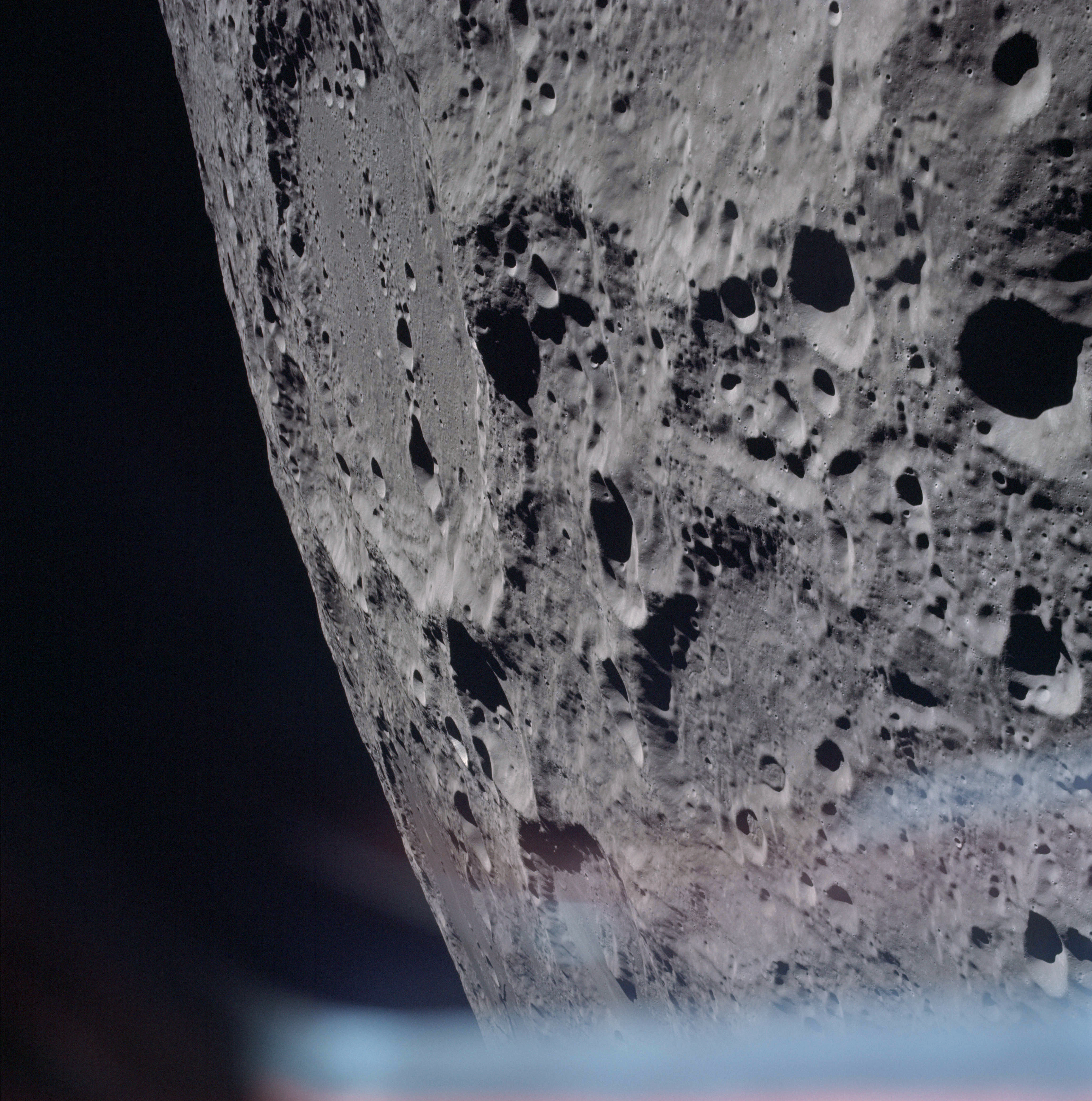
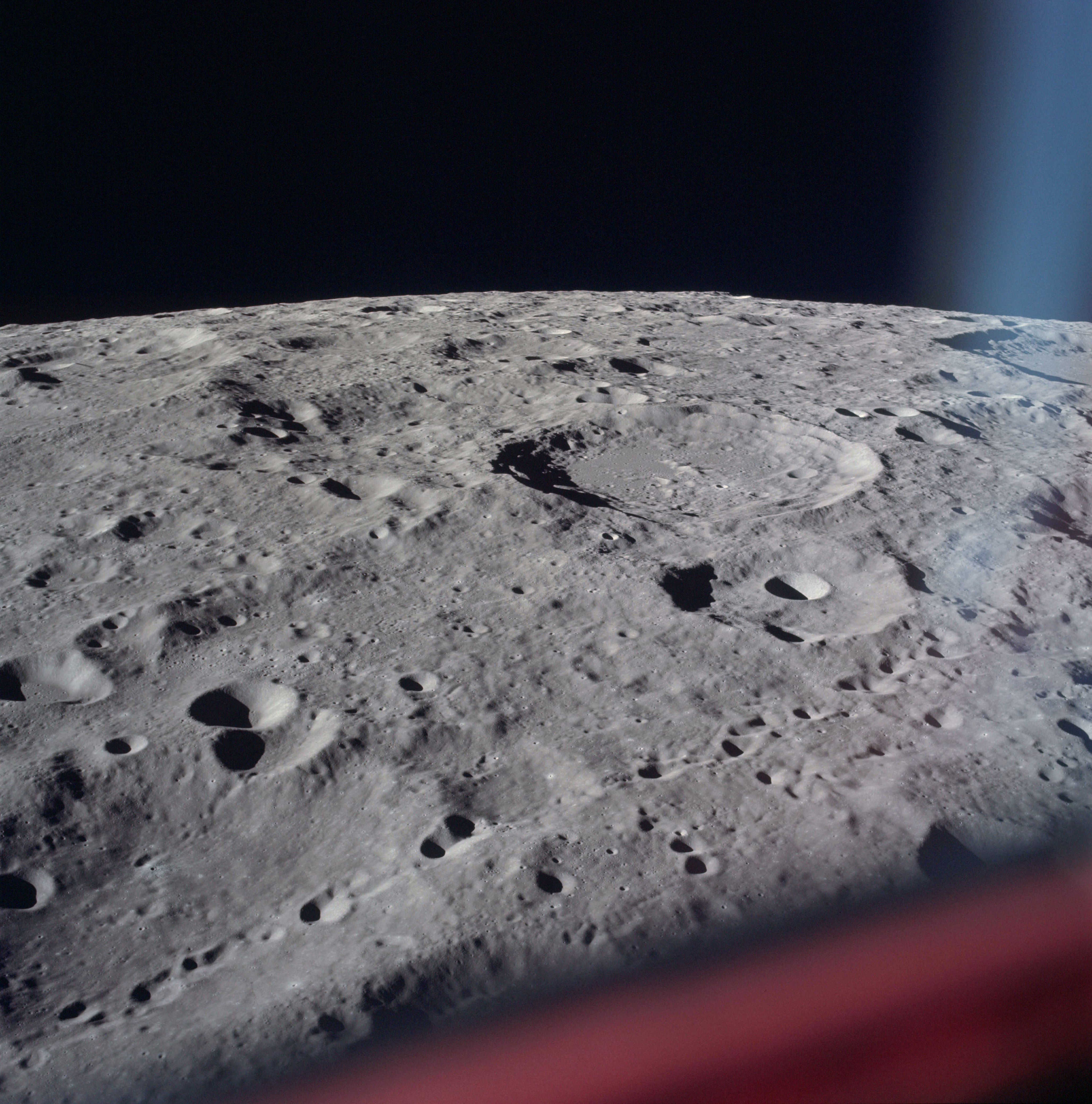
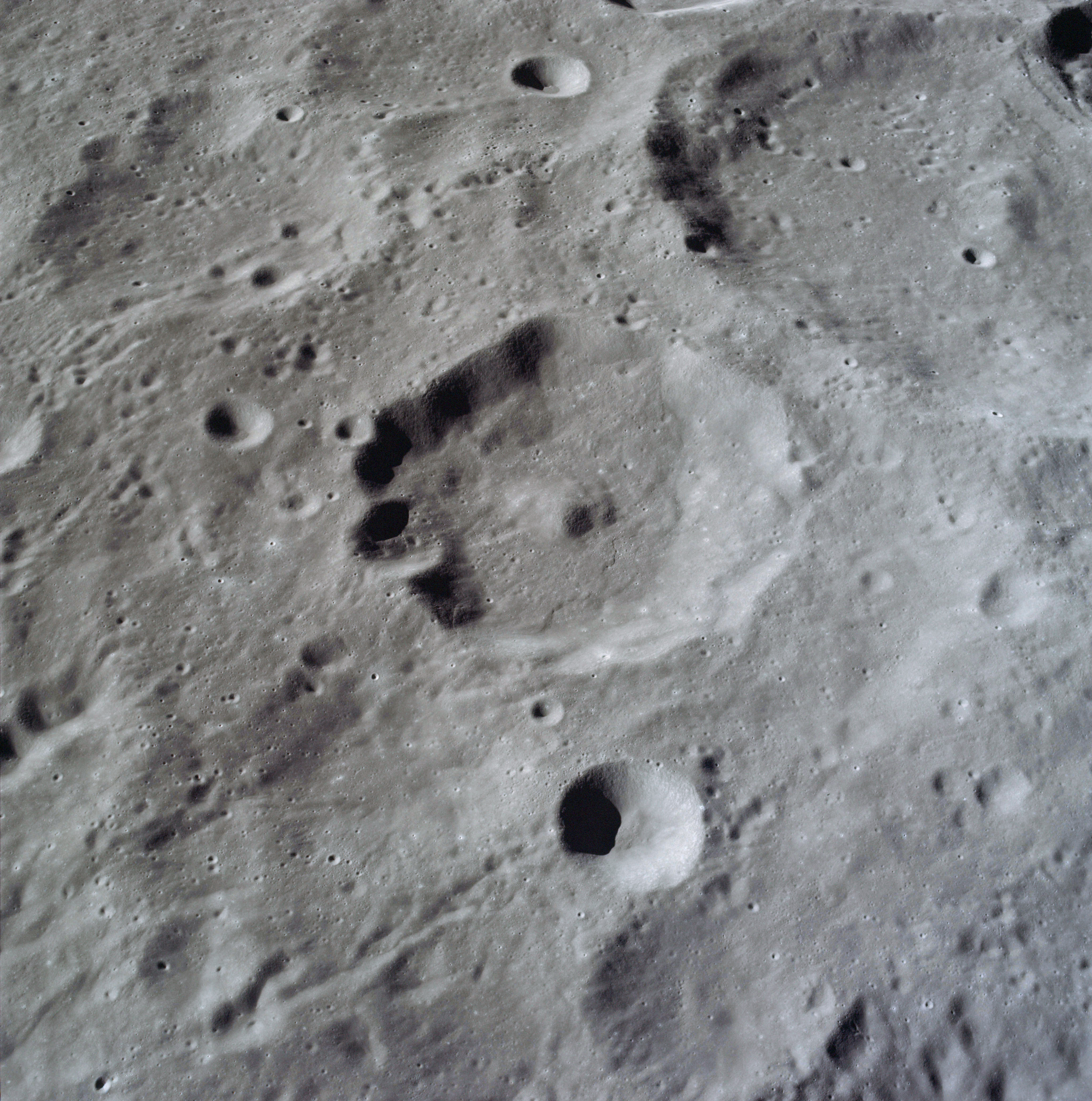
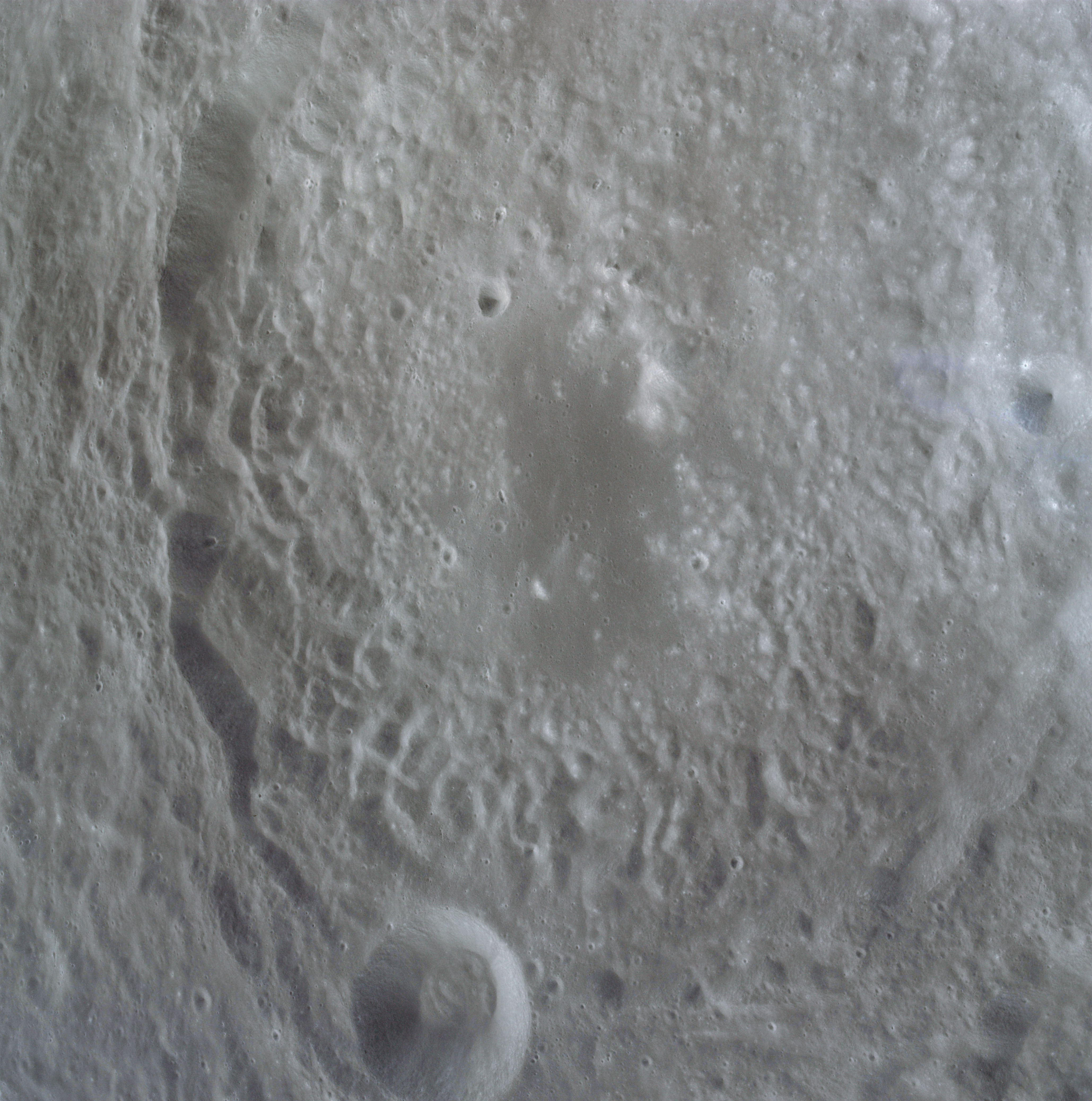
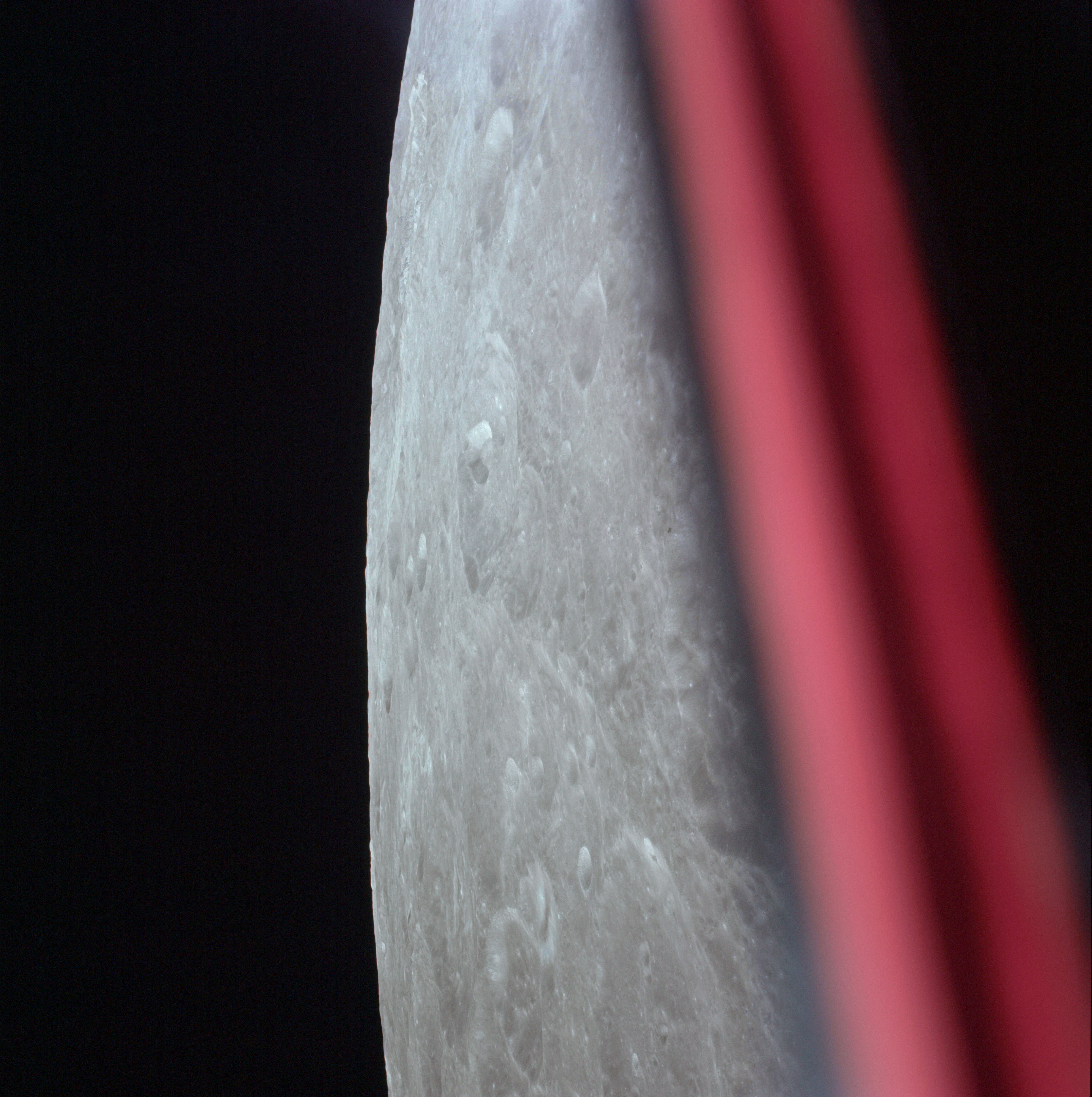
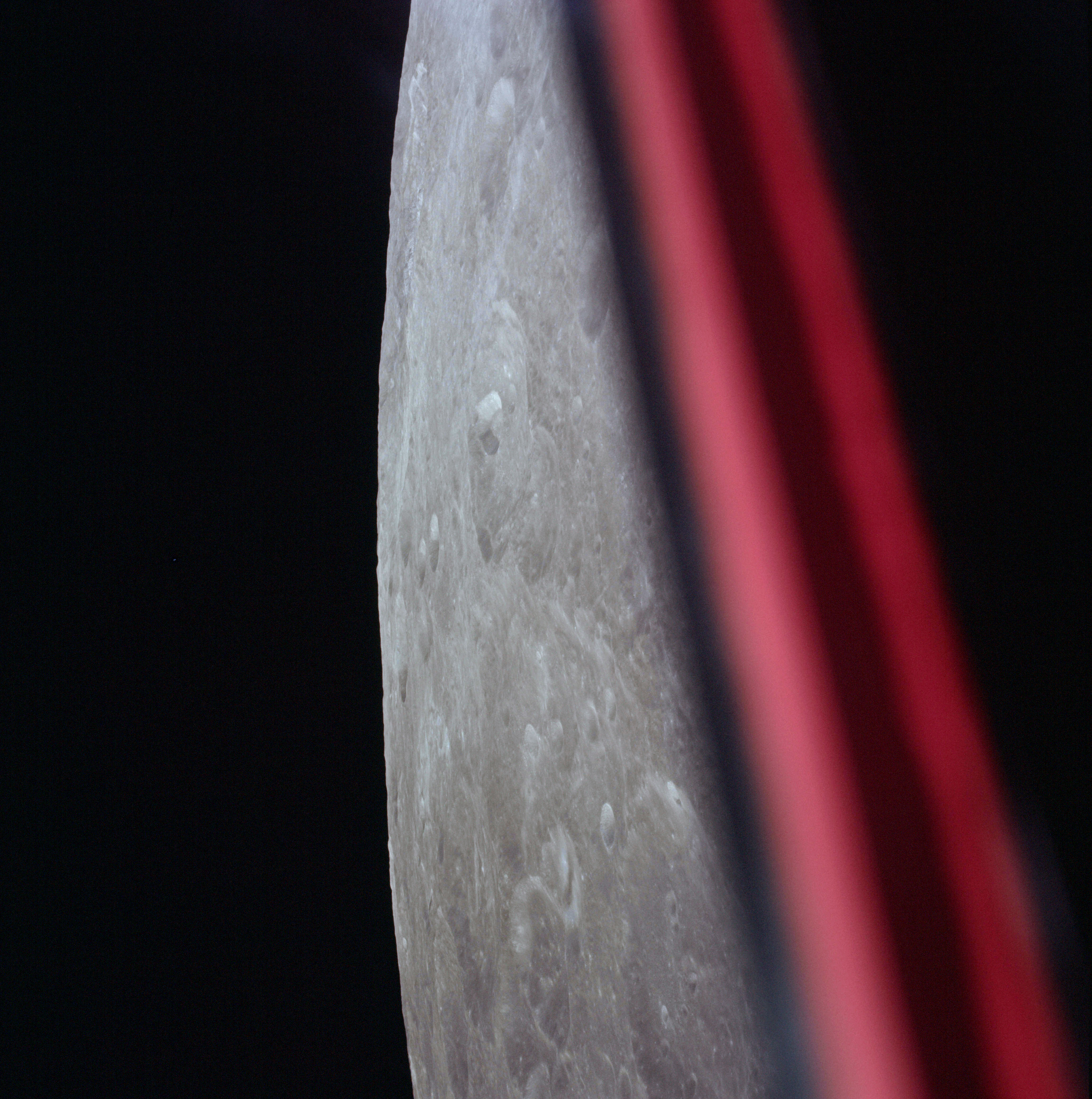
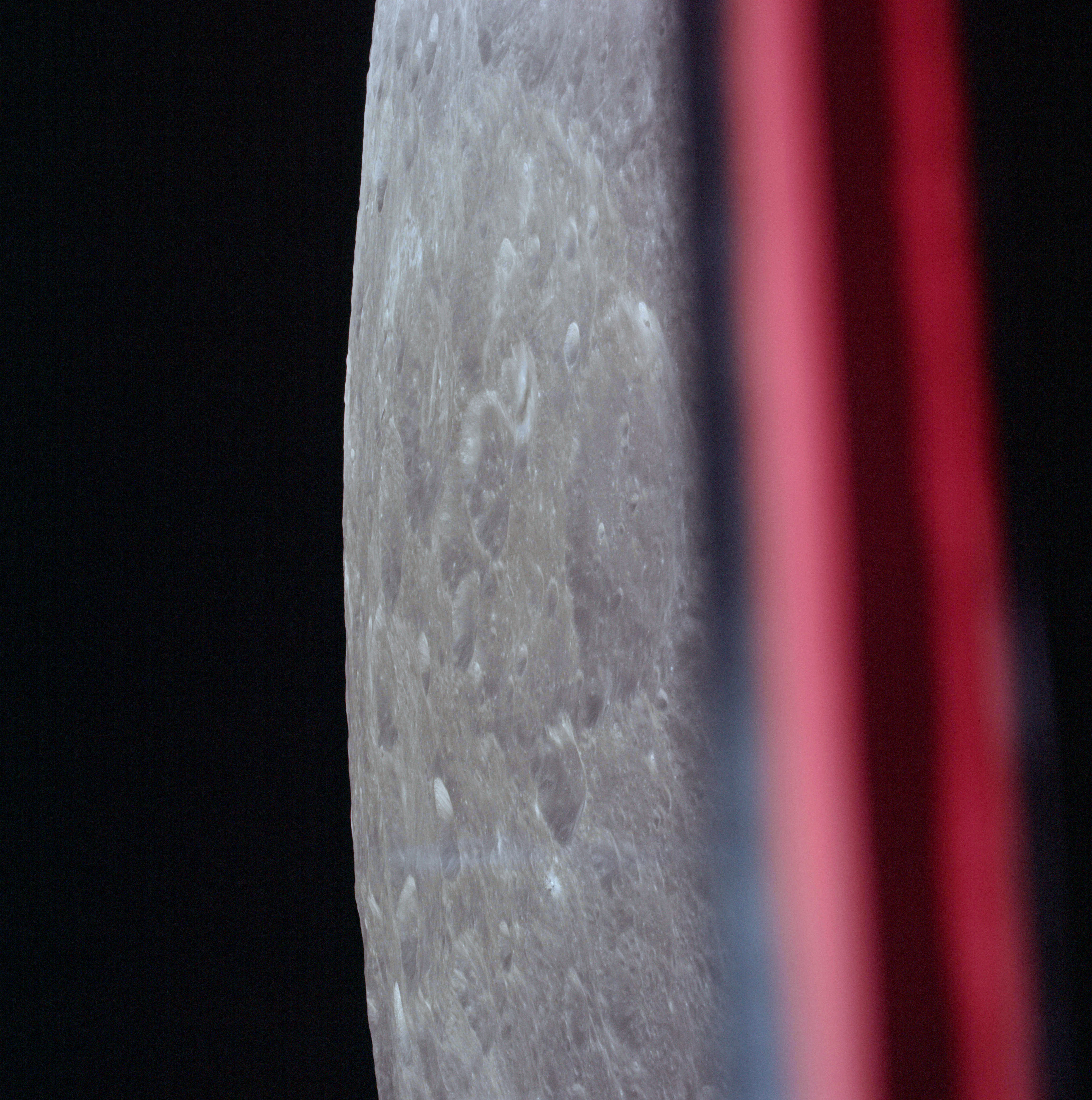
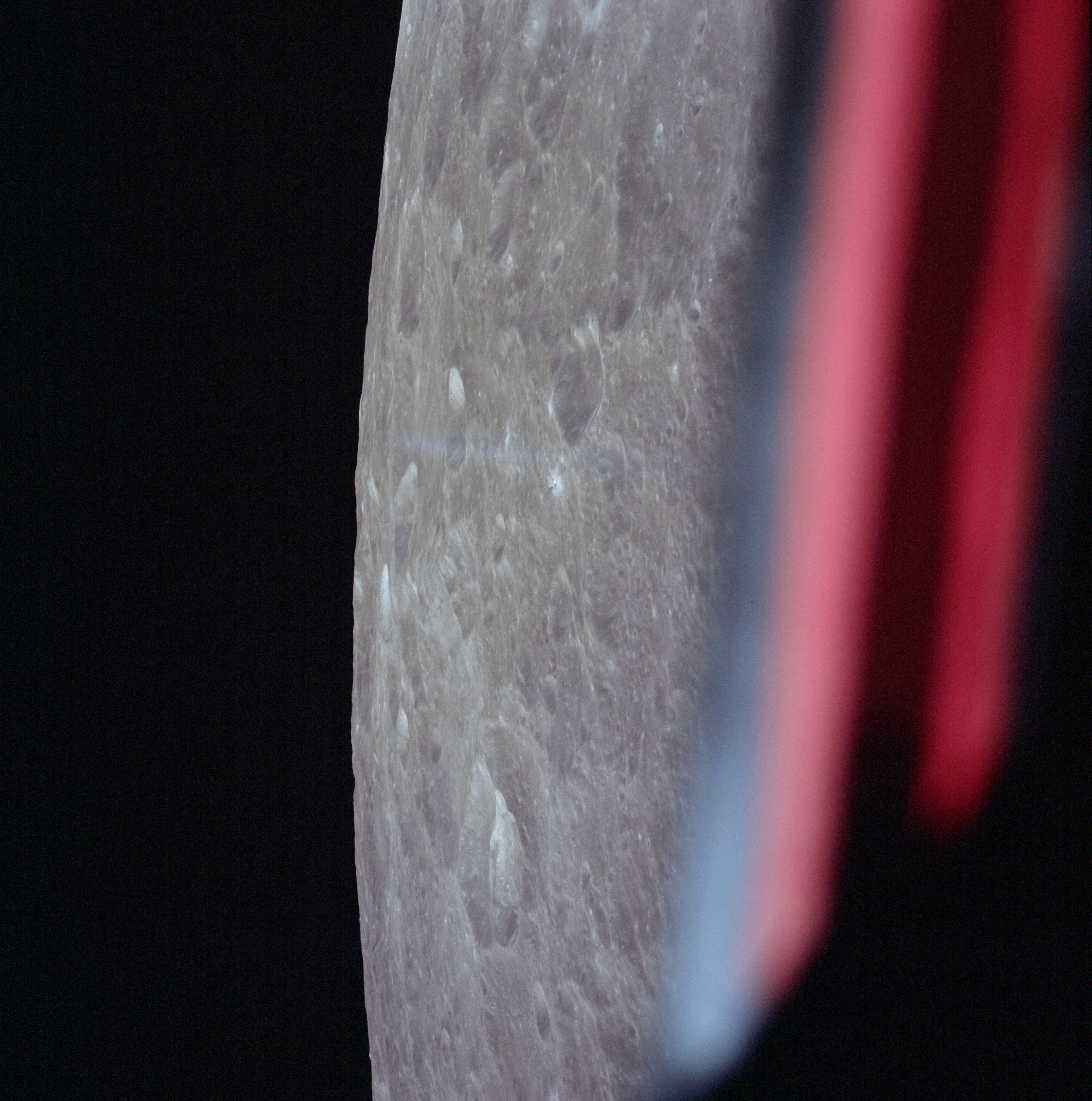
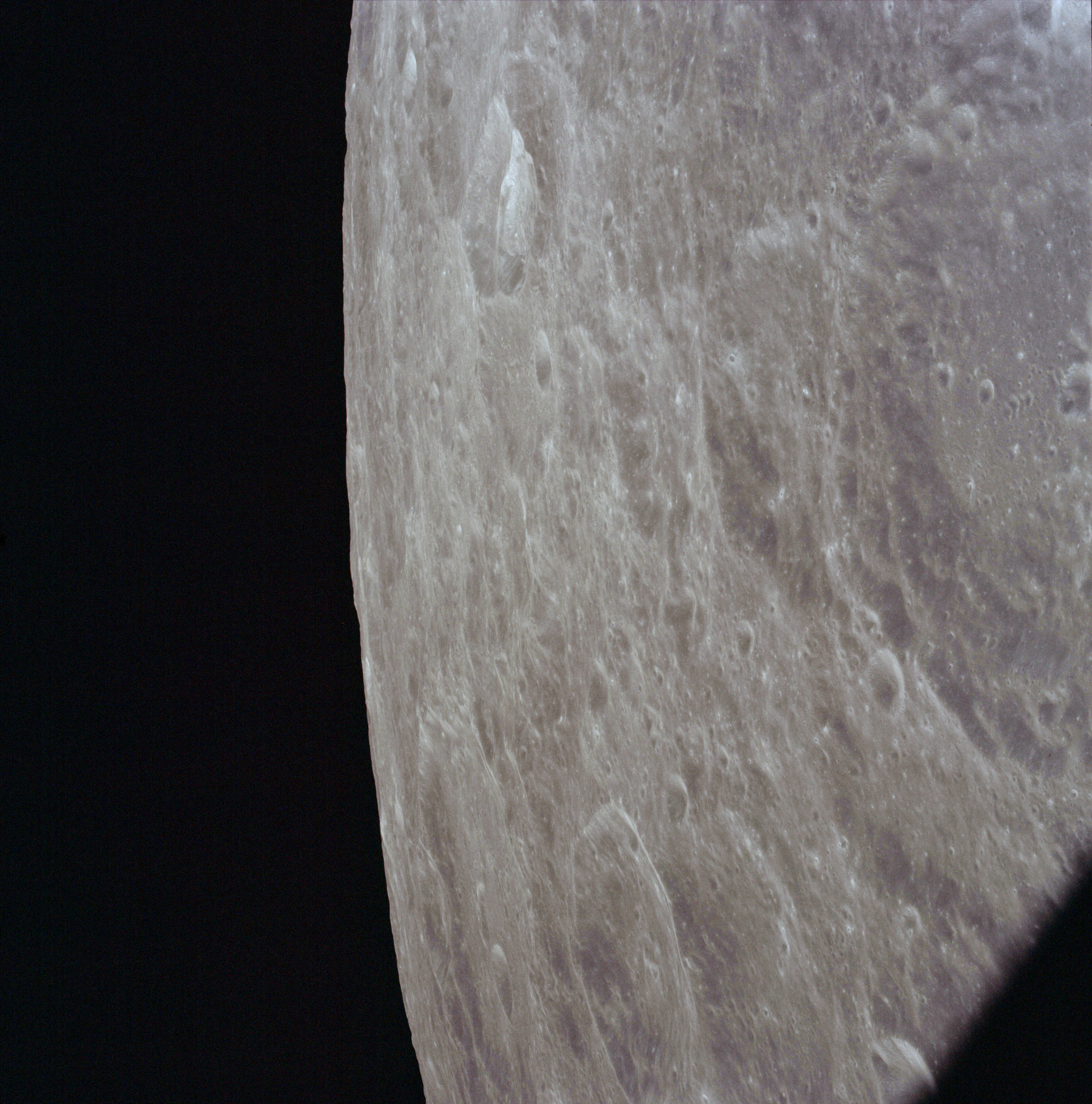
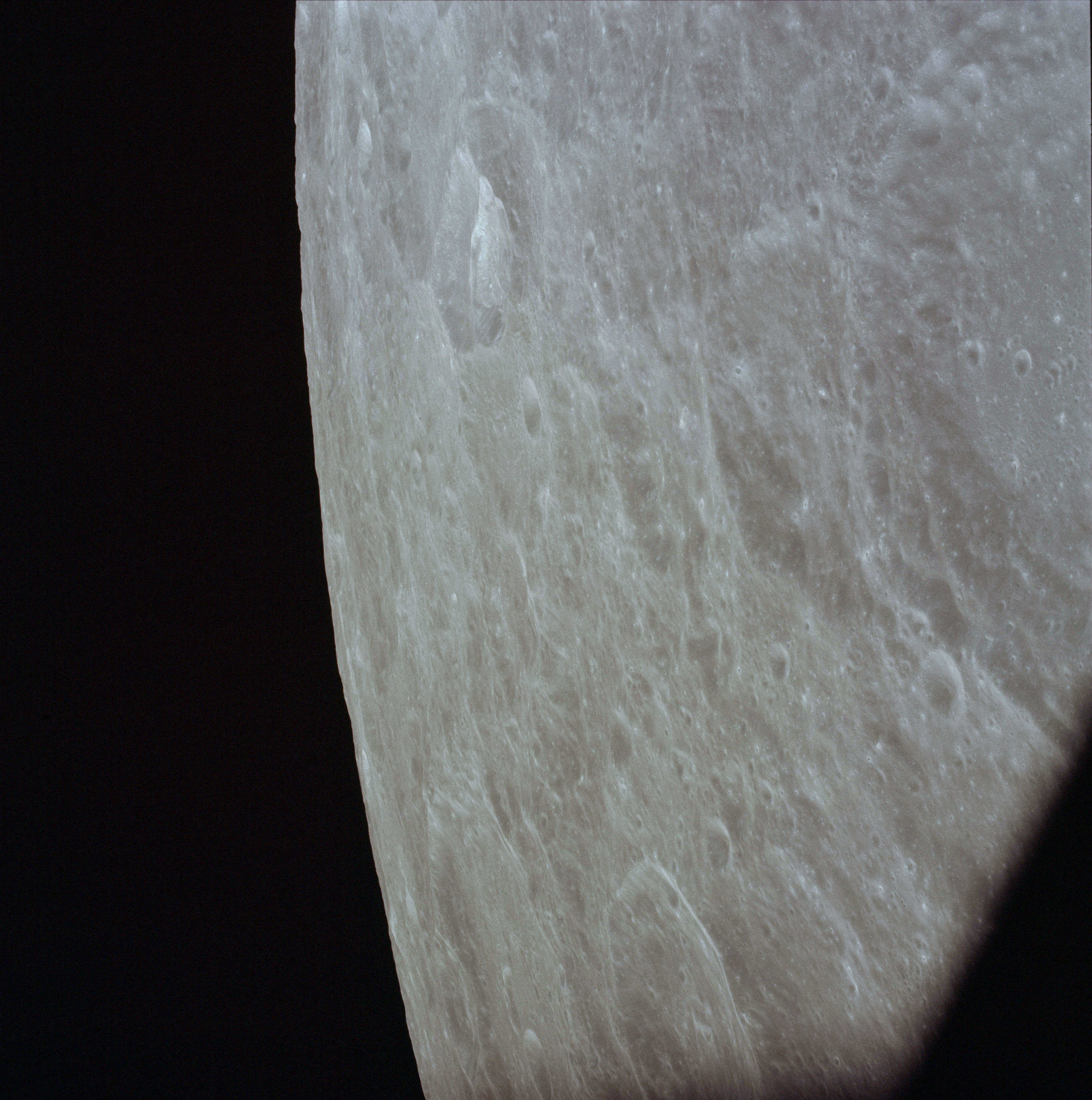
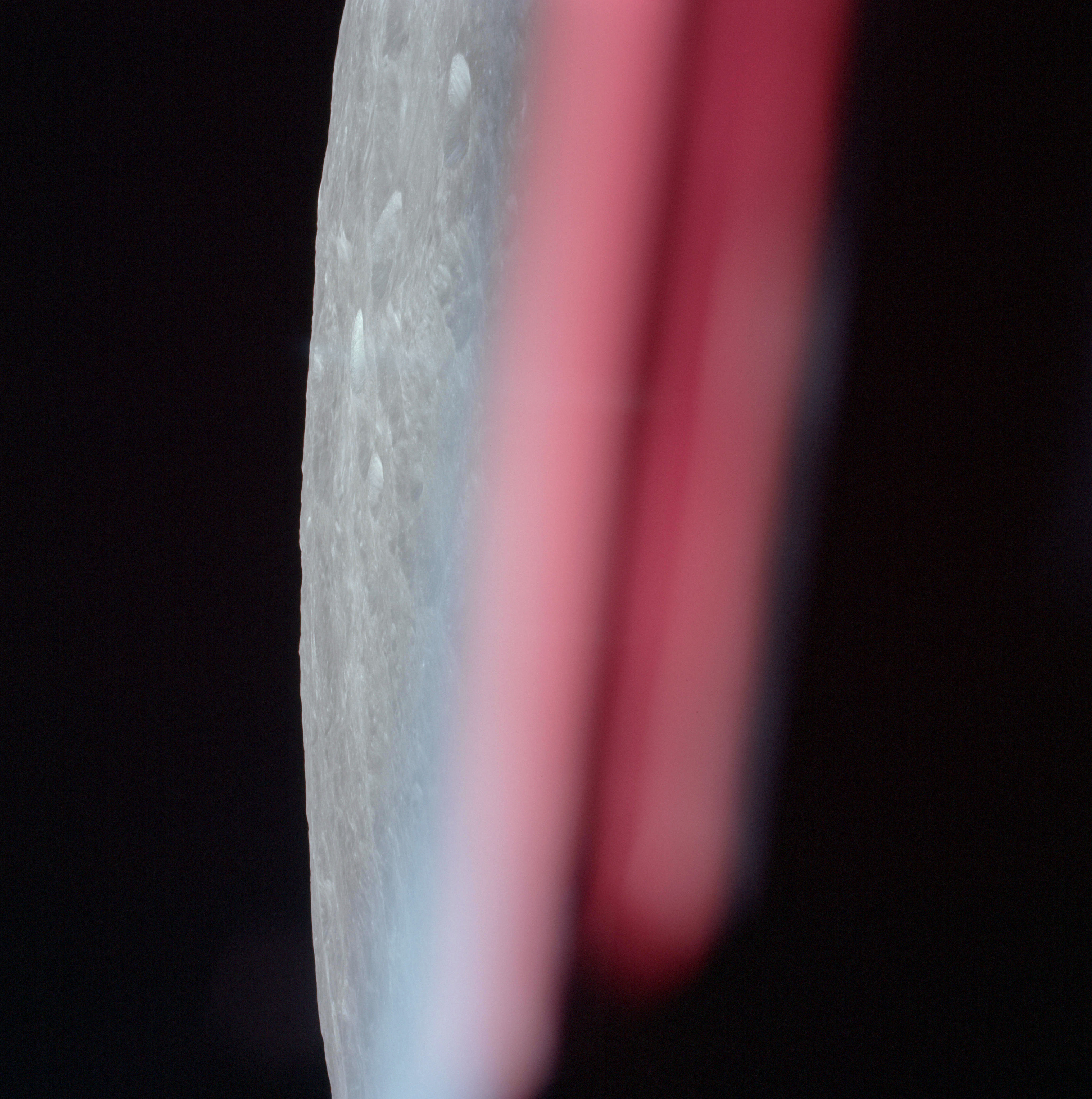
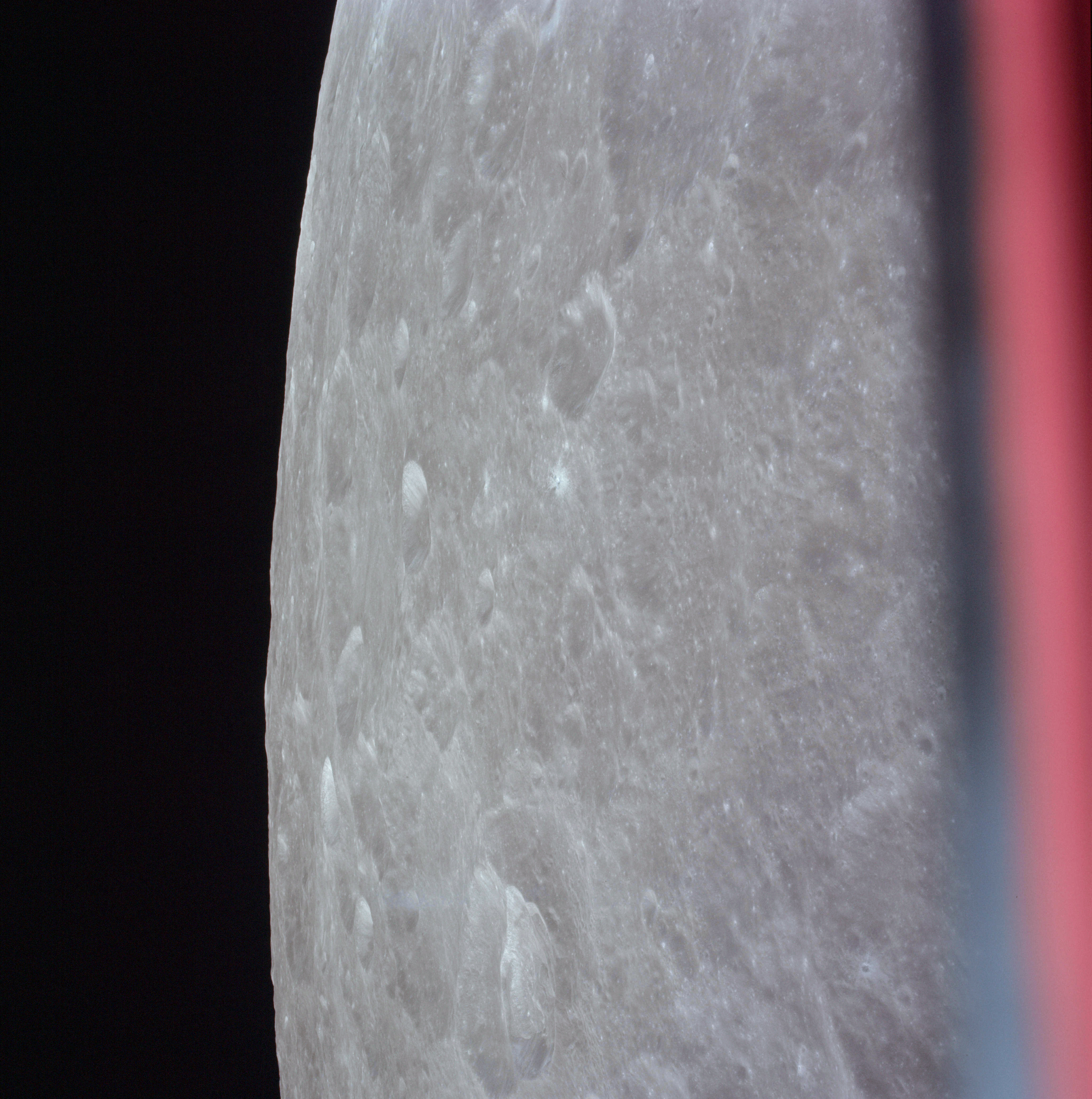
This is Apollo Control at 175 hours, 21 minutes Ground Elapsed Time. The crew of Challenger has signed off for the night, climbing into their hammocks. The Commander Gene Cernan in the upper berth, Lunar Module Pilot Jack Schmitt in the lower hammock. Scheduled 8 hours sleep period, wakening shortly after noon, today. Command Module America currently in a 67.8- by 54.9-nautical-mile [125.6 by 101.7 km] orbit. Command Module Pilot Evans has 4 hours and 22 minutes remaining of his sleep period before being awakened for a plane-change maneuver and a trim maneuver to get in the proper orbital plane for a rendezvous. And at 175:22, taking down the air/ground 1 line, until somebody wakes up, this is Apollo Control.
This is Apollo Control at 176 hours, 7 minutes Ground Elapsed Time in the mission of Apollo 17. Command Module America about one third of the way through a frontside pass on revolution 45. Fifty-two minutes remaining until America coasts behind the Moon. The crew aboard Challenger meanwhile is settling in for 8 hours scheduled sleep period which will end shortly after noon today, Central Time. 3 hours, 37 minutes remain of the Command Module Pilot's sleep period. Command Module America presently in a lunar orbit measuring 55.1 nautical miles [102.0 km] at pericynthion by 67.7 nautical miles [125.4 km] apocynthion. The Gold team of flight controllers settled in for about a 12-hour shift today on a quick turn around. And at 176:08 Ground Elapsed Time, this is Apollo Control.
This is Apollo Control at 178 hours, 7 minutes Ground Elapsed Time. Command Module America at the present time on the 46th lunar orbit immediately over the Taurus-Littrow landing site where the crew of Challenger has approximately 5½ hours remaining in their sleep period. Evans, meanwhile, has some hour and 37 minutes remaining in his scheduled sleep period before a wakeup call is made for the coming day's activity, including a trim maneuver to tune up the Command Module's orbit and a plane change maneuver to place the Command Module in the proper orbital plane for the rendezvous which will take place after the Lunar Module has lifted off the lunar surface and is placed back into orbit around the Moon. The Command Module spacecraft systems are all functional - functioning normally at this time according to the the flight controllers here in the Control Center. Some 49 minutes remaining until America goes behind the Moon. At 178:08 Ground Elapsed Time, this is Apollo Control.
179:41:12 - This is Apollo Control; 179 hours, 41 minutes Ground Elapsed Time. About a minute until we have lock-on with the Command Module America on 47th revolution around the Moon. Shortly after we have good solid lockup, the Spacecraft Communicator Ken Mattingly will call Ron Evans on air/ground 2 circuit for a wakeup. We'll bring that up at that time. Meanwhile the crew in the Lunar Module Challenger is still asleep at this time, with some 3 hours remaining until they're awakened. Standing by for word that we've locked onto the Command Module downlink. We've had acquisition. We'll bring up air/ground 2 and stand by for the wakeup call to Command Module America.
179:45:02 Mattingly: Good morning, America. Rise and shine.
Comm break.
179:46:13 Mattingly: Hello, America, this is Houston. Over. [Long pause.]
179:46:31 Evans: Hey, Houston, this is the Command Module Pilot on the United States spaceship America. I'll be ready to go to work as soon as I can get untangled.
179:46:41 Mattingly: Okay. We got plenty of that for you.
179:46:46 Evans: [Laughter.] Okay. I think I woke up just about the time - just before you called, for some reason.
179:50:59 Evans: Well, Houston, at least it's daylight today. Yesterday you got me up in the middle of the night.
179:51:06 Mattingly: Oh, this is a gentleman's day.
179:51:10 Evans: [Chuckle.] Right. [Long pause.]
179:51:38 Evans: Of course, I guess it's really a 2-hour day when you go around the Moon, isn't it?
179:51:45 Mattingly: You don't get so tired that way.
179:51:50 Evans: [Laughter.] Right. [Long pause.]
179:52:36 Evans: Okay. S-Band Mode is to Voice, Squelch is - says "Off"; I'm want to leave it Enabled. Crew report, I'll get in a minute and wind your watch.
179:55:02 Evans: Houston, America. If you happen to have a summary report of EVA-3, I'd sure like to hear it.
179:55:12 Mattingly: Okay. We'll do that. Let me give you a - a quick rundown on review of what we're going to do this morning. We've got the extra RCS trim burn that's going to be coming in, and I've got a PAD for that guy. And I have about 1, 2, 3, 4, 5, 6, 7, 8, 9 one-liners to go into your Flight Plan to - to bring it up to date. The general plan is to do a minus-X RCS on the trim maneuver, in order to avoid impinging on the SIM bay. That burn will be about 30 seconds worth. And that's going to give you about 9 foot per second Delta-V. The maneuvers have all been checked out, and it's a reasonable time line. And so, I have both the plane change and the trim PADs for you. And that may cut into your eat period just a little bit. So you might keep that in mind, that when you get a chance to nibble; that's probably a good - good thing to be doing. And then once we finish the plane change, we - we're going to be back on the nominal Flight Plan, and pressing on in a - just like we have been. We'll be leaving the Mapping Camera in and taking pictures with it still retracted, in a attempt to avoid increasing the number of cycles on the camera. And we'll be running the SPS PU valve in the Decrease position, in order to optimize our propellant loadings. [Pause.]
179:56:44 Evans: Ah ha! Okay. That sounds like good.
179:56:51 Mattingly: So, when you're ready to copy some of those things, that's - Might be a good thing to get started on. Go ahead and finish squaring away your cockpit. And, while they're putting together an official summary, I can tell you my unofficial summary of EVA-3 is that that sure is super. You've got to watch those tapes when you get down. That's really a - that's really a spectacular place, as you can probably see. And they found a lot of mighty...
179:57:17 Evans: Oh, that's really [garble].
Mattingly: ...interesting rocks there. [Long pause.] Jack, being a true geologist, is making up new geological terms as he goes along.
179:57:37 Evans: [Laughter.] I can - yep, I'll bet. [Pause.]
179:57:48 Mattingly: What you ought to do is, when he gets aboard, you ought to tell him that you saw a bunch of vertical dikelets over on the north side of the massif. Tell him they were very dark, very small.
179:58:01 Evans: Vertical dikelets?
179:58:03 Mattingly: Yeah, I think that's a word he coined on the way down there.
179:58:06 Evans: Dikelets? Oh, okay [laughter].
179:58:13 Evans: Hey, I got a Update Book here. I guess it'll be good for a trim burn - trim [garble].
179:58:22 Mattingly: Okay. In general, let me tell you also that your RCS is 4.7 above the Flight Plan. And, just as a summary, unless you want to plot them, I'ii just tell you that the oxygen and the hydrogen are doing good things. And you've got plenty of it. And I'm ready to give you a - The first PAD will be a trim RCS burn and the second one will be the plane change burn. [Pause.]
179:58:56 Evans: Okay. No, that's good on the hydrogen and oxygen. And, I'm ready to copy the trim P30 PAD.
179:59:05 Mattingly: Okay. I'll give you the trim. RCS/G&N; 37416; GET 181:34:01.22; plus 0009.2, all zips, and all zips; roll 180, 179, 316; 0067.3, plus 0062.4; 0009.2, 0:30, 0009.2; 13, 292.3, 29.9. And at Sirius and Rigel, 118, 159, 349. This will be four jets, minus-X on the RCS. And, I'd like to just add a comment here about the attitude. This attitude is one that's computed after you've gone to the plane-change REFSMMAT. And when you call P41, you'll be getting a different set of attitudes computed out of it because of the P41 computing a plus-X burn. But, when you're in attitude and P41's called, and you get to the Delta-V register, you should be able to put all of the Delta-V in one axis. [Long pause.]
180:00:48 Evans: Oh, okay. This really is a posigrade burn is what you're saying. And I really won't be able to trim it?
180:00:59 Mattingly: I'm not sure I understood your comment there.
180:01:04 Evans: Well, in other words, we're not - we're not changing Noun 81. You know, like we do on the - the Sep maneuver.
180:01:14 Mattingly: Oh. That's - that's correct. You're - you're gonna - you're gonna see the numbers go to zero during the burn.
180:01:23 Evans: Okay. Real good. We just won't - [Verb] 50 [Noun] 18 won't be the right attitude. We'll use the Verb 29 maneuver and use that attitude.
180:01:32 Mattingly: That's correct. And then when you get there, that should put it all in - in the X-axis.
180:01:39 Evans: Okay. Mighty fine.
180:01:42 Mattingly: Now I'm ready for the readback.
180:01:44 Evans: Ah, let me read it back. Okay, it'll be G&N/RCS for the Trim burn. Weight is 37416; TIG is 181:34:01.22. I'm not sure on the seconds, is that correct.
180:02:01 Mattingly: That's correct.
180:02:05 Evans: Okay. Noun 81 plus 9.2 in X, 0, 0, roll, 180; pitch, 179, yaw, 316; HA will be 67.3; Perigee, 62.4; Delta-V total is - be 9.2; burn time is 30 seconds; Delta-VC is 9.2. Sextant star is 13, shaft is 292.3, trunnion is 29.9. Sirius and Rigel, 118. Missed the pitch align and the yaw align is 349. It'll be four jets, minus-X, and it'll be at the plane change REFSMMAT.
180:02:48 Mattingly: Okay. And that pitch align is 159. [Pause.]
180:02:56 Evans: Okay. Pitch align, 159.
The PAD is interpreted as follows:
Purpose: This PAD provides the details of a small trim burn to refine the shape of the spacecraft's orbit. When Ron entered his current orbit three days ago, there was an expectation that the Moon's irregular gravity field would circularise it in the intervening time. However, this did not occur as predicted so this manoeuvre is to carry out what gravity failed to do.
Systems: The burn would be made using the four RCS thruster quads around the Service Module, under the control of the Guidance and Navigation system.
CSM mass (Noun 47): 37,416 pounds (16,972 kg).
Pitch and yaw trim (Noun 48): Not applicable. These trim angles are only relevant to the SPS engine.
Time of ignition (Noun 33): 181 hours, 34 minutes, 1.22 seconds.
Change in velocity (Noun 81), fps (m/s): X, +9.2 (+2.8); Y, 0 (0); Z, 0 (0). The change in velocity is resolved into three components which are quoted relative to the local vertical frame of reference. The positive component in X indicates a prograde burn.
Spacecraft attitude: Roll, 180°; Pitch, 179°; Yaw, 316°. The desired spacecraft attitude is quoted relative to the alignment of the guidance platform which itself will be aligned per the plane change REFSMMAT.
HA, expected apolune of resulting orbit (Noun 44): 67.3 nautical miles (124.6 km).
HP, expected perilune of resulting orbit (Noun 44): +62.4 nautical miles (115.6 km). The burn's main effect will be to raise this perilune from its current height of 55nm (102 km), making the orbit more circular. Note the emphatic plus sign on this figure. This indicates that the altitude is a positive value; i.e. above the surface and not below it!
Delta-VT: 9.2 fps (2.8 m/s). This is the total change in velocity the spacecraft would experience and is a vector sum of the three components given above. Given the simplicity of the burn, this is the same as the X component.
Burn duration or burn time: 30 seconds.
Delta-VC: 9.2 fps. This figure is entered into the EMS Delta-V counter. Soon Mattingly will point out that giving this figure is a bit useless.
Sextant star: Star 13 (Capella, Alpha Aurigae) visible in sextant when shaft and trunnion angles are 292.3° and 29.9° respectively. This is an attitude check.
GDC Align or Set stars: Should the IMU fail to provide a trustworthy attitude reference, Ron can use the spacecraft's other gyros (the BMAGs) and their associated Gyro Display Couplers as a reference. To align these, the spacecraft is rotated so as to place Sirius and Rigel against the telescope's graticule (or reticle) in a predetermined fashion. Were he to do this, the spacecraft's attitude with respect to the desired REFSMMAT would be given by the GDC Align angles.
GDC Align angles: 118°, 159°, and 349° in roll, pitch and yaw respectively.
Additional notes are twofold. The first is that the burn uses the four forward-facing RCS thrusters around the Service Module. If the spacecraft was facing forward in its orbit, i.e. sharp-end-forward , then using these jets would result in a retrograde burn, against the orbital motion. However, the required pitch angle is 179° which means it is flying blunt-end-forward. The second note is that the assumed REFSMMAT is that required for the subsequent plane change manoeuvre.
180:03:00 Mattingly: Okay. The next one will be the plane change, and I'll have that ready in just a second. [Pause.]
180:03:14 Evans: Okay. I'm in the Flight Plan with that one.
180:03:16 Mattingly: Okay. Stand by just a second. [Long pause.]
180:03:53 Mattingly: Okay. LOPC SPS/G&N; [pause] 37416; plus 0.38, plus 0.92; 182:33:53.00; minus 0017.9, minus 0365.5, minus 0006.9; roll, 0; pitch, 0; yaw, 315; 0062.7, plus 0062.6; 0366.0, 0:20, 0353.8; 22, 148.9, 19.5; Sirius and Rigel and the roll, pitch, and yaw aligns are the same: 118, 159, 349. This will be four jets and 12 seconds. [Pause.]
180:05:30 Evans: Okay. LOPC, SPS/G&N, 37416; plus 0.38, plus 0.92; TIG 182:33:53.00; Noun 81 is minus 17.9, a minus 365.5, and a minus 6.9; roll, 0; pitch, 0; yaw, 315; HA, 62.7, perigee, 62.6 - That's pretty circular - Delta-V total is 366.0, burn time is 20 seconds, Delta-VC, 353.8; sextant star 22, shaft 148.9 and 19.5; Sirius and Rigel, 118, 159, 349; four jets, 12 seconds.
The PAD is interpreted as follows:
Purpose: This PAD is for a burn that will change the plane of the CSM's orbit.
Systems: The burn would be made using the large SPS engine at the rear of the Service Module, under the control of the Guidance and Navigation system.
CSM mass (Noun 47): 37,416 pounds (16,972 kg).
Pitch and yaw trim (Noun 48): +0.38° and +0.92°. These angles represent an initial direction for the gimbal-mounted engine to aim the thrust through the stack's centre of mass. As the burn progresses, slow shifts in the stack's centre of mass will be compensated for by the nozzle's aim being altered by the TVC (Thrust Vector Control) system.
Time of ignition (Noun 33): 182 hours, 33 minutes, 53.00 seconds.
Change in velocity (Noun 81), fps (m/s): X, -17.9 (-); Y, -365.5 (-); Z, -6.9 (-). The change in velocity is resolved into three components which are quoted relative to the local vertical frame of reference. The large negative Y component shows that this burn is perpendicular to the spacecraft's orbital motion. The main effect of it, rather than being prograde or retrograde, will be to rotate the plane of the orbit rather than alter its linear velocity. Having said that, the small negative X value shown that the spacecraft will be slowed slightly which, as Ron notes, will make the orbit very nearly circular by dropping the apolune height.
Spacecraft attitude: Roll, 0°; Pitch, 0°; Yaw, 315°. The desired spacecraft attitude is measured relative to the alignment of the guidance platform which itself will be aligned per the plane change REFSMMAT.
HA, expected apolune of resulting orbit (Noun 44): 62.7 nautical miles (116.1 km).
HP, expected per of resulting orbit (Noun 44): +62.6 nautical miles (115.9 km). As well as having the CSM's orbit pass over the landing site, the burn shapes it in preparation for the Lunar Module's upcoming rendezvous.
Delta-VT: 366.0 fps (111.6 m/s). This is the total change in velocity the spacecraft would experience and is a vector sum of the three components given above.
Burn duration or burn time: 20 seconds.
Delta-VC: 353.8 fps. This figure is entered into the EMS Delta-V counter. The EMS's independent accelerometer will shut the engine down in case the G&N system fails to do so. This figure, Delta-VC, is slightly lower than Delta-VT because the EMS does not take account of the engine's tail-off thrust. Instead, the engineers have factored it into the number that will be entered into the counter.
Sextant star: Star 22 (Regulus, Alpha Leonis) visible in sextant when shaft and trunnion angles are 148.9° and 19.5° respectively. This is part of an attitude check.
GDC Align or Set stars: Should the IMU fail to provide a trustworthy attitude reference, the crew can use the spacecraft's other gyros (the BMAGs) and their associated Gyro Display Couplers as a reference. To align these, the spacecraft is rotated so as to place Sirius and Rigel against the telescope's graticule (or reticle) in a predetermined fashion. If they were to do so, the spacecraft's attitude with respect to the desired REFSMMAT would be given by the GDC Align angles.
GDC Align angles: 118°, 159°, and 349° in roll, pitch and yaw respectively.
The only additional note is that an ullage burn of 12 seconds using the four rear-facing RCS thrusters would be required to settle the contents of the propellant tanks to the rear.
180:06:20 Mattingly: Okay. It's a good readback. And I've got a couple of Flight Plan things to give you when you're ready for that. [Pause.]
180:06:34 Evans: Okay. I'm with you.
180:00:00 Mattingly: Okay. The first one is at 180 hours and 20 minutes. [Pause.] And...
180:06:51 Evans: Okay, I've got it.
180:06:52 Mattingly: Okay. We owe you an attitude there and the attitude will be 179, 222, 359. The High Gain: pitch, minus 39; yaw, 145. Why don't you read them back individually as we go along?
180:07:14 Evans: Okay. Roll, 179; pitch, 222; yaw, 359. High Gain will be minus 39 and 145.
180:07:22 Mattingly: Okay. And that's the - that's at 180:20. That's with the Verb 49 there. The next one is at...
180:07:29 Evans: Ah, yes. That's right.
Mattingly: ...181:35, which is on the next page, and that's going to be at Verb 49 maneuver to LOPC. What we're going to do here is two sepaRate maneuvers. We're going to do a - a maneuver which is a roll, so that when you do the next one, you'll avoid the gimbal lock because of the direction that the CMC would normally maneuver you. So, this maneuver is going to be in two parts. The first one we're calling a Verb 49 maneuver to the gimbal lock avoidance attitude at 181:35. That attitude 081, 181, and 317. The High Gain: pitch, minus 19; yaw, 227, and Auto and Narrow for AOS. [Long pause.]
180:08:46 Evans: Okay, at 181:35, we'll have a Verb 49 to gimbal lock avoidance; roll 081, 181, and 317. High Gain will be a pitch of minus 19, and yaw, 227; Auto and Narrow for AOS.
180:09:04 Mattingly: Okay. Now at 181:43, you can just skip that High Gain call out. At 181:45, we want to add a Verb 49 maneuver to the LOPC burn attitude. [Pause.]
180:09:32 Evans: Okay. At 181:45, Verb 49 to LOPC burn attitude.
180:09:39 Mattingly: Okay. Now on the next page, we go over to 182:15. And, I want to add a PU Valve to Decrease. [Pause.]
180:09:55 Evans: 182:15. [Pause.] PU Valve to Decrease.
180:10:06 Mattingly: All right, sir. And I have two more to give you, but before we do that, how about let's terminate the jet monitor by calling P30 - P20, and a Verb 21 Noun 26 to all zips, and then we can uplink while we're finishing. [Long pause.]
180:10:42 Evans: Okay. You have Accept. [Pause.]
180:10:50 Mattingly: Okay. And you got the monitor terminated?
180:11:08 Evans: I guess it went to P30 faster than it showed up down there or went into P30 not through it. [Pause.]
180:11:25 Mattingly: Okay, why don't you put the Pan Camera to Standby and the Power, On, while we're about it and we can let them look at that stuff while we're getting the rest of our Flight Plan updates? [Pause.]
180:11:40 Evans: Pan Camera's Standby, Power is On.
180:11:42 Mattingly: Okay, thank you.
180:11:47 Mattingly: All right. Let's go back to our updates and the next one should come at 182:44. [Long pause.]
180:12:05 Evans: Okay. 182:44.
180:12:10 Mattingly: Okay. At 182:44, I want to delete the "Mapping Camera, Extend." [Pause.]
180:12:24 Evans: Okay. Delete the "Mapping Camera, Extend." Wait a minute. I scratched out the opening the cover. We got to do that.
180:00:00 Mattingly: Yey. You wanna do that because we're going to the pictures anyhow.
180:12:36 Evans: Yeah. Okay.
180:12:40 Mattingly: Okay. Then the next thing we want to do is at 182:48, just a half inch down. I have a new attitude for you. Where it says 097, 068, 019, it's now going to be 096, 097, and 352; and the orb-Rate attitude is still all zeros. [Pause.]
180:13:15 Evans: Okay. The attitude after the P20 option 5 plus-X forward will be 096, 097 and 352 and orb Rate is 0.
180:13:24 Mattingly: Okay, that last angle was 352. I'm not sure we got that right.
180:13:31 Evans: Okay. 352 for Yaw. That's correct.
180:13:34 Mattingly: All right, sir. And while we're about it, why don't you take the Pan Camera Power back Off? [Pause.]
180:13:51 Evans: Okay. Pan cam - pan ca - Pan Camera Power is Off! [Laughter].
180:13:56 Mattingly: Okay, and as long as we're talking about Pan Cameras, let's go to 183:45. [Pause.]
180:14:08 Evans: 183:45. Okay.
180:14:12 Mattingly: Okay, and after the Pan Camera block, want to add "V Over H Override to High Altitude." [Long pause.]
180:14:30 Evans: Okay. After "Pan Camera, Standby, Stereo, and Power," put "V Over H to High Altitude."
180:14:34 Mattingly: That's affirmative. And the last update is on the next page - 184:27. And it says "Mapping Camera, Retract" and since we didn't extend it you don't have to retract it.
180:14:58 Mattingly: All right, sir. And let's see what else we have here - how about running your paw over most of your biomed sensors? It looks like you've got some noise on there. And avoid changing them. Why don't you just kind of rub on each one and see if we can get it to come in a good signal? [Pause.]
180:15:20 Evans: Okay. I'll do that. [Long pause.]
180:15:47 Mattingly: Okay. You're making progress there.
180:16:37 Evans: Hey, there's old Hadley Rille out there. That's a pretty deep little trough. Hey, you really didn't get a perspective of that thing, at least I didn't from some of the pictures. Not until you had a chance to get up here and take a look at some of the other things. [Pause.]
180:16:58 Mattingly: Okay, I'll - I'll tell you when we get through...
180:17:00 Evans: Okay, that's the last of the Flight Plan things, huh?
180:17:03 Mattingly: Yes, sir; that was the last of the Flight Plans, and I still need a morning report from you and things like that; and I'll keep an eye on the clock down here and try to help you stay on the time line. The one thing that I see that may have to change is - I gave you a Delta-VC for the RCS burn that wasn't very useful, and we have to set it up to count in the other direction. There's a couple of things you do - like set it to 100.
180:17:28 Evans: [Laughter.] Yes. Yeah, okay.
180:17:35 Mattingly: It's just a backup monitor anyhow and so it's - setting it to 100 is probably the safest thing to do.
180:17:40 Evans: Yeah, that's right. [Pause.]
180:17:52 Evans: Okay. Let me see if I've got time to put some hot water in my eggs.
180:17:57 Mattingly: Okay. [Long pause.]
180:18:29 Mattingly: Okay, Ron, the computer is yours when - whenever you want to go to Block. [Pause.]
180:18:43 Evans: Sleep last night was probably about 6 hours - kind of intermittent - but it seemed to me like when I was sleeping I was sleeping pretty good. For some reason, I woke up a couple or 3 hours after I went to sleep and I got to sleep about an hour late. Oh, and I was just itching like a son of a gun.
180:19:08 Mattingly: What's that? The sensors?
180:19:09 Evans: The only thing I can think of is that - No, my arms, you know, my forearms.
180:19:16 Mattingly: Oh, I see.
180:19:17 Evans: From the wrist back to the elbow.
180:19:19 Mattingly: Okay.
180:19:21 Evans: The only thing I can think of is maybe the old Beta cloth itch, you know. Then I looked around and there was nothing there. You know, no hives or anything like that. So I got out some of that [garble] cream and put that on and it stopped it. Went back to sleep.
180:19:41 Mattingly: Okay. And it's coming up on time to start our - our first Verb 49 maneuver which can be running and I'll watch the angles while you put a little hot water in your food there if you want to. [Long pause.]
180:20:07 Evans: Okay, we've got to target load, I guess, in desired orientation. [Garble] okay, [garble]. [Pause.] Verb 49 Enter, Verb 25, Plus 179.00 Enter, plus pitch 22 - 222.00 Enter, yaw 359, plus 359.00 Enter. Okay, we're still saying 0.2 of a degree per second; Proceed to [garble] keys - Proceed.
180:20:58 Mattingly: Okay, and the High Gain to Auto, please. [Pause.]
180:21:05 Evans: High Gain's in Auto and we'll set that at minus 39, yaw 145, just in case it breaks lock.
Comm break.
180:22:32 Evans: Hey, Ken, I'm going to be off my headset here while I change back to my comm carrier.
180:27:20 Evans: Okay. We're going Att 1/Rate 2. Yes. [Pause.] Oh. Star number 11 - Aldebaran.
180:27:45 Mattingly: You lucked out.
180:27:49 Evans: Yeah. That's a good one. [Long pause.]
180:28:11 Evans: It's a little ways off. [Long pause.]
180:28:31 Evans: Okay. Proceed, it was Aldebaran. [Garble] Dnoces. To Dnoces. [Long pause.] 6. [Long pause.]
180:29:16 Evans: Dnoces is hard to recognize through the telescope. Must be it. [Pause.] Yep, that was it. [Pause.]
180:29:39 Mattingly: How about that? [Pause.]
180:29:44 Evans: Okay. Need for some torquing angles. Plus 173 [pause] 5.
180:30:01 Mattingly: Okay, got those.
180:30:05 Evans: Okay, we'll torque at 30:10.
180:30:08 Mattingly: All right. [Long pause.]
180:30:28 Evans: 52 - 52 Enter. We want to do an Option 1 to the LOPC orientation. Okay? Let's see, 622, 180 - that's a pretty neat - isn't that where I'm supposed - and 8179316. Outstanding! Okay, it's dark out there, and I think I could find a star if I had to.
180:31:11 Mattingly: Okay, I copied the angles for you if you need them.
180:31:12 Evans: [Garble.]
180:31:17 Evans: Okay. It scares me everytime that light comes on. Ah ha! It went away. [Garble]. [Pause.] What the coarse align error is. [Long pause.] [Garble.] [Long pause.]
180:32:23 Evans: Just barely in the sextant field of view.
180:32:27 Mattingly: Okay.
180:32:33 Evans: I don't know. That wasn't a very good mark. [Long pause.] Let's try that again. [Long pause.] Okay, let's try Dnoces again. Pretty logical since we're in this attitude. But we didn't gauge our...
180:32:58 Mattingly: Okay. And the angles I copied last time were 217 on the shaft and 33 on the trunnion. [Pause.]
180:32:59 Evans: [Garbled under Mattingly.]
180:33:11 Evans: That's close. [Pause.] Just in the sextant again. [Long pause.]
180:33:45 Evans: Looks like 217 and 33's going to be it once you get it in there. [Long pause.] I'll settle for that. There's the old coarse align error. I'll let you copy those down there. I don't want them up here.
180:34:16 Mattingly: Okay.
180:34:20 Mattingly: And you can torque any time.
180:34:25 Evans: And let's see - Okay; we'll torque at 34:30.
180:34:28 Mattingly: Okay, that's a good number. [Long pause.]
180:35:22 Evans: Ah ha! Knows exactly where it is. Okay.
180:35:27 Mattingly: Isn't that amazing?
180:35:32 Evans: Yeah.
180:35:36 Mattingly: And it shows we even know how to calculate the burn attitude.
180:38:01 Mattingly: And, Ron, I just noticed that in all our scribbling, I missed the line that said "Configure for the dump" on the previous column about 23. I don't know if you saw it in there or not. [Pause.]
180:38:18 Evans: I missed it. [Pause.] I'll sure get it. [Pause.]
180:38:32 Mattingly: And when it's convenient for you, I've got...
180:38:35 Evans: Okay.
180:38:36 Mattingly: ...couple of hydrogen tank fans to change and the - the good docs would like to hear how you're eating and pushing pills.
180:38:49 Evans: [Laughter] Okay. Took a Seconal last night, and I'm by the H2 fans.
180:38:57 Mattingly: Okay. And that's Hydrogen tank 3: Fans, Off, and Hydrogen tank 1: Fans, On.
180:39:08 Evans: Okay, number 3 went from Auto to Off, tank 1 is going from Off to On.
180:39:15 Mattingly: Very good. [Pause.]
180:39:22 Evans: Okay, let's see, I got that done - at 40. Next thing we got coming up, huh? Okay, I'll go down there and get some of this stuff configured. Oh, I ate just about everything yesterday, and then some other things on there, and a bunch of extra stuff too, so when I get a chance, I'll call that down. Okay?
180:39:46 Mattingly: Sounds fine.
180:39:48 Evans: Getting ready for this urine dump. [Long pause.]
180:46:27 Mattingly: And, Ron, we're coming up on dump time and don't forget, we want to close the covers, and that kind of good stuff before we start the dump.
180:46:40 Evans: Okay. UV cover is clo [pause] - Let's see - UV is Off. IR is Off. [Pause.] That's. [Long pause.]
180:47:34 Evans: That's. Yeah, I start on old fuel cell purge here. Do this O2 fuel cell purge. [Pause.] Okay. [Long pause.] Now let's see, the waste...
180:48:16 Evans: Mark it. The old waste water dump is on.
180:48:20 Mattingly: Okay. [Pause.]
180:48:28 Evans: Drain Valve is Dump; Battery Vent is Closed.
180:49:51 Mattingly: Okay, Ron, the EECOMs have calculated about 12 minutes to go on your dump, and it wouldn't hurt to set your kitchen clock or whatever you do to help remind yourself because that'll be after LOS. And we've taken a look at all of the systems and everything looks pretty good there and Retro would like to remind you that the weight has changed on your trim PAD and that has some implications to the way that it computes the burn arcs if you want to be superprecise. And looks like everything is Go for a trim.
180:50:35 Evans: Okay; sounds good: I'll set my little ding-ding here for about 10 minutes.
180:50:40 Mattingly: Why don't you try about 9? Charlie swears it's no more than that.
180:50:44 Evans: Ah, okay. [Pause.] I believe Charlie. [Long pause.]
180:51:13 Evans: Want me to configure the DSE, or are you going to set it up for me?
180:54:32 Mattingly: And, Ron, we've got about a minute and a half to LOS and I never did give you a summary of the EVA. Just a few quick particulars were that they got 7 plus 15 out of EVA-3. Got almost everything done. They had to delete station 10 in order to make up time, but that's made up for by the fact that they found some more interesting things at other stops. And there was - I mentioned the dikelets, and there's some indication that they may have seen a dike or something of that nature over on the North Massif. And Jack went out and applied all his - his physical skills to the lunar surface gravimeter and that included jumping and kicking and pounding and it still doesn't work. Guess we'll get them up about 183:45 and the only thing we've had to do on their Surface Checklist for launch day is just to scrub the P22 that was in there, and we're just going to drop that one to make up some time. And looks like they ought to get about 8 hours sleep out of it, so looks like everybody's in good shape. And you've got just a few seconds to LOS. Keep your eye on the waste water and we'll see you.
180:55:51 Evans: Good, - Thank you, Ken.
This is Apollo Control. We've had Loss of Signal from the spacecraft America, going behind the Moon, nearing the end of revolution number 47. Now a Ground Elapsed Time of 180 hours, 56 minutes. 2 hours, 48 minutes remaining until Cernan and Schmitt aboard the Lunar Module Challenger are awakened at Taurus-Littrow. And approximately 48 minutes until America comes around again, coming up on two maneuvers. Spacecraft communicator Ken Mattingly read up the PADs or the data needed by the Command Module Pilot for performing these maneuvers. The first is a trim maneuver to tune up the Command Module orbit prior to the Lunar Orbit Plane Change maneuver. The trim maneuver will be done on the back side of the Moon when we're out of contact with the spacecraft. That trim maneuver is scheduled at 181:34:01, or 181 hours, 34 minutes, 1 second Ground Elapsed Time. Total velocity change in posigrade, 9.2 feet per second [2.8 m/s]. Burn time, RCS, that's with the Reaction Control System engines, 30.06 seconds. And as Mattingly mentioned to Evans, it's been done in so-called minus-X direction. In other words, the spacecraft will pitch over, engine bell forward, toward the direction of flight so that Evans will see where he's been instead of where he's going, and the RCS thrusters will fire forward, so that the instruments in the SIM bay will not be damaged by the exhaust plume from the rearward-firing engines. The effect is the same. However, the spacecraft is performing the maneuver in a pitched-over attitude - actually 180 degrees away from the original planned direction. On the next frontside pass then, following that, the scheduled Lunar Orbit Plane Change maneuver putting the Command Module America back in the proper co-planar path with the landing site for rendezvous later today. This maneuver is scheduled at a Ground Elapsed Time of 182:33:53. Total burn time on the SPS engine of 20.07 seconds, for a velocity change of 366 feet per second [112 m/s]. This is a burn that will force the plane of the orbit back to coincide with that of the Lunar Module as it makes its ascent from Taurus-Littrow back into orbit for the rendezvous sequence. The orbital measurements after the trim burn will be 67.3 nautical miles apocynthion by 62.4 at pericynthion [124.6 by 115.6 km]. The plane change maneuver has also some retrograde component in it. A very slight retrograde component, which will circularize the orbit at 62.7 nautical miles [116.1 km]. At 181 hours even, this is Apollo Control.
181:16:XX Begin lunar rev 48
181:32:10 Evans (onboard): Okay, coming up on 1 minute here.
Evans (onboard): Next 30 seconds.
Evans (onboard): Hey, here we go.
181:33:34 Evans (onboard): Full power's On mark to mark. Okay, 1.2 [garble] Z.
Evans (onboard): Okay, plenty bomb time [garble]. Past the hat [?] Hey, some real flashes out there. Minus-X test is on. Holding attitude pretty good, with slight alteration; 16 seconds 5.7. Hey, okay. We're burning, 25 seconds. Thirty seconds to get a minus 0.5 and a plus 0.5 in Z. Okay, so we pull out the minus 0.5. [Garble] there's a 2 plus 0.5 and Z plus Z is down [garble] got a roll at 7 [garble].
Evans (onboard): We'll trim that to Z, turns into a plus Y.
181:35:48 Evans (onboard): There, we've got it. Noun 85's at the end of the trim. R - that zero, two zero, 270, 170.
Evans (onboard): Okay - Delta-VC is minus 1.
181:37:18 Evans (onboard): Okay, let's go back to Low Bit Rate.
181:39:55 - This is Apollo Control at 181 hours, 39 minutes Ground Elapsed Time. Some 37 seconds now until the spacecraft America comes from behind the Moon on revolution 48. One of the first items of business on this pass will be a report by the Command Module Pilot Ron Evans on the trim maneuver which he will have completed just prior to acquisition on this rev. 2 hours and 4 minutes remaining of the Challenger crew sleep period. Waiting now for word from Network that the...
181:41:03 - We've had acquisition now. We'll stand by for the initial calls.
181:41:33 Evans: Ah ha! Looks like we're getting you already. [Long pause.]
181:41:54 Mattingly: Hello there. How's it going?
181:42:00 Evans: Okay. Just now calling the Verb 82. It's 67.4 by 62.8 [nautical miles, 124.8 by 116.3 km]. [Long pause.]
181:42:35 Evans: Okay. Let me give you a little burn report here...
181:42:38 Mattingly: All right.
181:42:39 Evans: ...[garble] reading on the burns, so you can get that off the recorder.
181:42:42 Mattingly: Okay.
181:42:43 Evans: Ah, let's see. Okay. With 30 seconds of burn time, by my stopwatch there, I ended up with a plus - no, let's see - with a minus - minus 0.5 X. I think 0 in Y and a plus 0.5 in Z. Okay_ so I tweaked out the plus X and rolled right 90 degrees and burned a 0.6 in a plus-Y. Okay. With final trim of - on the Noun 85s of 0 plus 0.1 and a minus 0.1. Delta-VC was a minus 110.4 but we had that about a minus, a plus 110.4. But there's no bias check at a plus 0.9 - on the bias.
181:43:47 Mattingly: Okay.
181:43:48 Evans: Okay, the Noun 20 values - Noun 20 values - after the 90-degree roll there and for the final trim were 270, 179, 317.
181:44:05 Mattingly: Okay. Sounds like you're way ahead of the game.
181:44:11 Evans: Yeah. Worked real fine.
181:44:15 Mattingly: Have you had a chance to get anything to eat yet? [Pause.]
181:44:22 Evans: Yeah, I ate some scrambled eggs and I'm nibbling on the bacon bars: and I had a - some orange juice.
181:44:30 Mattingly: Okay, I wasn't trying to fish for a report. I was just trying to find out it you were still eating or how things were going.
181:44:35 Evans: [Laughter.] I'm a little - I'm still eating a little bit. But we're in good shape.
181:44:42 Mattingly: Okay. You get a - you get a medal for not overdumping the waste water tank. [Pause.]
181:44:51 Evans: Yeah. It's amazing.
181:44:54 Evans: The old 9-minute mark was right on. I set it at 8 minutes, just to be sure, and 1 minute later it was 10 percent. Tell Charlie he figured right there.
181:45:07 Mattingly: Well, we won't be able to talk to Dumis again.
Charlie Dumis mans the EECOM console in the MOCR for the Gold Team.
181:45:25 Mattingly: Okay. And I don't remember if I explained...
181:45:26 Evans: I didn't bother with the sextant star check.
181:45:29 Mattingly: Yeah. Okay. And I don't know if you've got an explanation on why your angles changed for the P20 business after the burn, but, this - this plane change burn is going to have a little orbit shaping in it as well as the previous one. So that it - it is going to have some components that are both radial and tangential. [Pause.]
181:46:01 Evans: Ah ha. Okay.
181:46:04 Mattingly: So that meant that your REFSMMAT wasn't quite the REFSMMAT that you were anticipating earlier. And that explains the - why those angles had to change on you and also explains some of those odd-ball components.
181:46:22 Evans: Okay. Okay. I was wondering about that but - I'll tell you, those guys in the Trench down there know so much more about what's going on when they calculate that stuff than I do that I'll - I'll - I'll believe them. [Pause.]
The MOCR slopes gently down towards the front. Based on this, the front row, mostly occupied by the flight dynamics controllers, was known as 'The Trench'.
181:46:45 Mattingly: Hey, Ron, are you - are you in a place where you can spare a minute or two? Is it convenient?
181:46:56 Evans: Sure.
181:46:57 Mattingly: Okay. Got somebody that would like to talk to you for just a minute.
181:47:03 Evans: Oh, yeah?
181:47:04 NASA: Ron, this is Jim Fletcher. How are you?
Dr. James C. Fletcher served twice as NASA's Administrator. His first term was from 27 April 1971 to 1 May 1977. His second term lasted from 12 May 1986 to 8 April 1989.
181:47:11 Evans: Yes, Dr. Fletcher. Mighty fine, sir.
181:47:14 NASA: We had hoped to catch you last night but you were behind the Moon when the ceremony was going on. Did you catch any of it at all?
181:47:23 Evans: Well, I - I got the briefing, or the report from it from the CapCom, but it sounds like it was a mighty fine ceremony and something that this nation can really be proud of.
181:47:40 NASA: Well, Ron, there's one thing that the President wanted to make sure that you got. And I had hoped to do it last night. We've been in very close touch with the White House and the President has been following closely what - what's going on up there and, of course, it's absolutely fascinating to us down here. But he wanted to be sure that you understood that he'd like to wish you Godspeed as you return to Earth. And I must say I'd like to add that and also add that, from everything I heard, this is a spectacular success. [Pause.]
181:48:24 Evans: Well, thank you very much, there, Dr. Fletcher, and please convey my thanks to Mr. President. I appreciate that very much, and I - I also appreciate the opportunity to be able to do something for my country and I - hopefully, this is the one thing that I will be able to do. And I certainly appreciate it. Just the thoughts, themselves, really.
181:48:49 NASA: Well, very good, Ron. I'd just like to say that I've never - I've never had any idea whatsoever that things would go so well in the scientific part of the - of the orbital science. It's - it's almost unbelievable when I talk to the guys in the backroom, and I just wanted to make sure that you knew that I knew it.
181:41:15 Evans: Yes, sir. We certainly do and they worked real hard to get the - these experiments and the equipment all squared away. I was following along with them pretty well and I had lot of confidence.
181:49:29 NASA: Well, very good. Thanks kindly.
181:49:34 Evans: Yes, sir. Dr. Fletcher; appreciate it.
181:49:38 Mattingly: And, Ron, how about the High Gain? [Pause.]
181:49:47 Evans: Okay. Let me reset it here I guess. [Long pause.]
181:50:14 - That was NASA Administrator Dr. James C. Fletcher.
181:50:16 Evans: Okay. I'm in Reacq and Narrow now.
Comm break.
181:50:40 - He was passing along a similar message to the one that he spoke to the crew in Challenger on yesterday while Evans was apparently behind the Moon, or at least out of contact on that particular circuit.
181:51:52 Mattingly: And how about Auto on the High Gain when you get a chance?
181:51:58 Evans: Okay, I'm right there, so we've got her.
181:52:03 Mattingly: Okay, and let's see we've got a few minutes. I had - I had two more magazine changes to go in the Flight Plan if it's convenient to give them to you now.
181:52:16 Evans: Ah, let me get started on the other Verb 49 here, okay?
181:52:20 Mattingly: Okay, just fine.
181:52:25 Evans: Lights. [Long pause.]
181:52:38 Evans: 315. Plus Enter - plus [pause] and one more Proceed. [Pause.]
181:53:02 Evans: Okay, we're on our way. [Long pause.]
181:53:16 Mattingly: Okay, Ron, just for your information, about 291 looks like the maximum yaw you ought to see on this. And we'll keep an eye on it for you.
181:53:27 Evans: Okay. [Long pause.]
181:53:44 Evans: 203. [Pause.] [Garble] [Pause.]
181:54:00 Evans: Okay, why don't we take some of those Flight Plan changes here? [Pause.]
181:54:07 Mattingly: Okay. And these are real simple ones on page 283. [Pause.]
181:58:19 Evans: Looks like we're going to miss it.
181:58:22 Evans: Okay. Day 8: sausage, grits, fruit cocktail, orange beverage, coffee, and tea, and a vitamin. [Pause.] Next box: ham - couldn't find my cheese 'til last night so I didn't have it, one rye bread, can of peaches or sack of peaches, cereal bar, orange drink, coffee, graham cracker cubes, apricot cubes, jelly candy, sugar cookies. Supper - had hamburger and catsup, [pause] vanilla pudding, grape drink; [pause] I guess that was it. [Pause.]
181:59:39 Mattingly: All right, sir. [Pause.] We've got about 34 minutes or so until the burn. I've got a news summary I can read if you'd like to have that or if you'd like to put it off 'til later I can do that too.
182:00:03 Evans: No, why don't you go ahead?
182:00:06 Mattingly: I'll just read it and if I start to bother you, why just holler at me and I'll stop.
182:00:15 Evans: Okay.
182:00:16 Mattingly: This is put together by a - a Mr. Jim Korkowsky and it looks like he's done a pretty nice job of summarizing the news, so I'm going to read it cold. And he's given us a summary of the late news. And the weather couldn't be worse in Houston. It had to be better on the Moon or in orbit around it. This morning more cold and drizzle blanketed the Houston metropolitan area. Yesterday morning it was 32 degrees. This morning a little warmer but a lot wetter, and it's getting colder on Friday. On the national-international scene: Peace talks in Paris between Dr. Henry Kissinger and Le Duc Tho have ended - at least for the time being. Dr. Kissinger is in Washington today to brief President Nixon on the talks. The past 3½ weeks, the pair of negotiators have held 58 hours of talks. Neither side is giving out any hints. When asked about the ceasefire by Christmas, Dr. Kissinger told reporters at Andrews, "I don't want to make any predictions." The U.S. by sizeable vote has had its assessment to the - to fund the United Nations reduced by a vote of 81 to 27. The U.S. will now pay only 25 percent of the cost rather than the present 31 percent. Transatlantic fares may drop beginning in February. The International Air Transport Association says all carriers will set their own prices. It appears that air travelers to Europe next year may get some real bargains. In the hotly contested and federally supervised United Mine Workers election, the insurgent candidate, Arnold Miller, has gone into a lead over incumbent President Tony Boyle. Miller has led a grass roots movement to oust Boyle who took over the union control from the late John L. Lewis. We mentioned the rather dismal weather in the Houston area this morning, but the midwest and northeast are really getting some bad weather. Ice storms seriously hampered the northern part of the nation, from Idaho to the eastern seaboard. After almost a year, troops involved in the India-Pakistani War are beginning to go back to their homelands. Truce-line maps have been exchanged and approved by both governments. Civil servants of the European Common Market, they're called Eurocrats, are on strike. The 8,000 employees walked off the job due to a salary dispute.
182:02:37 Mattingly: On the regional and local scene: the Houston City council has vetoed a plan to build a new commuter airstrip in southwest Houston for the STOL aircraft. Residents of the area have been protesting. The community of Tomball, north of Houston, is looking for a new police force. The police chief and seven officers walked off the Job Tuesday, after the City Council refused the officers a pay raise. In Harris County, the State Highway Patrol snd reserve police have been called in to maintain police protection. That's maintain protection in Tomball. The project to expend the - expand the Armand Bayou as a park and wildlife refuge has been given a boost with a $100,000 pledge. So far $350,000 has been pledged and $750,000 is needed to gain Federal matching funds. Galveston will hold a school bond election on February 3rd. The bonds, if okayed, will be used to air-condition all schools not so equipped and to improve lighting in two schools. It's a light day in sports; the head coaching job for SMU is open. Being considered are North Carolina coach Bill Dooley, and Washington coach Jim Owens. George Blanda, a living testimony for the over-40 set, will become the oldest man ever to play football this Sunday. Prior to Blanda, I guess, we've had some other folks, but this ought to be a new record. In pro basketball, Houston didn't play last night. Currently, Baltimore, Boston, Milwaukee, and Los Angeles lead the divisions. In pro hockey, Alberta beat the Houston Aeros, 3 to 2. The big news in Houston sports is a City Council approval of the Greenway Plaza as a site for the new 10½-million-dollar sports arena. And finally in - Christmas shopping is in full swing. Christmas trees are in tents, on street corners, and supermarket sites all over the area. Private homes throughout the whole area are lighting up with decorations ranging from happy Santa Clauses in sleighs to nativity scenes. It'll be a Christmas world waiting for you when you come home. And that ends our summary for this morning.
182:04:54 Evans: That's a good summary; appreciate it. Little bit of everything in there.
182:05:02 Mattingly: Yeah, it looks like Mr. Korkowsky reads a lot of newspapers there.
182:05:08 Evans: [Laughter.] He sure did. [Long pause.]
182:05:29 Mattingly: Okay, Ron. We're picking up some thermal problems on the Pan Camera. Would you manually roll left to 30 degrees and we'll hold it until we've passed - you know the terminator - or cross the terminator.
182:05:43 Evans: Okay. [Long pause.]
182:06:05 Mattingly: And, Ron: that terminator crossing comes fairly close to the burn, so you might think about, if it looks agreeable to you, just go ahead and we'll use that as the burn attitude. You'll have to get a new P40 trim to take care of the gimbal offsets. So you may see a slight Pitch and Yaw attitude change.
182:06:29 Evans: Okay; that's no problem. I'll just roll left and then use a P41 trim. [Long pause.]
182:06:48 Evans: [Cough] [Long pause.]
182:07:16 Evans: I hit Accel Command to make that 90-degree roll there, the other day, or just a while ago. And, if you hit the stick a little too hard, you really ramp it up to a little better than a - a degree a second. You can really get a sensation of roll, especially when you can see the Moon. [Long pause.]
182:08:01 Evans: How's that? Pretty good attitude?
182:08:04 Mattingly: Looks like we're going to have to go a little further to give us 5 or 10 more?
182:08:10 Evans: Okay, I didn't let go of the stick, just - okay.
182:10:22 Evans: Okay. I just made a Delta-V check a while ago and it was minus 22.2. Bias check was a mi - let's see, went from 100 to 100.9 in a minute and 40.
182:10:37 Mattingly: Okay.
182:10:40 Evans: [Garble] Rate 2; auto RCS, a little [garble]. [Pause.] And let's see - Okay, we'll turn off six [garble]. [Humming] Let's see, the Delta-VC is... [Long pause.] 353.8 for the Delta-VC. [Pause.] Okay; SIM bay I checked it a while ago, BMAGs are Rate 2, Auto RCS Selects are okay. [Long pause.] Okay. [Garble] 7416, that's pretty good. Okay, plus 0.38 and a plus 0.92. That's all right. [Pause.] Okay, Verb... [Pause.] Load my own, I guess, it looks like, don't I?
182:12:50 Mattingly: Yes, sir. When I gave you the uplink, they had to put in the - the trim burn.
182:12:58 Evans: Yeah, that's right. Plus 182 Enter. Plus [pause] 182:33:53 ...
182:13:16 Mattingly: Looks good.
182:13:17 Evans: ...[Garble]. It's all right. 25, Enter. Okay; Noun 81s, 15.9, minus 17. Okay; Y is a minus 365.5. Z - 9 - minus 9 Enter. Okay; 17.9, 365.5, minus 6.9, Proceed.
182:13:59 Mattingly: Okay, they look good here.
182:14:01 Evans: [Cough] Okay. [Long pause.]
182:14:21 Evans: The computer thinks we're going to be circular, 63.0 by 63.0. Of course, that's impulsive, I guess. 366.0 for total, that's right. Okay. 19... [Pause.] On the DET. [Long pause.] Okay, I got the DET going. [Pause.] I think my sextant star check's not going to be any good here. [Garble under Mattingly]
182:15:11 Mattingly: Okay, we can give you another one here if you'd like that.
182:15:15 Mattingly: They've been scurrying around here, and got you some new numbers.
182:15:18 Evans: I don't see any reason - Oh really, I'll do it just for the heck of it.
182:15:24 Mattingly: Okay, ah...
182:15:26 Evans: Got time here - let's see, 19 minutes...
182:15:30 Mattingly: Okay...
182:15:31 Evans: [Garble] down here and I'll just let you read them to me as I get [garble]...
182:15:33 Mattingly: All right, sir, it's a shaft of 237.2, when you get there. [Long pause.]
182:15:52 Evans: Okay. Plus - What did you say it was?
182:16:50 Evans: Nope, it's the wrong calculation [laughter]. I don't see anything.
182:16:58 Mattingly: Okay, well...
182:16:59 Evans: What star's it supposed to be?
182:00:00 Mattingly: ...we're off in roll by a degree from where he calculated it. [Pause.]
182:17:08 Evans: Okay.
182:17:11 Mattingly: It's supposed to be good old star number 22 [Regulus, Alpha Leonis]. [Pause.]
182:17:21 Evans: Oh, I can't see squat in the telescope. Hey, there it is. [Under Mattingly] There it is.
182:17:24 Mattingly: Okay, you're passing through the right roll angle so it...
182:17:27 Evans: Okay; yep, that's it.
182:17:31 Mattingly: Okay.
182:17:32 Evans: Outstanding!
182:17:36 Evans: Okay, Verb 37 Enter, 00 Enter. [Pause.] Direct and High Manual.
182:17:56 Evans: [Garble] Optics zeros. Okay. Put those things up for a minute. [Cough, humming] Okay. There. [Cough] 358, 314, that didn't change very much. Okay. [Long pause.]
182:18:43 Evans: Okay, it says we're there. [Pause.] Set IMU. [Long pause.]
182:00:00 Evans: Ah, got the wrong pitch. Acts just like the simulator, you can't tell, I thought when you got in the spacecraft that if you're 180 [garble] it's supposed to flop back and forth, but it doesn't do it. [Long pause.]
182:20:08 Evans: Okay; 326, 357.5, and about 315.4. Let's see, align the GDC. [Long pause.]
182:21:03 Evans: [Cough] Okay. It's easy to see those lines. Stab Control. Direct Ullage breakez?s are going In. [Pause.] Pitch 1, Yaw 1. Okay. [Garble] control and SPS breakers are In. Manual Attitude, Rate Command. Okay, looks like about Deadband Min Rate to Low - [garble] is in Rate Command. LM only. Gimbal Drive's in Auto. We're down to the 6-minute check. Okay, we won't have any manual starts on this one. Do not restart it. If it quits, we'll shut it down at burn time plus 1. V - VGY only. [Long pause.]
182:22:45 Evans: Back to zero and then trim Y, I guess. [Long pause.] All axis. [Pause.] Y and Z just a little trim X. [Long pause.]
182:23:35 Evans: Okay, [pause] we scratched out the part, so we're going to turn the tape recorder on, right?
182:23:49 Mattingly: Yes, sir.
182:23:53 Evans: Okay. [Pause.]
182:24:01 Evans: At 12 seconds for ullage. Burn time was 20 seconds. [Pause.]
182:24:12 Mattingly: Okay, and you're Go from this end.
182:25:35 Evans: Hey, refresh my memory on the mission rules there, Ken, could you? If it doesn't start on bank A, do we start on bank B? [Long pause.]
182:26:02 Mattingly: Stand by. We're - we're making sure we'll tell you the right thing, here.
Evans:182:26:08 Okay. I was a little confused about the no Manual Starts. That's not a manual start to me, though. [Long pause.]
182:26:38 Mattingly: Okay, Ron. The rule says, "If no start on A, try B."
182:26:46 Evans: Okay. That's what I thought. [Pause.] [Humming] [Pause.]
182:27:02 Evans: Plenty of battery juice here. Let's go to A, On - and B, is On and coming up. Okay, fuel cell 3, pressure is all right in 2-A; and 2-B is okay. And Helium Valves are in Auto, we're in Decrease; and the Oxidizer Flow Valve PUGS Mode is Primary. Primary, Decrease, and Normal. Okay. That's a lot of work. I'd like to get strapped in a little bit here. [Pause.]
182:28:04 Evans: Okay. Bus tie - I forgot the crazy tape recorder. [Pause.] Command Reset - here we go. [Pause.]
182:28:23 Evans: Okay. Helium valves, I did that. Servo Power 1. Okay - number 2, back to AC.
182:28:39 Evans: Mark. Directs are Off. BMAGs are uncaged. Okay, no hardovers. Go to SCS. Hand Controller number 2 is Armed. Okay. pitch 1, got it; yaw 1, ah, we got it. Okay. Trim is about set there; okay. Yaw's 0.9; pitch is about [pause] kazink, kazink, kazink, kazink. Okay; we have the trim. Okay. Give it back to the computer. Returns to zero. THC clockwise; no MTVC. Okay; pitch 2; got it; yaw 2, got it. Ah ha! We have the trim plus point - about - and plus, plus, minus. Okay; give it back to the computer. No MTVC.
182:29:58 Evans: Okay; 3 minutes to go. THC. Okay. On the AC. Directs are On. Cage the old BMAGs. Key Release. Proceed for the final trim. Got a 618. D-18 says we're there. Okay; we'll Enter that. 204. Do you want a gimbal test option? Yes. Plus 2, minus 2, 0, plus 2, minus 2, 0. 3004. Okay; we have the trim with 3 minutes to go. [Pause.]
182:30:58 Evans: Okay; Limit Cycle's back Off. [Garble] burn, we'll go Rate to High [Cough]. [Pause.] DET looks good; we've got a 20-second burn. Shutdown on 21 seconds. [Long pause.]
182:31:37 Evans: Okay. Delta-V in Standby. Have CMC, GDC, Rate Command; Limit Cycle, Off; Deadband, Min; Rate to High; Trans Control Power's Off. Directs are both Off; CMC, Auto. Okay. There we go; missed one. Att 1/Rate 2 on the old BMAGs. Rate Command; all four Gimbal Motors are On. We're CSM on the CG. [Garble] Logic, [garble] Roll, Roll; Alpha; S-IVB. pitch is Auto; DET is working; Armed, Armed.
182:32:17 Evans: Okay; at 16, Auto RCS Selects, On; circuit breakers are still good [humming]. [Long pause.]
182:32:42 Evans: Okay. I'm waiting for 30 seconds [garble] the Normal Trans Control Power and the Delta-V Thrust A switch. [Long pause.]
182:33:21 Evans: EMS G; EMS to Normal; Trans Control Power is On; and Delta-V Thrust A is On. Okay; four jets, 12 seconds. [Humming] [Pause.]
182:33:45 Evans: Okay; we have ullage. Okay; 699, Proceed.
182:33:54 Evans: 3 - oh - okay! Woohoo! There we go! We got ignition about 87. Okay; number 2 is coming On; we're up to 90 on the Delta-VC. Wait a minute! Okay; 913. Looking good. Okay; Roll Error is Off. That's all right; we're done. 3, 1...
182:34:16 Evans: Shutdown - automatic! Okay; minus 9.5 on the EMS. Okay; 366.8. Let's Proceed to stop the Rates here. 6.8. Okay; man, look at those [Noun] 85s! I'm a little bit off, but that's good.
Noun 85 shows the velocity to be gained in all three axes. As the burn is being performed, the three numbers should decrease toward zero. If the burn is perfect, they would all end at zero.
182:34:37 Evans: Okay; pitch 2; got it; yaw 2; got it; and number 1, got it; number 1, got it. Okay; Servo Thrust is Off. Well, let's see. Forgotten what it feels like. Ha: That's pretty neat. [Pause.]
182:35:09 Evans: Okay; that was okay. Somehow we got a 0.3 in there. That's in X anyhow. Y is zero; that's what I want. Z is all right, so we'll just leave it that way. I'll Proceed with the changes again. That just changed. Okay; 00 Enter. [Pause.] Okay; Verb 6 Noun 20 Enter. Okay; I presume you're reading the DSKY there, or haven't you been, Houston?
182:35:45 Mattingly: Yes, sir. [Pause.]
182:35:53 Evans: Three. [Pause.] The time as near as I could tell was pretty good. What, VGX - What did I say - 366.8, I think. Delta-VC is a minus 9.5; tail off is 11 or something. 12.2. [Pause.] Okay; let's get some more switches off. Trans Control Power - okay - Locked, Locked.
182:36:36 Evans: Trans Control Powers are Off; Directs are Offf; Direct Ullage circuit breakers are Open; Pitch 1, yaw 1 are Open. Okay. EMS Function is Off. Mode is Stand [pause] Rate 2. Okay. We'll come and get the bus ties. [Long pause.] [Humming] [Pause.]
182:37:24 Evans: Hey, that was a neat burn [garble]. [Cough].
182:37:29 Mattingly: Feels more like an airplane, that way, doesn't it?
182:37:30 Evans: Yeah. Yeah. It was kind of like an afterburner that time. Okay. A Bat Bus AC is Off; BC is Off. [Pause.] Not too bad. Okay; we're on Main A. Must be [pause] little oxidizer, yes. [Pause.] 0.6. Fuel is 28.4 [garble] and balance is minus - Now, let's see - about 460, I guess. [Long pause.]
182:38:48 Evans: Thing going in the right direction?
182:38:53 Mattingly: We don't think the PUGS really ever stabilized.
182:38:59 Evans: Nah, I don't think it did, either. [Long pause.]
182:39:20 Evans: Okay; AC Roll switches are Off, now. [Long pause.]
182:39:36 Mattingly: And, Ron, we're ready to give you some new stuff in the computer whenever you're - pass by and give us Accept.
182:39:47 Evans: Okay. You have Accept. While you're doing that, I'll do the post-SPS SIM prep cue card.
182:39:56 Mattingly: All righty. [Pause.]
182:40:06 Evans: And I'd really forgotten how that thing kicks you in the seat of the pants. I guess I must have been floating off the seat a little bit more this time than I was on the - the rest of the burns. [Pause.]
182:40:26 Evans: Okay. Pan Camera Power is Off; and the old Logic Power should go to Deploy/Retract. [Long pause.]
182:40:58 Evans: Okay, down is A, down is B. Deploy/Retract. [Coughs] Got - to inhibit all jets. Okay, we'll inhibit the - I'll except the roll, right now.
182:41:30 Evans: On - okay [garble]. [Pause.]
182:42:01 Evans: I'll just inhibit the Roll 1, Delta 1, and then I can start the - Yeah, here's the DAP now. You through with the computer?
182:42:10 Mattingly: Okay. We're through. It's your computer.
182:42:15 Evans: Okay. [Long pause.]
182:42:39 Evans: And [pause] [garble] two are On, Off now. [Pause.] Camera Laser Altimeter, Open. [Pause.] Barber pole in the gray. [Long pause, Cough] 20 Enter. [Pause.] 22 Enter, 5 Enter, plus-X SIM bay att. [Long pause.] 2.25 [pause] 2 Enter. We are going to use a 2½-degree deadband this time. [Long pause.] Fifty is around the Moon. Okay. [Long pause.]
182:45:18 Evans: 276 plus 2. That was... [laughter]. [Long pause.]
182:46:00 Evans: Different attitudes. [Long pause.]
182:46:25 Evans: I think I'll make a cup of coffee.
182:50:14 Evans: Ken, I'm just now remembering one of your comments from 16 that we didn't get done on this extra comm carrier cloth - there's cloth here, you know.
182:50:36 Mattingly: Uh huh.
182:50:37 Evans: Don't need any extra electronics, but we sure could use another cloth hat [laughter].
182:50:43 Mattingly: Oh, you can wash it off. You probably do that inadvertently.
182:50:49 Evans: [Laughter.] I already have. I didn't wash it with the right thing though.
182:50:53 Mattingly: [Laughter.] I - I was wondering if you would own up to that. Hey...
182:50:59 Evans: [Laughter.]
182:51:00 Mattingly: ...the good Doctor over here says that your - your traces are flat lines. Thought you ought to be aware of that.
182:51:09 Evans: Oh, they are?
182:51:11 Mattingly: Do you feel okay?
182:51:12 Evans: Well, let me... They're kind of itching it - They're kind of itch - Yeah, I'm okay. But they're kind of itching anyhow. I feel like I ought to change them so...
182:51:21 Mattingly: Okay. That would really make him happy. [Pause.]
182:51:34 Evans: No wonder they're flat lines - It's unplugged.
182:51:39 Mattingly: Okay.
182:51:40 Evans: Said something sooner [laughter].
182:51:44 Mattingly: All righty. We're about 4 minutes from LOS and...
182:51:46 Evans: I can turn that [garble] off.
182:51:47 Mattingly: ...and all systems have been looked at, and they're all looking okay. So, guess we'll see you on tother [sic] side.
182:51:59 Evans: Okay. How's my stuff, now that I got plugged in?
182:52:07 Mattingly: We don't see anything, yet.
182:52:12 Evans: Didn't, huh? [Long pause.]
182:52:59 Evans: Well, I needed to change them anyhow so...
182:53:01 Mattingly: Okay.
182:53:02 Evans: I'll try to...
182:53:03 Mattingly: Looks like you hit something there when you did that. [Long pause.]
182:53:20 Evans: I was just shaking my coffee. [Pause.]
182:53:27 Mattingly: I tell you, it sure put life in the signal.
182:53:32 Evans: It did?
182:53:34 Mattingly: How are those binoculars working out?
182:53:39 Evans: Hey, they're working real good. I find I have a bit of a problem holding them still, though.
182:53:47 Mattingly: Yeah, they're about the max magnification, I think, that you can hand hold. Have you tried looking...
182:53:56 Evans: Yeah.
Mattingly (continued): ...in Earthshine at it? See if you can pick up anything there?
182:54:04 Evans: Yeah. And they just don't quite look as - let enough light through, I don't think, in Earthshine. In other words, you can see better with the naked eye, but they don't - they don't let enough light through the binocs to enhance your image capability at all.
182:54:24 Mattingly: Okay. I was curious because I noticed in the - in the dark shadows in the daylight side, that they did bring out things that you couldn't see with the naked eye. I guess that's contrast that does that.
182:54:39 Evans: Yeah, I noticed that too. Yeah, you can look down in the shadow of a - of a crater, where you got the Sun down there, but if you have more backlighting or something. You know, but you can - you can see that pretty good with the naked eye, anyhow. Earthshine, now, about all I can get out of the Earthshine, really, are differences in albedo. And you can get some - textural - Well, not so much textural differences, but terrain bumps and humps, and flow fronts, and - see craters, you know?
182:55:21 Mattingly: I wish I was there with you. [Pause.]
182:55:30 Evans: I tell you, I had no idea how interesting and how much fun it would be. [Pause.] After the first day, and I finally got over the - I guess you could - I don't know. You'd call it the effects of adapting to zero g or something. But you're just a little bit woozy. You really don't feel like doing a heck of a lot that first day up. So, it's good that the first day is kind of...
Very long comm break.
Ron's voice is lost as America goes behind the Moon.
182:56:08 - This is Apollo Control. The Command Module America passing behind the Moon on the end of the 48th lunar orbit. 48 minutes until the crew of Challenger is awakened at Taurus-Littrow. During the just-completed front side pass the Command Module Pilot Ron Evans completed the lunar orbit plain change maneuver which went nominally on time with velocity change of 366 feet per second [112 m/s] using the Service Propulsion System engine. Just prior to that, before he appeared on the front side of the Moon, a small trim maneuver was performed using the forward firing Reaction Control System thrusters. This maneuver was to trim up the orbit. Some dispersions that had grown during the lunar orbit period that America has been in motion about the Moon. The Gold Team of flight controllers is handing over at the moment to their replacements after about a 12-hour shift. The oncoming team is the White Team of flight controllers headed up by Eugene Kranz. There will not be a change of shift press briefing of the off-going shift. 47 minutes to wake up of the surface crew, Schmitt and Cernan. And at 182:57 this is Apollo Control.
183:00:15 Evans (onboard): Okay; Canopus, where are you? There she comes.
Evans (onboard): Adapted or something [Cough]. Canopus is the old blue star.
183:04:54 Evans (onboard): Okay.
183:15:XX Begin lunar rev 49
183:16:08 Evans (onboard): Okay; Laser Altimeter is coming on at 16:15.
183:16:21 Evans (onboard): Laser Altimeter is On. Barber pole?
183:16:37 Evans (onboard): Camera's coming On.
Evans (onboard): There's got to be something. Horizon. [Cough] It's just like coming into LOI.
Evans (onboard): Oh.
Evans (onboard): Okay; [garble] should be coming on...
183:21:47 Evans (onboard): Man, I stink. Whew! And myself.
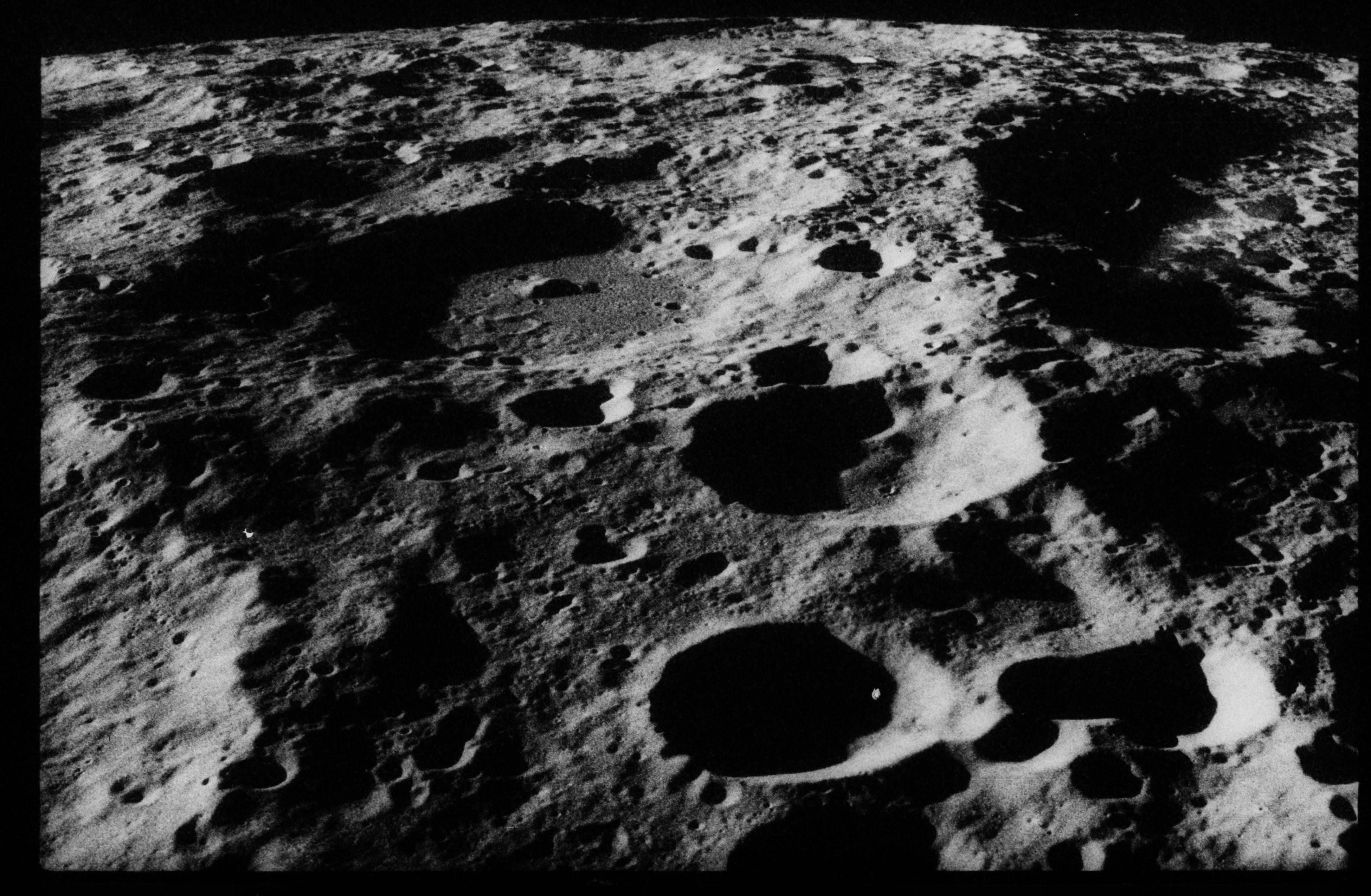
Evans (onboard): Okay; that's looking north from - frame number 3, looking north - on the magazine Yankee Yankee - looking north from Gagarin.
Magazine YY is a roll of 35mm high speed black & white film, rated at ASA 6000. It is therefore used in the Nikon camera with a 55mm lens.
AS17-160-23948 - View north towards crater Beijerinck - Image by NASA/Johnson Space Center.
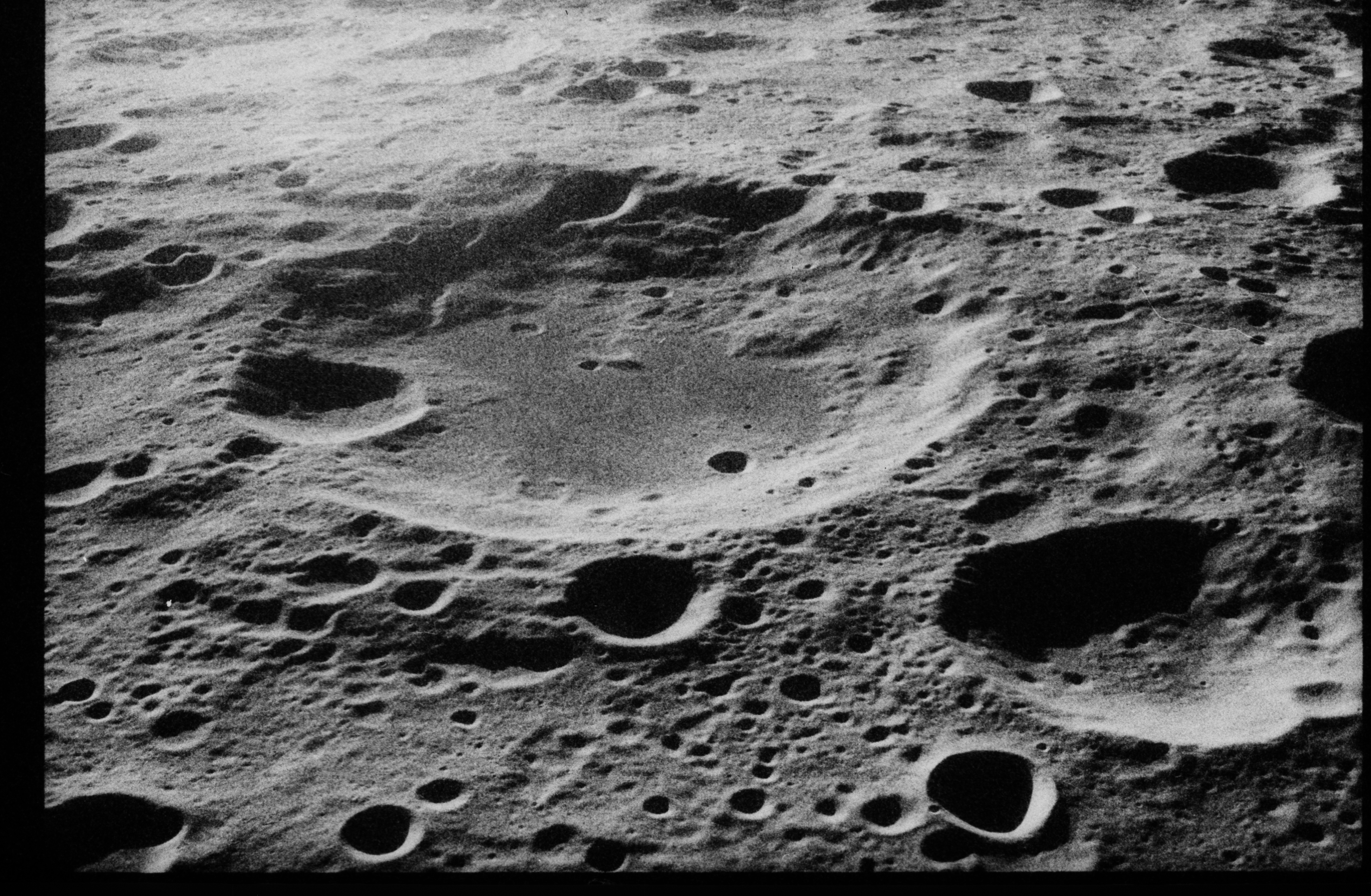
Evans (onboard): Okay; that's mag - that's number 4, looking right at Agassiz [sic]. That's south.
As we don't currently have the audio of Ron's farside voice, it is unclear whether 'Agassiz' is a mistranscription. The fourth image on YY is of Isaev, a 94-km which dominates the northwest quadrent of the Gagarin basin.
AS17-160-23949 - View west towards crater Isaev. Crater Grave is lower right - Image by NASA/Johnson Space Center.
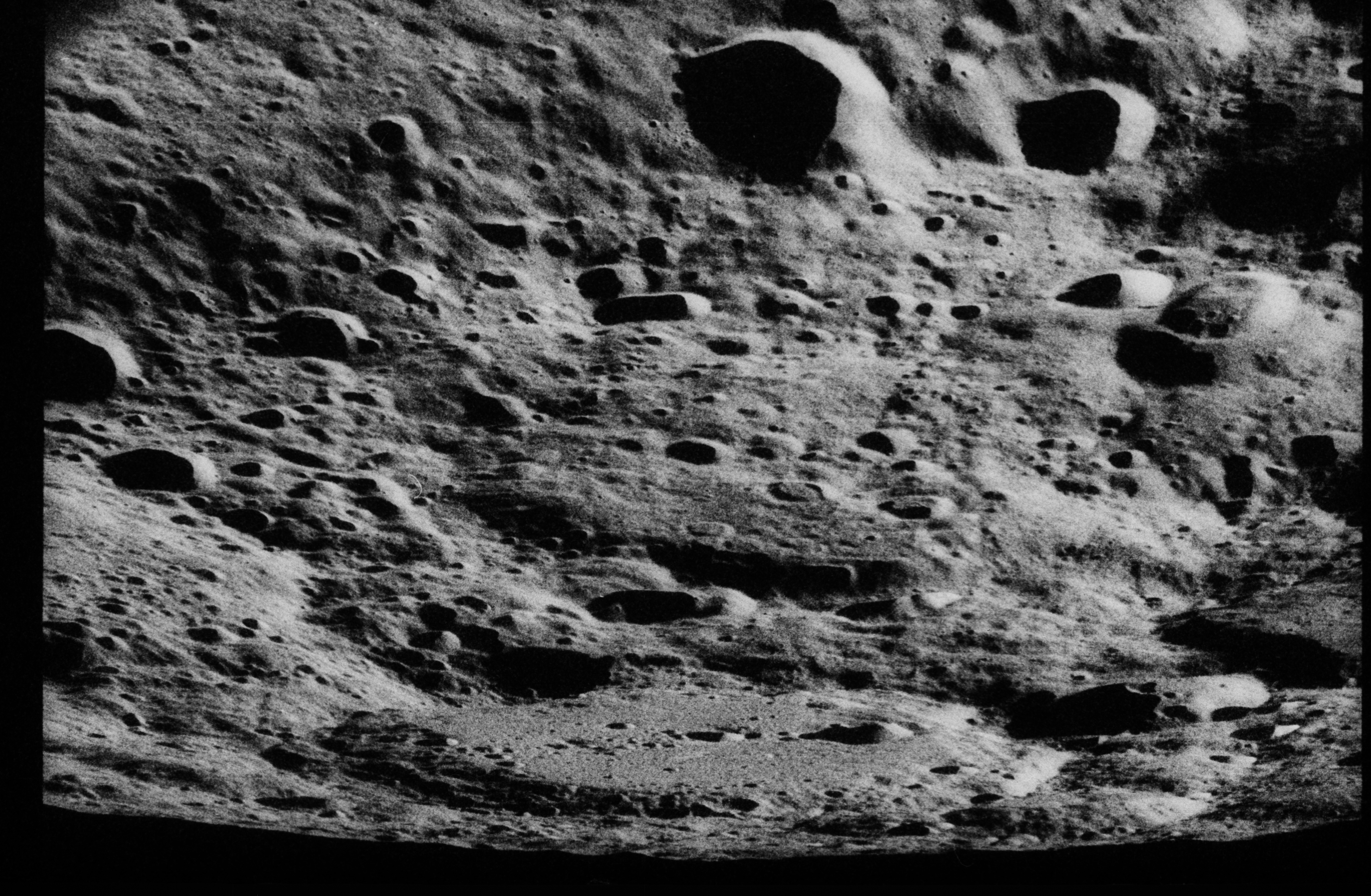
Evans (onboard): Five is looking south from Gagarin along the terminator. Let me see if I can get this back across old Mar - Looks like an upside down picture. Not Marginus, I mean - Ingenii, I think
AS17-160-23950 - View southwest towards crater Pavlov (143 km). Foreground crater is Gagarin M (17.5 km) - Image by NASA/Johnson Space Center.
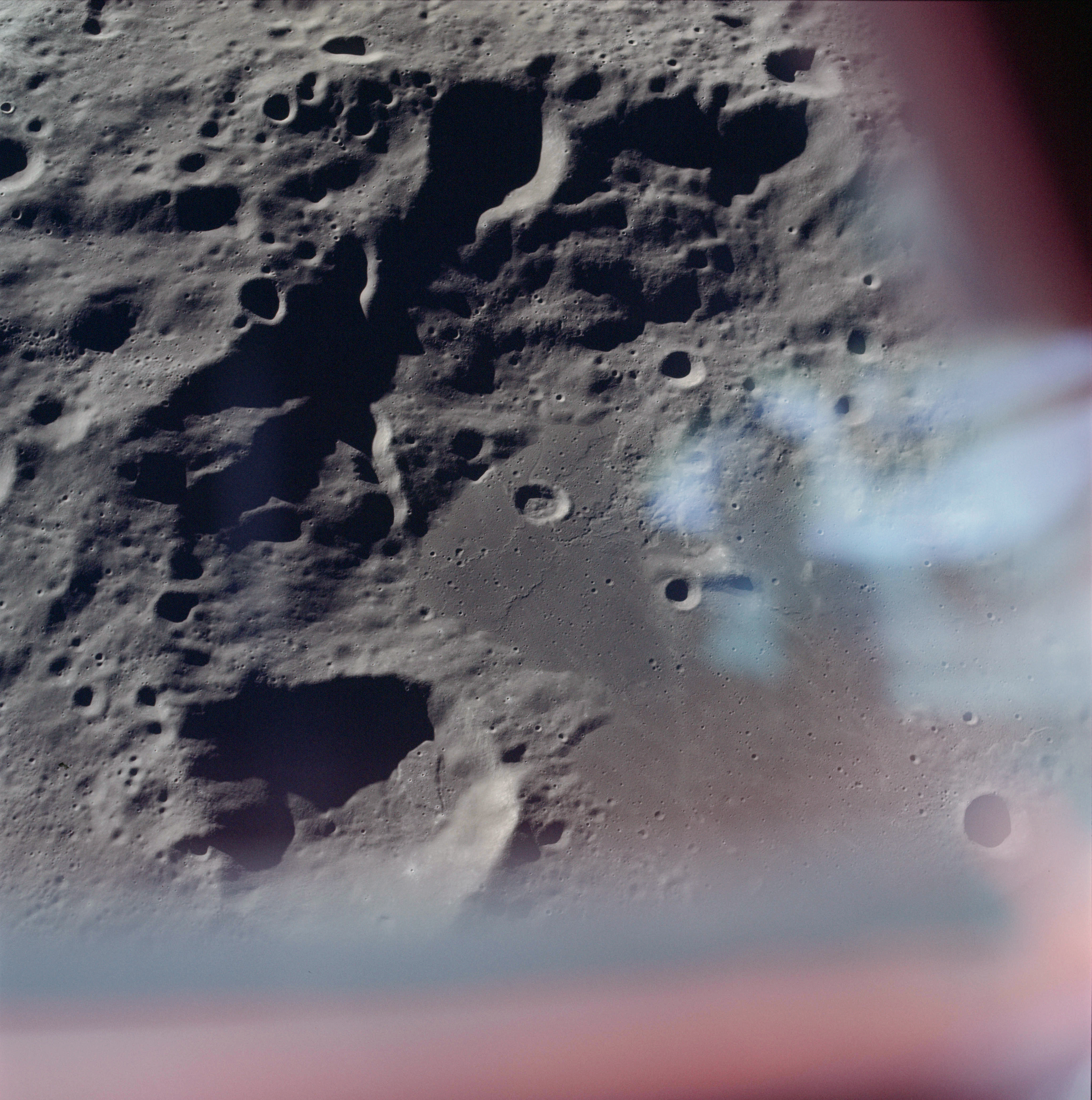
Evans (onboard): Okay; mag Oscar Oscar, 130, was taken at Agassiz.
Again, 'Agassiz' seems to refer to Isaev which fills frame 130 on mag OO.
AS17-151-23236 - Crater Isaev. Isaev N is at lower left - Image by NASA/Johnson Space Center.
Evans (onboard): Okay; 131, looking south of Agassiz off toward Ingenii.
The dominant feature on frame 131 is crater Pavlov.
AS17-151-23237 - View south towards crater Pavlov - Image by NASA/Johnson Space Center.
183:26:43 Evans (onboard): Okay; frame number 133 is looking north - Let's see, just - I guess Marconi. Let me look for sure, though.
Ron's count has missed one, but frame 132 is indeed crater Marconi.
AS17-151-23238 - View north towards crater Marconi (73 km) - Image by NASA/Johnson Space Center.
Evans (onboard): That's Marconi. Just past Chaplygin. Yes; there's a lovelet.
Evans (onboard): I want a piece of candy here.
Evans (onboard): I'm not even sure where this one is, or what it's close to.
Evans (onboard): Anyhow, it's got a - a scarp going down through it. And looks like it goes up - it looks like flow front is what it looks like to me. Except the flow front goes up this side, the south side of the crater. It's a domical, a very subdued, eroded, domical central peak on the thing. And the whole crater is somewhat eroded except that the center - central peak is - seems to be more rounded than the crater walls themselves. Almost like it might have been an uplifted type of feature - possibly volcanic. But anyhow, the - it looks like a flow front going around there, and I'll get a picture of that on number 134 - 133, I guess, magazine Oscar Oscar.
Frame 133 is Chauvenet Q, a 42-km crater that matches Ron's description, including what appears to be a lobate flow on the crater floor.
AS17-151-23239 - View north to crater Chauvenet Q with Chauvenet P at bottom of frame - Image by NASA/Johnson Space Center.
Evans (onboard): Darn, I missed Tsiolkovsky. Son of a gun' Well, here comes the flow.
183:32:18 Evans (onboard): Sure have a lot of different albedo textures on the thing. What makes it look like a - I sure want to see that low Sun, see if that's a topographic rise over Tsiolkovsky or not, and I - looks to me like there's just a - it's just an albedo. It has dark albedo streaks in there. Maybe they are shadows, but I don't think so. Can't see - interpret. You have flow from a so-called landslide. Looks like in a spot or two there, it's rocky. It doesn't come out and roll over. It just comes out and slopes down at maybe a 45-degree angle.
This is Apollo Control at 183 hours, 32 minutes. We're about 14 minutes away from the scheduled wakeup time for Apollo 17 - the Lunar Module crew. However they beat us to the punch this morning and we just got a rousing rendition of "Good Morning To You" sung by the crew of Gene Cernan and Jack Schmitt on the lunar surface. The Surgeon reports that the two crewmen appear to have gotten a good night's sleep - 6 to 7 hours, and we'll pick up with the taped replay of that Good Morning rendition from the crew and then follow it live.
183:34:13 Evans (onboard): Okay. Let's see, just south of Roosa [sic]. Not these subdued craters that Roosa is on the edge of it, but the next one on down from that. I'll look at my map later to find out for sure what it is. But that crater is - looks like it's early Eratosthenian in age, in that the slumping along the walls is fairly fresh. There's not a real apparent ejecta blanket around it, and there's a - a flow ridge down in the center of the crater. Most of - most of the bottom of the crater, though, is composed of very small bumps and furrows. This type of thing. The albedo is lightly - When the - when the Sun is sort of shining on the central peak on the thing, you can see stariations - striations running every which direction. In other words, the horizontal - you have horizontal and vertical striations on the thing of different colors. The - the dark striations in the thing are - kind of - let's see, kind of in the tannish - tannish-gray tinge.
183:35:43 Evans (onboard): Anyhow, the bottom of the floor has a relatively - you can see flow lines in the mare flow or the mare fill of the thing. Now, what's the name of it? Oh, it's Langemak. Sure. Okay; it's Langemak.
Frame 134 on OO is Langemak. This 105-km crater has a patch of mare in its centre surrounded by a ring of hills leading to the crater's rim.
AS17-151-23240 - Crater Langemak with crater Sherrington at bottom of frame - Image by NASA/Johnson Space Center.
Evans (onboard): Yes, I ought to be able to get a good shot of Arabia out window 1 here. What time is it? Thirty-six - 4 minutes. I'll get one of essentially the horizon. Where is the clicker on this? Looking out across - first of all. Okay; [garble] 11. I'll take another shot thataway. Another shot to the west. And we'll take one out of window 3 here looking down across - 2, I mean, looking down that way. Okay; those are all f/11. Let me try the same thing in f/8 just to make sure I'm getting the right settings. What I'm trying to do on these are make a profile for the - I just moved the thing.
A sequence of nine images look to the horizon, AS17-151-23241 to 23249.
AS17-151-23241 - Buisson, AbulWafa (according to Photo Index) - Image by NASA/Johnson Space Center.
AS17-151-23242 - Buisson, AbulWafa (according to Photo Index) - Image by NASA/Johnson Space Center.
AS17-151-23243 - Buisson, AbulWafa (according to Photo Index) - Image by NASA/Johnson Space Center.
AS17-151-23244 - Buisson (according to Photo Index) - Image by NASA/Johnson Space Center.
AS17-151-23245 - Einthoven (according to Photo Index) - Image by NASA/Johnson Space Center.
AS17-151-23246 - Einthoven (according to Photo Index) - Image by NASA/Johnson Space Center.
AS17-151-23247 - Saenger (according to Photo Index) - Image by NASA/Johnson Space Center.
AS17-151-23248 - Buisson (according to Photo Index) - Image by NASA/Johnson Space Center.
AS17-151-23249 - Buisson, AbulWafa (according to Photo Index) - Image by NASA/Johnson Space Center.
183:37:41 Evans (onboard): That central - central crater down here really shows up. Central crater of Arabia is what I'm talking about. Probably be too much sky on this 80-millimeter thing.
183:38:16 Evans (onboard): Well, let's see, I got a Pan Camera photo pass 38 in 2 minutes. I've got to get going on that. Crazy dark slide somewhere. Big deal. That's all I need. [Garble] is to change my camera in a minute.
183:39:11 Evans (onboard): Okay; the pitch and yaw is going to be coupled.
Evans (onboard): [Garble] uncoupled.
Evans (onboard): One's D-1; B-2 and D-2. One in A-2.
183:40:22 Evans: is that - jets are enabled, that C-1 and C-2 for roll, Off. Pitch and yaw are off. [Pause.] And, Houston, ready for Pan Camera to Standby and Stereo to Power and all those good things whenever you are.
Overmyer: Roger, America. We're standing by.
Evans: Okay.
Overmyer: Okay, Ron. You can go Pan Camera, Standby.
Evans: Camera is - Hey! Good morning, Robert. How's it going?
Overmyer: Real fine. Real fine. Lousy weather, but we're all here.
Evans: [Laughter] Okay. Let's see - Pan Camera - that's verify Standby. Okay, it's going up to Stereo. Turn the old Power switch On. The V/H is still in the High Altitude.
183:41:44 Overmyer: You may be interested. We just woke up the Challenger, or maybe they woke us up, I guess. They gave us a song here from - from there first, and they're all fine and they're in their Surface Checklist - getting ready for ascent.
Evans: Hey, great! Okay, I ought to get my prep for transfer ready here. You know, kind of last night and also this morning as I was flying across the back side of the Moon here - been thinking a little bit, and I wonder, it seems like that the Eratosthenian-age craters, you know the ones that are fairly - fairly fresh, you know they're not Copernican, they don't have rays and this type thing, but they're fairly fresh in their slumping characteristics on the inside and this type thing. But they all seem to have a mare floor; you know - a flat, mare floor - a volcanic-type floor in the thing, and I wonder if there's anybody that's kind of come up with a theory at all that maybe it had a liquid mantle during the - the Eratosthenian era during the formation of the Moon, you know. And those craters at that point in time were - were penetrating that - that liquid mantle.
Overmyer: It's a thought. Roger, Ron. That's a good thought. You get kind of the feeling like you're seeing - like out Hawaii where craters like stick up out of the ocean and you see the walls of the craters in the ocean up in amongst them. That the kind of feeling you get?
183:43:57 Evans: Must not be because I don't know for sure what you mean (chuckle).
Overmyer: Rog.
Evans: I guess the feeling I was getting is that most of the Eratosthenian-age craters all have some sort of a mound - a domical structure down in the bottom of the crater. You know, even the smaller ones, some - some of the - the 30 - 50 kilometer si - class, you know, have either a the flat floor - they look - they look volcanic on the floor. Some of the bigger ones, of course, they're definitely volcanic - lava flows on the floor of these big craters. The slumping in the walls is not as fresh as a Copernican-age crater, but, you know, they - It's not all beat up, either. The walls - the crater walls had a slumping coming down through there and it's still fairly fresh in the slumping, but you don't have any rays showing up on the outside of the crater. So they're kind of Eratosthenian age.
Overmyer: Roger; copy.
Evans: And - and all - all of the craters that are that age have the mare fill in them, you know?
183:45:30 Overmyer: Roger.
Evans: Like there's - there must have been some volcanic activity during that period of time.
Overmyer: I - I guess my feelings were, Ron, what I'm trying so say is...
Evans: 365, 3 - Go ahead.
Overmyer: If you had a - If you'd had a liquid mantle and the crater sticking up through it, you might have the mare not only on the floor of the crater, but the mare would be on the exterior walls of the crater. You'd see a high-water mark along the exterior, wouldn't you?
Evans: Oh, I see what you're saying. Yeah. Now you - you had to have some sort of a solid crust and then the impacts hit the solid crust and broke through the crust and got down into the liquid mantle.
Overmyer: Okay. Now I got you, Ron.
Evans: That's the type of operation I was thinking about.
Overmyer: Rog. I got you.
183:46:35 Evans: Yeah. You know, but it would have to be a relatively thin crust.
Overmyer: Roger. Understand.
Evans: Okay. I've got the temporary stowage bags all set. [Garble] [Humming] From the decon bags on A-2 - got one bag of ropes in there - put those - Where can I put those? Right hand - yeah, okay. That's in the right-hand temporary stowage bay.
Overmyer: Okay, Ron. You're coming up on 1 minute to Pan Camera T-start. I'll call you in 30 seconds.
Evans: Okay.
183:48:08 Overmyer: Okay, 30 seconds to T-start time.
Evans: Okay, I'll say we started at - excuse me, I've got a piece of candy in my mouth - 8:41. Camera will go to Operate.
This is Apollo Control at 183 hours, 49 minutes. Gene Cernan and Jack Schmitt aboard Challenger on the lunar surface after having gotten up about 15 minutes early. Now having breakfast. They're a bit behind in the timeline but we expect to have them caught up by the time they are about 1½ hour prior to lunar lift-off, which is when we begin the really busy period of lift-off preparations, and everything appears to be going along very smoothly at this time. The crew's early arising caught us a little unprepared here in Mission Control. We had our own wake up tune to play up to them this morning which was to be the title theme from the motion picture 2001 A Space Odyssey. However they beat us to the punch with their own wake up song to the Control Center and we'll play that back for you at this time.
The PAO then plays Gene and Jack singing 'Good Morning to You' to Gordon Fullerton.
And after giving us a few minutes to catch our bearings, we hit them with the theme from 2001 A Space Odyssey. Since then things have been going along pretty much normally. The poetic offering was from Jack Schmitt. He said it was for all the kids back home. It was his version of the Night Before Christmas. We have reacquired Ron Evans aboard the Command Module America and everything is progressing very smoothly aboard that vehicle. We're on separate communication circuits at the present time and will be, up until the revolution prior to LM lift-off at which time we'll switch back to a single air-to-ground, a single spacecraft communicator operation and be able to follow the operations in both vehicles simultaneously. That will be at Acquisition of Signal on the CSM's 51st revolution.
Evans: Bob, if you want to keep your eye on the clock for me, I'll - [garble] transfer bags...
Overmyer: Don't sweat the camera, Ron, I'll - I'll cue you. Just forget the Pan Camera and I'll cue you about a minute prior to Pan Camera stop.
183:49:28 Evans: Okay. This jett bag is so full of junk, I don't know if I can get it through the tnnnel.
183:50:00 Evans: Okay. Stow the old rope in the right-hand temporary - right hand, okay. That's fine. Did that. Decon bag straps from top of A-2 and hang on L-3. Okay, that's the way it's been for a long time. Remove two jett bags, vacuum bag, and the vacuum cable from A-2. Okay, the cables are already in the bag. Yeah. Empty jett bag, the vacuum bag, and the cable in left-hand temporary stowage - put them in last night. Ah, yes, that's in there. Okay, let's see. Stow the empty jett - Oh, I did that, okay. Replace remaining jett bag on A-2, and load with following. Okay, A-9 is empty, so I got that. Fecal bags? Oh, those are the empty ones. Oh, and - yes, we've got some extra ones on here. Heat flow experiment - did a good job and now it's going down the tubes. Okay, it's in the bag. Okay, the helmet shield. WG's.
183:50:55 Evans: Extra ones. Okay, that's all four of them. There, forgot to take that one off.
Overmyer: Okay, Ron. Wnen you can reach up, we'd llke High Gain, Auto.
Evans: Okay. Remove CWGs and interconnects from A-8, stow in right-hand temporary stow - Okay, well, I'll put a - [clipped] CWGs in each guy's temporary stowage bag...
Overmyer: Okay, Ron. You're 1 minute from Pan Camera T-stop time.
Evans: ...A-8. Okay. - [clipped] we at.
Overmyer: I'll give you another cue at 30 seconds.
Evans: [Garble] get that one, then. Okay.
Evans: I forgot to write down T-stop. What time is it.
Overmyer: It's 184:06:43. And you - You're about 30 seconds from T-stop time now.
Evans: 06:43. Okay, 06:43 we'll shut it off. Go to Standby.
184:06:42 Overmyer: Mark, T-st - T-stop.
Evans: 2...
184:06:46 Evans: Mark it. Stop. Okay? Hey, while I'm thinking about it, I started the - the Mapping Camera and Laser Altimeter about 3 minutes early there - on the back side.
Overmyer: Okay. We copy.
Evans: Okay. Got a...
Evans: [Clipped] the old vacuum cleaner.
Evans: [Clipped] go. [Clipped] is.
Evans: All right. Now, if I can find the cable [humming].
Evans: Power cable in the vacuum bag. Ah, there's old vacuum bag.
Evans: Okay. Vacuum bag here. Which, from the sounds of things, those guys are pretty dirty down there. Probably need an extra bag.
184:10:05 Overmyer: Roger.
Evans: [Humming] Got the pins on it. Going to unroll [garble] in the cable [humming; whistling].
Evans: It works. Ah. Good little vacuum cleaner we got. [Chuckle]. Does that when it starts up. Let me try it again. Okay? Watch the main bus B.
Overmyer: Okay, we'll watch main bus B.
Evans: And, let's see - main bus B - 3, 2, 1...
184:11:44 Evans: On. Starting - Yeah, [garble]. It's just the starting torque on this crazy motor, I guess. Well, it works. I'm glad I tried that out. I'd hate to have that thing while we're - Oh, I know what to expect now. Now, if this thing will fit down here between F-2 and the MDC like it's supposed...
Overmyer: Ron, we're going to think about that a while. Your starting current was a little higher than we expected on that. We're checking through the back room.
Evans: Okay. I wasn't quite expecting it, either [chuckle].
Overmyer: Gets your old heart rate going a little bit. Doesn't it?
184:13:09 Evans: Yeah. Makes it kind of go pitty-pat.
Evans: Okay. Let's see now.
Evans: Oh, that's Hadley Rille. Looked out the window. Okay, back to work here. Let's see. Vacuum brush - Did that. Power cable - connect the cable. Stow assembled vacuum between F-2 and MDC, okay. Oh, helmet stowage bags - I put mine down there, but I don't have theirs. [Clipped] can bring them across [Humming]. I should be able to get that right there, I guess.
184:17:57 Evans: [Clipped] our time here? Let's see, 17. We're just barely - barely making headway, here [clipped]. Okay to that. Close out curtain and stow in the right-hand temporary stowage bag. Okay. Good idea and then we can get in there and put them old rockboxes in those holes.
Overmyer: Hey, Ron. Do you have the - Did you write down the time that you torqued to the current REFSMMAT at 183 or right around there?
Evans: Yeah, sure did. I meant to give you that. I'm sorry. Let me give it to you. Okay, I did a coarse align, and I torqued at 183:01:45.
Overmyer: Thank you, Ron, and while we've been...
Evans: Coarse-align torquing errors were - Want them?
Overmyer: Go ahead.
Evans: Okay, coarse-align torquing erros were minus 0.439, minus 7 - 0.798, minus 0.092.
Overmyer: Okay.
Evans: Star angle difference 0.01.
Star angle difference was 0.01 of a degree. This is the difference in the measured angle and the known angle between the two stars, an indication of Ron's sighting accuracy.
Overmyer: Got that. While we've interrupted you, we've got two little things down here...
Evans: What's that?
Overmyer: ...for - We could remind you on. One of them is that the...
Evans: [Garble.]
Overmyer: ...the current we saw on the - the current we saw on the vacuum cleaner was just about nominal and it tripped on the undervolt by just a tenth of a volt, so we - it's - We wouldn't have expected the undervolt, but the current - starting torque current was just about nominal. And the other thing is - is that we're still getting kind of bad data on the EKG. If you have time, you might check your sensors. There's no hurry on either of those.
184:20:59 Evans: Oh, okay. Let's see. Do you have a zodiacal light photo PAD yet?
Overmyer: Rog. I got it right here, and I've got - off a - P24 landmark tracking PADs, too, if you want to wait until 30 or take them now - any - your choice.
Evans: Let me get this other stuff squared away first...
Overmyer: Rog.
Evans: ...and I'll get. Got about two more things to do, looks like, then I'll be all done. It's a good thing I did half of it last night.
Evans: [Humming]
184:22:45 Evans: [Humming] Have a sugar-cookie cube for a little energy. [Clipped] R-12's [garble].
Overmyer: Okay, Ron. Pan Camera Power to Off.
Evans: Camera Power...
184:23:17 Evans: Off.
Evans: Bottom of PGA bag, insert the bottom flap in the top pocket. Got my suit in there. Won't come out. Take my suit out, I guess.
Evans: Okay. Let's see. I guess we're ready to take our Mapping Camera, Off, huh? - What you said? [Garble] 24. Yeah. Upper - it's going...
184:25:05 Evans: Off.
Evans: Okay. Mapping Camera's going to Standby.
184:26:05 Evans: Off. Barber pole. [Clipped] ER's going Off. Transponder is going to Heater. Okay, Mapping Camera/Laser Altimeter Cover - Closed - Barber pole. Gray. Okay. Those all three are closed, in, Tank 3 Isolation Valves. Okay, we can go to P00 and turn on A-1 and 2. A-1 - down - up - down. Okay. A-2. We got coupled attitude.
Evans: And, Houston; America. I am ready to copy.
Overmyer: Okay, Ron. We're ready with the zodiacal light PAD. Zodiacal light at 1 - T-start time - 184:58:22.
184:26:23 Evans: Okay, T-start, 184:58:22.
Overmyer: Okay, and over at 185:50, we've get the F-1 Tracking PAD and 17-1 tracking PAD and I just might add that we will not give you the tenths of a second on the T-2 time because these are high altitude.
Evans: Oh, yeah. We don't need those. Okay.
Overmyer: Okay. F-1: T-1 is 185:38:00; T-2 is 42:50; TCA is 44:30; T-3 is 45:18; it's north 9 - 09; north 09 nautical miles.
Evans: Okay, F-1: 185:38:00; 42:50; 44:30; 45:18; north 9 miles. That's it, I guess.
Landmark F-1 is one of two selenodetic reference points listed in the CSM Lunar Landmark Maps. Its coordinates are given as 1.863°N, 88.250°E and it is located in the northern part of Mare Smythii.
LRO context image of landmark F-1 in Mare Smythii - Image by LROC/ASU.
Explanation of the tracking PAD follows:
T-1 (185:38:00 GET) is the time that the landmark is on the horizon and is 6 minutes, 30 seconds before closest approach.
T-2 (185:42:50) is 4 minutes, 50 seconds after T-1 and is when Ron begins to pitch the spacecraft at 2° per second to keep it at an approximately constant attitude with respect to the landmark.
TCA (185:44:30) is the time of closest approach.
T-3 (185:45:18) is 7 minutes, 18 seconds after T-1 and 48 seconds after TCA. It marks the end of the landmark tracking mode.
An additional note states that at TCA, the spacecraft will be 9 nautical miles (16.7 km) north of the landmark.
Overmyer: Okay. 17-1. You ready?
Evans: Yep.
Overmyer: Okay. 185:57:25; 186:02:15; 03:55; and 04:43. It's south 03 nautical miles.
Evans: Okay, 17-1. 185:57:25; 186:02:15; 03:55; 04:43; south 3 miles.
Overmyer: Okay, Ron. That's the PADs I've got in front of me right now. You're up to date.
Evans: Okay. Thank you.
Landmark 17-1 is the crater Sherlock near the landing site.
LRO context image of the sighting landmarks around the landing site - Image by LROC/ASU.
Explanation of the tracking PAD follows:
T-1 (185:57:25 GET) is the time that the landmark is on the horizon and is 6 minutes, 20 seconds before closest approach.
T-2 (186:02:15) is 4 minutes, 50 seconds after T-1 and is when Ron begins to pitch the spacecraft at 2° per second to keep it at an approximately constant attitude with respect to the landmark.
TCA (186:03:55) is the time of closest approach.
T-3 (186:04:43) is 7 minutes, 8 seconds after T-1 and 48 seconds after TCA. It marks the end of the landmark tracking mode.
An additional note states that at TCA, the spacecraft will be 3 nautical miles (5.6 km) south of the landmark.
Audio recordings of the PAO feed are not available between 184:16 GET and 186:01:45 GET.
This is Apollo Control with 184 hours, 32 minutes. Jack Schmitt and Gene Cernan aboard Challenger on the lunar surface at the present time, are going through the platform alignment, getting their guidance and navigation equipment ready for lunar lift-off. They will also shortly begin donning their pressure suits. And they appear to be running about 30 minutes behind the timeline. However, we expect they will have adequate opportunity to make up the lost time prior to a lunar lift-off. And, we're looking for lift-off to occur pretty much on time at 188 hours, 1 minute, 44 seconds Ground Elapsed Time. This is actually about 1 minute, 10 seconds earlier than the preflight plan with the difference caused by the fact that the Command Module for a period of time, was in a slightly smaller orbit than had been planned premission. With the plane-change and orbit circulisation maneuver performed a few hours ago by the Command Module, that orbit is now back on the planned trajectory. However, because of the smaller orbit, the CSM was in for a period of time, the lift-off time of the LM has had to be moved up 1 hour, 1 minute, 10 seconds, to put the LM in the proper position with respect to the Command Module, for their rendezvous. This is a so-called phasing consideration for the lunar lift-off. Again lift-off currently planned for 188 hours, 1 minute, 44 seconds or about 1 minute, 10 seconds earlier than called for in the Flight Plan. Ron Evans aboard America is involved in scientific activities at the present time, getting set up for Zodiacal Light photography. Everything continues to go very smoothly aboard America. Evans a little while ago hooked up the inflight vacuum cleaner and powered it up to see if it was going to work. That piece of equipment will be used quite a bit after Schmitt and Cernan return to the Command Module with their dirty bags of rocks and dirty spacesuits and there will be quite a clean-up chore for all three crewmen in the Command Module. America at this time is in it's 49th revolution of the Moon, and about 20 minutes away from disappearing behind the Moon on this revolution. We're showing 3 hours, 27 minutes now until Lunar liftoff.
184:30:38 Evans: [Humming] How did that plane change - the tracking work out on that plane-change burn? Is that okay?
Overmyer: As far as I know, it was beautiful. Let me check with FIDO right now. It's very good. Let me - Let me get your parameters...
Evans: Okay.
Overmyer: They don't have a real smooth solution yet, on their track, but it's real good. No problem at all.
Evans: Good, okay. Old computer comes through again.
Overmyer: That's affirmative. I guess those residuals on the SPS burn were like zero, weren't they?
Evans: Yes. That's a good...
Evans: [Garble] P20. Is there a place in there where I hook up that TV camera? I think I'm going to do that now. [Clipped] look like it.
Evans: Okay, let's see - it's 30 something. I can get it out, if I can find it. Old jett bag's in the way. Don't want that floating all over the place.
184:43:03 Evans: Okay. Nikon, 55-millimeter [garble] 2, infinity. Mag Yankee Yankee - gives frame - let's see - [garble] lights and tape the old floodlights. Okay.
Overmyer: Ron, we'd like to get the H2 Tank 2 Fan, to Off, please? I'll say again: H2 Tank 1 Fan, to Off.
Evans: [Clipped] 1 Fan is Off. 1, 2 and 3 are all On.
Evans: Okay. It's time to run the radar check, it's been in Heater a minute. Okay. [Garble] Closed, okay. Heater for 21 minutes. Power. Okay, A - Transmitter A and she is reading 2.8. Okay.
Evans: [Garble] Transponder to Test or - Okay, you're reading about 2.35. Okay. Now go to Operate Systems Test. 0.4 right hand to see if it unlocks. It probably won't do anything. Less than 0.8. Reads 0.3. Same thing as it did before. [Clipped] that one.
184:49:25 Evans: Looks like Rendezvous Radar Transponder Self Test works. Okay. Systems tests goes back to the - Alpha is still 1.2.
Evans: [Clipped] to the Heater. Okay.
Evans: Here we go. 290 and 0. Okay. T-start is in there.
Evans: Let's see - 0.5 [clipped] plus one-half degree deadband. Five up 50 18 2 and 4. Looks pretty good. Now, let's see. We can go ahead and...
Evans: Ah, Noun...
184:52:23 Overmyer: Ron, we're couple of minutes from LOS here and you're looking good. We'd like to make sure you get the Data System, Off and just a comment on the rendezvous transponder. We're going to leave it in heater straight through until ascent because the - the LM got up late. They're not doing their P22 today.
Audio recordings of the PAO feed are not available between 184:16 GET and 186:01:45 GET.
This is Apollo Control at 184 hours, 52 minutes. In about 2 minutes, 45 seconds, we'll be losing radio contact with Ron Evans aboard America as the CSM goes behind the Moon on the 49th revolution. At the present time, Evans is in the process of checking out the rendezvous transponder on board his spacecraft, the first in a series of steps he'll be taking to configure the CSM for the rendezvous with the Lunar Module. Aboard the Lunar Module Challenger on the lunar surface, the team of Cernan and Schmitt will soon begin getting into their space suits, getting the Lunar Module configured for lift-off, a process, a series of steps which they have already begun. And, everything aboard the Lunar Module appears to be very close to normal. We are looking at one minor problem, and that concerns the water aboard the descent stage of the Lunar Module. For some reason, the consumption of water has been a bit greater than was predicted. This water is used primarily, at least the bulk of it, is used for cooling equipment aboard the Lunar Module. It's boiled into the vacuum of the lunar atmosphere and carries away heat from the electronic equipment in the LM. If we run out of water in the descent stage, the crew will simply switch over to the reserves of the ascent stage and use those prior to lift-off. Our current prediction is that the descent water will last up through 186 hours, 40 minutes, plus or minus 1 hour, so as early as 185 hours, 40 minutes, or as late as 187 hours, 40 minutes we could run out of water. In the Lunar Module descent stage, if we run out early, again the procedure would be to have the crew switch over to the ascent water supply. This again would, in turn, cause no problem. We have adequate reserves in the ascent stage of the LM for a normal or an abnormal rendezvous and docking. And, in about 30 seconds, we'll be losing radio contact with Evans aboard America.
Evans: Oh, okay, okay. Understand. Okay; the old Data System is going Off. And I got to configure the DSE at AOS, it looks like.
Overmyer: And we have configured the DSE and controlled it, Ron. You can scratch that line of the Flight Plan.
Evans: Okay.
Overmyer: And have a good zodiacal light.
184:53:24 Evans: [Laughter.] Flip, flip, push-pull, click-click, around the corner, 3 seconds, one-half, one-fourth, skip one, skip two, skip five. Ought to be fun.
Audio recordings of the PAO feed are not available between 184:16 GET and 186:01:45 GET.
And, we've had Loss of Signal now with the CSM. Be reacquiring in about 45 minutes. The spacecraft at that time on the 50th revolution of the Moon, We'll continue with the dual line setup communicating with the CSM on one circuit and the Lunar Module on another circuit through the next revolution, then beginning with Acquisition of Signal with the Command Module on the 51st revolution, which is the LM lift-off rev, we'll be switching to a single communication circuit with a single spacecraft communicator. Again, Cernan and Schmitt appear to be running about 30 minutes behind the Flight Plan timeline, but we expect they'll have adequate opportunity to make up that time before liftoff in a couple of hours. There are places in the Flight Plan where there is a bit of a built in pad, and they should have no trouble being ready for an on-time liftoff if things continue to go as smoothly as they are at the present time. Cernan and Schmitt both in good shape for the liftoff. Cernan reported he got about 5 hours of sleep, Schmitt about 6 hours. Both crewmen have been eating well, and, along with their vehicle, in good shape for the lift-off and subsequent rendezvous. This is Apollo Control at 184 hours, 56 minutes.
185:05:42 Evans (onboard): Better change back. One, 2, zip. Okay. At 08, we want 30 - two 30-seconds. At 10, two 20-seconds. 11:30. Five, B, skip one, skip one. Okay. At 30, change to the 20. Okay. We've got the 20. Okay. At 08:30, we'll take her Off.
Evans (onboard): [Garble] good. [Humming] [Garble] bad. Got the [garble] to SM/AC; 20-seconder. At 11:30 is a 10.
185:07:49 Evans (onboard): [Garble] I'm going to go to B. Okay. We move on to B at 11:50; 10- and a 20-minute.
Evans (onboard): [Garble] 20-second. [Garble].
Evans (onboard): 18, 19, 20. Change the shutter.
185:08:50 Evans (onboard): Go at 20.
Evans (onboard): [Garble] change the shutter.
185:09:21 Evans (onboard): Okay. At 11:30, that'll be 10 seconds. At 13:00, a 5; 13:30, a 3.
Evans (onboard): 48, 49 - Okay, make sure we're in B. Yes. Skips every other one going...
185:09:55 Evans (onboard): Cock it. I think the thing started at 40 - 54. 3, 4...
185:10:20 Evans (onboard): Cock it. Change the jobberdoo. Five seconds at - 13:00. Okay. Five seconds. 13:30, 13:50. Skip one, skip one. Okay. 13:00:15, 5 seconds. Okay, 30 seconds to go. Okay; and you can see some kind of zodiacal light coming up there. Looking out window - bright. I think that's Sirius. Stands out, too. [Garble] Sirius and - 2. 56, 57, 58, 59...
185:11:42 Evans (onboard): Cock it. Change the jobberdoo. Change it. Okay. The next frame's a 3 at 13:30. Okay.
185:12:00 Evans (onboard): Cock it. Change the jobberdoo. 6, 7, 8, [garble]...
185:12:06 Evans (onboard): Cock it. Change the jobberdoo. Get set. [Garble]. This thing on? Okay, it's a 1. [Garble]. Okay. Probably do it a little bit late. Okay, at 14:10, skip one stop.
185:12:37 Evans (onboard): Cock it. Change the jobberdoo back. it's - 30. [Garble].
185:12:57 Evans (onboard): Cock it. Change the jobberdoo. Going...
185:13:01 Evans (onboard): Cock it. Change the jobberdoo. It's 50 - 7, 48, 49, 50...
185:13:16 Evans (onboard): [Garble], here comes the [garble]. Good gosh, look at this ray coming up ahead of me. It's beautiful. Hey! [Laughter] Wow! [Garble] Sun came up. Just a - a - That'll be a bright chunk sticking up there. Right at the 50, the 14:50. Beautiful sequence. Ah-ha! Wasn't that good? Oh, beautiful. Outstanding! Didn't know I could do it. [Garble] 1/15 already. Now, let's see, where are we here? Where did we end up?
185:14:XX Begin lunar rev 50
Evans (onboard): Oh, we ended up on the 1/60. [Laughter]. Now, better do a 1/1000. Beautiful Job. Oh, that's good. Okay. Let's see. Cock it once. Cover it with a book, and take it for a check frame. We have a minute and 30 - 30. We ought to have enough of this thing to [garble] with. Whew! I'll be glad when the guys get back with the [garble]. Not with the soap, because soap doesn't do any good [garble]. All one time. Just need a good deodorant. Took all the deodorant with them to the surface. Outstanding stuff. Wow! I didn't think I could ever do that. Well, I'll tell you, Bob Mercer, you and [garble] Bob - I don't remember - Anyhow, you made it so it's a reasonable type thing to - to make. If it had been any more complicated than that, I'd have never got it. Just barely getting done. [Garble] on the camera - camera.
185:16:05 Evans (onboard): [Garble] that one first, Sirius or Saturn? Whatever it is, it's just a little bit off to the right of track. And let's see now, where are we? That's on frame 30. [Humming] Gee. It's 31 - 31, I guess, once you pull it through; 30 was the last one I took of that one. That one was [garble]. Okay, maybe I missed one of the 1-degree ones. Ha!
Evans (onboard): [Garble] 28, 29, that's 24 frames. Okay. That's right. I got them all. Now, what am I supposed to be doing in the old Flight Plan? Lights up. Okay. Stow the camera. Notes: Notes: Everything worked good. Let's see. Started [garble] late. [Garble].
Evans (onboard): [Humming]
185:20:16 Evans (onboard): Okay. Start the old Auto Pitch rate. I guess we did that. Auto RCS Select. Jets back On. Let's see. Where are we now? [Garble] P20, option 5, landmark track. [Garble].
185:20:41 Evans (onboard): Zero Enter. [Garble]. Two Zeros Entered. [Garble] Entered. [Garble]. Couple more. Okay. Proceed to [garble].
185:21:09 Evans (onboard): Plus - minus, 68.00 Enter. Plus Enter. Zero - minus 68.
185:21:20 Evans (onboard): Zero.
185:21:22 Evans (onboard): Noun 79 [garble] 0.5, okay. Verb - [garble] Enter. Proceed. Seven? That's pretty close. Okay. [Garble]. The old High Gain. [Garble].
185:21:50 Evans (onboard): That's a minus 2. [Garble] at 330. Reacq and Narrow for AOS. [Garble]. Okay. Landmark track. Guess we'd better do that. [Humming]
Evans (onboard): That's Bravo Bravo on there. [Garble]. Okay; Bravo Bravo. Here we go. [Garble].
Evans (onboard): We're looking at the old lunar surface. Okay. [Garble] turn the power off. Whoops! Well. [Garble].
Evans (onboard): [Humming]
185:24:57 Evans (onboard): [Garble] is over there. No Go. [Garble] well on that.
Evans (onboard): Okay, good shape.
Evans (onboard): [Garble] 1/250. One frame a second. [Garble], 38.
Evans (onboard): Plus 18, 63. Two, plus 44.
185:27:50 Evans (onboard): Plus Enter Zero all the [garble] be below the lunar surface.
185:28:01 Evans (onboard): Okay. That's Optics Power, On. [Garble].
185:28:47 Evans (onboard): Oh, the old check valve, and that buster's kind of tight. Lots of pressure. [Garble].
Evans (onboard): [Humming]
185:33:27 Evans (onboard): Okay. [Garble]. Okay. It turns out to be 1. - plus 1.863, plus 44 in [garble].
185:34:13 Evans (onboard): [Humming] Okay. 38:00, start time. [Garble]. We're on? It ought to be [garble]. We're on [garble].
Evans (onboard): Okay. [Garble]. Swig of water, find my [garble].
185:35:10 Evans (onboard): All right, 3 minutes.
Evans (onboard): Ouch.
Evans (onboard): [Humming] [Whistling] [Humming]
185:37:14 Evans (onboard): Okay, 37.
Evans (onboard): A little goodie.
185:38:06 Evans (onboard): Okay, got the old Mission Timer [garble].
Evans (onboard): What? Okay. T-2 is at 42. [Garble] the DAC. [Whistling]
185:39:09 Evans (onboard): [Humming]
Audio recordings of the PAO feed are not available between 184:16 GET and 186:01:45 GET.
This is Apollo control at 185 hours, 40 minutes. And we're about 45 seconds now from reacquiring the Command Module on it's 50th revolution of the Moon. During this front-side pass, Ron Evans aboard America among other things will be performing some landmark tracking using the optics equipment on the Command Module. This will provide information on the precise orbital plane of the Command Module that information then to be fed into the Lunar Module guidance system and used in the targeting of the Lunar Module for lift-off and subsequent rendezvous with the CSM. On the lunar surface aboard Challenger, Gene Cernan and Jack Schmitt have completed suit up. They're in the suits unpressurized without helmets and gloves on at the present time. And appear to be about 20 minutes behind the timeline. They made up about 10 of the 30 minutes they were down and it looks like they will have no problem getting caught up about and hour and 15 minutes before lift-off, would lift off essentially on time. However, as we mentioned earlier the LM lift-off will be about 1 minute, 10 seconds earlier than the preflight Flight Plan called for. Lift-off based on the preliminary information generated by the flight dynamics officer to occur at 188 hours, 1 minute, 44 seconds. And we'll expect to have the flight dynamics officer final numbers for lift-off probably about an hour or to an hour and 15 minutes prior to lift-off.
185:39:10 Evans: [Humming] Thin sponge, but I guess it'll work. [Humming] Okay, now - let's see what we need. Find a new spot that's not burned. The hair is starting to grow out again. Got to take this sticky stuff off before it'll stick. [Humming] Take them along. Okay, where did the other little thing go? Okay; 20. (Whistling)
185:41:50 Overmyer: Mark. T-2 time.
Evans: Oh, okay. Coming up - 42 - No, it's 41:50, I hope. Because I'm not there yet.
Overmyer: T-2 is at 42:50; TCA is 44:30.
Evans: Oh, okay. It's on the old DAC here. Not seeing much. Maybe - 7 degrees. Okay, she's coming down now [garble]. Ah ha! I see it. Yes, and it is pointing a long ways from it. It's 5 degrees off. Well, not that much; 3 maybe.
Overmyer: Do you have the DAC on now, Ron?
185:42:56 Evans: Yes, DAC's On. Bring her down and - Okay, I guess the best thing to do is take the center of that thing - about right there. It's supposed to be 10 seconds apart. That one was a little bit off - discount that one.
Evans (onboard): 58.
Evans:Beautiful. Right there. Switch - Ah ha! Both in zero phase. Got it. About to lose it. Last one - Okay, the last one may not be that good. Just lost it.
185:45:22 Evans: Okay, the DAC is Off. Okay, TCA P20; 20 Enter. Time, Verb 25 Noun 89 Enter. Plus 20160. [Humming] I have time to load F Crater, look at that through the sextant. Right time to do that. 20 - 1 - Where am I? 15405, plus 15.
Overmyer: Roger, Ron. We'd like to make sure you configure your VHF prior to this landmark 17-1 tracking.
Evans: Okay. [Garble]. Plus 2016 - is plus 15405 Enter, 6 Enter.
185:46:53 Evans: Okay, configure VHF comm. B is Duplex. Okay; Duplex Bravo. Mode to VOX; I'm in. VHF AM is T/R; panel 9 - instead of Receive, okay? Antenna to right, adjust the Squelch. I can hear myself cutting in and out.
Overmyer: Okay, you sound good to us. Just a reminder that Rendezvous Transponder does not go to Power there. We just keep it in Heaters.
Evans: Okay, thank you. Okay. Number 1, that's make sure we be sure and pick it up right - transmitter 9, we're Duplex. Okay, by the way, the old zodiacal light went like a charm. Amazing. They cut out enough of those things, you know, so that it's reasonable to get them done.
Overmyer: Roger. Good show.
Evans: And one came smacking through the window - the Sun came smacking through the window at - 15:01, something like that.
Overmyer: Okay, Ron. You've got to load your Noun 89s, or maybe I missed it and we just want to remind you that we'd like B/D Roll configured and we will be using B/D Roll for the rest of the mission.
Evans: Oh, okay. You want to change the old DAP here - Did I miss that somewhere?
Overmyer: No, sir. That's a call from us.
Evans: Oh, okay. Thank you.
Overmyer: Wait until 186:11 - no hurry or anything like that. Just a reminder.
Evans: Okay, let me wait until after this landmark tracking here. I'll write her down though. [Humming] [Garble] in there. 5725 - Okay, give me a call shortly before T-1 and I can start my clock.
Overmyer: Roger, Ron.
Evans: And in the meantime, I can put in another little old sponge. Got to keep the surgeons happy. Besides - besides it feels better to change them anyhow. There's the spot.
185:51:01 Evans: Okay, you ought to be getting good data now.
Overmyer: I'll go over here and nudge the - Roger. He says he is getting good data now.
Evans: Okay.
Evans: I wanted to be all clean shaven and - so I could be all nice and presentable for the guys, and I didn't have time to shave yet.
Overmyer: Roger. You still itching?
Evans: it's not too bad, really. Right now it is kind of - just to a point right underneath the chin, you know, where - your comm carrier ties on with that little pad down there.
Overmyer: Hey, Ron. If you let it grow a little bit, you can join the backup crew.
185:54:19 Evans: Hey, that's right. Well, there goes old Picard right through the telescope. At this kind of Sun angle, he still has the dark halo. It looks like the dark halo is a little bit smaller. You can't notice the distinction quite as mach. It only goes out to about half a crater d_ameter now. You can see ahead of something out to one crater diameter. You can still see the dark material, dark albedo-type stuff on the eastern side of the crater. _nd the demarcation between the two of them. i% just disappeared.
Audio recordings of the PAO feed are not available between 184:16 GET and 186:01:45 GET.
Coming up in about 2 minutes we'll have a communications check from Challenger on the lunar surface to Ron Evans in America.
Overmyer: Okay, Ron. You're less than a minute to T-1. I'll give you a call at 30 seconds.
Evans: Okay.
185:56:54 Overmyer: Okay. Okay, Ron; 30 seconds to T-1.
Evans: Okay. Give me another call on start.
Overmyer: And, Ron, you might be getting - They're making a VHF check right while you're doing the landmark tracking.
Evans: Okay.
Overmyer: I'll call you at T-2, if you want, and you can go ahead and call - make your voice check.
Evans: Okay. Man, you can't find anything - anything with that sextant. Okay, let's see - T-1 was - went. 25 - 1 minute. Okay.
Overmyer: Ron, will you give me - your LM guys a call there, please. They're calling you.
185:58:xx Evans: Oh, okay. Hey, Challenger. This is Sea Monster. How do you read? This is America, really [laughter].
Challenger's side of the following conversation is lifted from the Apollo 17 Lunar Surface Journal by Eric Jones
185:58:39 Schmitt: Hey, Houston; we're reading CMP on VOX.
185:58:44 Fullerton: Roger.
185:58:46 Cernan: Hey, Captain America, this is Challenger. You're loud and clear. (To Jack) Go to T/R.
185:58:54 Schmitt: Okay, Ron. You're loud and clear. How do you read us?
186:5x:xx Evans: Hey, read you loud and clear.
185:5x:xx Schmitt: Okay; you were very good on B on T/R. (On A) you're in the mud a little bit.
185:59:04 Evans: Okay, I'm just transmitting Duplex Bravo.
185:59:11 Schmitt: Oh, okay. That's better. You must have turned away from your mike. How are you doing?
186:59:15 Evans: Okay, I'm doing great now; standing by for you. I am going to take a - do a little landmark tracking on you when I go over this time.
185:59:23 Schmitt: Okay.
185:59:24 Cernan: Okay. Are you in Voice/Range, Jack?
185:59:25 Schmitt: Yes, I am.
185:59:28 Cernan: Ron, are you going to do any ranging at all?
186:59:32 Evans: Negative on the ranging.
185:59:34 Cernan: Okay. Gee, you're loud and clear. How's America looking to you?
185:59:43 Cernan: Yeah, we got a beautiful bird down here. We'll see you up there shortly.
185:59:49 Evans: Okay, you're kind of fading out a little bit, but...
185:59:52 Cernan: Hang in there and keep your [docking] probe extended!
185:59:57 Evans: ...Okay?
186:00:00 Cernan: Okay; we're going to go VHF, Off.
186:00:03 Evans: Okay, we'll see you - when - just prior to lift-off then.
186:00:08 Cernan: Okay. Jack, VHF A Transmitter, Off.
186:00:12 Schmitt: Schmitt: A is Off.
186:00:13 Cernan: That's all you need to do. Outstanding!
185:00:16 Fullerton: Okay, Challenger,...
186:00:16 Cernan: [Garble].
186:00:17 Fullerton: ...you have a Go from us for depress.
186:00:24 Cernan: Okay; stand by one. [Pause] [To Jack] I doubt it. You might be able to (see the CSM as it goes overhead). It's awful glary though. He'll be well sunlit up there. [Pause] I doubt it.
186:00:40 Cernan: Okay; we have a Go for depress, Jack. On [Circuit Breaker Panel] 16, ECS Cabin Repress [circuit breaker], Open.
186:00:48 Cernan: Why don't you watch your gauge, and I'm going to...
186:00:51 Evans: I guess I can turn my VHF off, since their's is off.
Overmyer: Yes, it shows going off at the end of your landmark tracking.
Evans: Okay. And there comes Maraldi.
186:01:16 Overmyer: Okay. You're coming in 1 minute to T-2 time.
Evans: Okay. [Garble] Zero's Off, CMC - [Humming] Okay, we're passing over the Sculptured Hills. And coming into the landing site now. I still say - I'll start the old DAC. Oh, boy, that's going to be bright.
Overmyer: Okay; stand by for a mark on T-2.
186:02:16 Overmyer: Mark. T-2.
Evans: Long, long ways off. I was pointing up to Family Mountain.
Evans: Through the telescope, anyhow, the whole area down there's a lot lighter than it used to be, and I am sure this is due to the increase of the Sun angle. However, the landing site itself and the whole valley extending on out to the Serenitatis annulus is still darker - darker than the surrounding territory, but it - the higher Sun now, it's a lighter tan than it used to be. Come on, catch up with us there. Okay, I got three good marks right in a row there. Just because I missed the TCA, couldn't catch up with it. Last one. She's gone. Okay, in this sunlight, Family Mountain looks like it is black on the top. Not black, but real dark - real dark gray on top of it.
Overmyer: We'd like High Gain to Auto.
186:05:04 Evans: High Gain to Auto.
Overmyer: Please.
Evans: Back to P00 here, huh?
Evans: Okay, Verb 28 Enter. Verb 24 Enter. 1112 Enter, 0111 - That looks good. Proceed, Proceed. Okay, we will Verb 49 it.
Overmyer: Ron, you will need to select your jets for B/D Roll.
Evans: Thank you. Good point. I was diddling around, looking through the telescope, going across Serenitatis there. Let's see - where were we? 180, 244, and 12 - No, that's not the [garble]. Okay. [Garble]. Look in there.
Overmyer: Ron, just some information for you while you are working here. The consumable status, you're above the line on everything and, in particularly, you might be concerned about SM RCS here. You're 1 percent above the Flight Plan plan at this time, even after that burn.
Evans: Even after the burn, still 1 percent, huh?
Overmyer: That's affirmative.
Evans: That's good, because I had a little Accel Command in there, too. Yes, I found my bright mound crater. I wish I could do P24. I could just take a mark, somewhere west. I could - I can do that, can't I? Let's see - Enter, 37 Enter; probably get a 409 or something. Okay, I'll take a couple cf marks on it. Yes. I was afraid of that. This is fair enough. Still has the brown - the tannish ejecta off of it, and it's hit over in the - in that volcanic rille area. I got some sequence camera pictures of it, but I don't know how good that'll be.
Overmyer: Ron, did you get your mark on the crater you want?
186:10:56 Evans: Yes, I think I got a - yes. I got a 405 alarm and I don't think it will take a mark. Wnen you have that 405 alarm. But, anyhow, I took two marks on it.
Overmyer: Okay.
Evans: Might be in the data there; I don't know.
Overmyer: Ron, I've got that P27 update PAD, which is on page 3-277 of the Flight Plan at about 186 hours, it is a long one, so any time you want to copy it.
Evans: Okay, I guess I had better get going on that. Let's see, let's - Okay, the magazine Bravo Bravo is down to - 50 percent.
Overmyer: Roger.
Evans: I lost my pen somewhere. Pencil.
Overmyer: Okay, Ron. Now that you are in P00, we'd like Accept. We got a state vector.
186:12:14 Evans: Okay. And I am ready to start copying.
Overmyer: Okay, it's a long one. The first one is the CSM state vector. 71; GET is 188:01:42. Index is 21. The following line is all data. I'll break about every five, if you want to stop me. Opposite 02 we go - data as follows: 01501, 00002, 77563, 77431, 77517, 45633, 00013, 11736, 65021, 43762, 11131, 31244, 07624, 10720, 10043, 17330, end of the CSM state vector. Read back.
Overmyer: Good show, Ron. Amid you want to break here or do you want to take the LM state vector Verb 71?
Evans: If you are through with the computer, I might start the maneuver to attitude here.
Overmyer: Negative. We still need the computer, Ron.
Evans: Okay. Let's go on with the LM then.
Overmyer: Okay. I'll give you the same thing. Just interrupt me about every five. LM state vector, Verb 71; GET 188:19:00. Index 21 data follows: 01501, 77775, 77472, 77201, 77741, 70163, 00121, 16227, 77273, 41206, 17767, 36400, 05052, 15405, 10051, 32120. That's it. You can read back. The computer is yours.
Overmyer: Roger, Ron. Good readback. I've got a DAP weight for one man for the CSM, if you want to copy it somewhere. FAO would like to get the maneuver started, Ron. Go ahead, and I'll give it...
Evans: Okay. Okay. All righty; 244 and 341 Proceed; 50 18; CMC; caged; Proceed. Okay: CSM weight.
Overmyer: Okay, CSM DAP weight for one man: 36032. Note 2: engine trim good as is. And a note from FAO: if mag Bravo Bravo has 50 percent, no need to change; good for docking with 50 percent. Readback.
Evans: Okay, CSM weight is 36032. And that's for me alone, I guess. Packed [pitch trim] off and yacked [yaw trim] off are good as is. And there's 50 percent on mag Bravo Bravo, so we might as well use it, huh?
Overmyer: That's affirm.
Evans: Don't want to run out. Okay.
186:21:49 Evans: Houston, America. Did you all reset the surface flag?
Overmyer: That's affirmative. That's affirmative. We reset it.
Evans: Okay.
Overmyer: The only thing we got open right now, Ron, is the OU and ascent PAD or PADs.
Evans: Okay. If you have them, I could go ahead and copy them. If you don't have them yet, it's all right.
Overmyer: Okay, Ron. I've got the direct ascent and the coelliptic rendezvous TIG times of page 187 - yes, that's on time 187.
Evans: Okay, just a second there, Bob.
Evans: Okay, ready to copy the old direct ascent PADs, I guess.
Overmyer: Okay, Ron, the direct ascent, GET lift-off: 188:01:35.93; GET TPI: 188:55:57.00. Over.
Overmyer: Okay, Ron. And the coelliptic rendezvous PAD below that. GET lift-off...
Evans: Okay.
Overmyer: ...188:01:14.00; Noun 11, CSI time, 189:01:53.81; Noun 37, TPI time, 190:55:00.00. Over.
Evans: Okay, lift-off is 188:01:14.00; CSI's 189:01:53.81; TPI, 190:55:00.00.
Overmyer: One thing's wrong in there, Ron. The GE time - the lift-off is 188:04 on the coelliptic rendezvous PAD - 188:04:14.
Evans: Yes, that does sound a little better.
Overmyer: Did you get that, Ron? 188:04:14.00.
Evans: Okay, for the coelliptic, lift-off is later than ascent, so it is 188:04:14.00.
Overmyer: Roger. Good readback and up in that block if you didn't copy it there, that CSM weight that I gave you before is 36032.
Evans: Yes, 36032. That's right.
186:29:13 Evans: Okay, I guess you need a P52.
Evans: [Singing.] [Garble].
186:32:36 Evans: Regulus [garble].
Overmyer: Gave you an easy one, didn't we?
Evans: Yes. But - with the Earth in the field of view, you can tell you - there's a star there, but you can't recognize the pattern.
Overmyer: Well, we'll know when we look at the star-angle difference.
Evans: [Laughter.] That 's right.
Evans: 24 is Gienah. Okay, take me to Gienah.
186:34:03 Evans: Has to be Gienah, I hope. Oh, that's not so bad.
Overmyer: Yes, we'll buy that.
Evans: Okay. Plus 102, plus 030, and a minus 08. At 186, zap out 35, huh?
Overmyer: You can torque them.
Evans: Okay.
186:35:03 Evans: I torque.
186:36:04 Evans: Ah ha! I tested the theory. The field of view is 1.8 degrees precisely, isn't it? And the Earth...
Overmyer: Affirmative.
Evans: ...is just a little bit inside of it.
Overmyer: Affirmative.
Evans: So, this is indeed 2 degrees in diameter.
Evans: [Garble] doing here now. Calibration, okay?
Evans: [Humming] And it's pretty good fishing. That's what they had in the deadband.
Evans: Down this time...
Evans: That's it right there.
186:40:49 Overmyer: Okay, I copy those numbers in your DSKY.
Evans: Okay.
Overmyer: Ron, we're 12 minutes from - from LOS here and you're looking good. You want to be donning your PGA so that you're not - you're not on loop at LOS - we just - you're looking good and just be advised that we'll be - have the S-band relay from the LM to you - will be active when you come around and it'll be a single CapCom loop setup for this next rev.
Evans: Okay, I'll go to PTT then for that type of operation.
Overmyer: Roger. Real good. You will not be relaying to the LM; the LM will be relaying to you, but it won't go the other way, Ron. Unless we need it to set up the...
Evans: Oh, it won't? Oh, okay; I see.
Overmyer: And also we do have the dual...
Evans: That's a good deal.
Overmyer: ...desk set up here at CapCom, so if at any time we want to break down any relay at all and go back to split loop, we can do it, no problem.
This is Apollo Control at 186 hours, 42 minutes. Cernan and Schmitt aboard the Lunar Module Challenger at this time are getting the cabin of the vehicle ship shape for lift-off. They're essentially back on the timeline at this time and ready to begin the final lift-off preparations. Aboard the Command Module America, now in its 50th revolution, everything continues to go very smoothly. Ron Evans is beginning to get suited up and configuring the Command Module for the LM's lift-off, rendezvous and docking.
Overmyer: Ron, just a reminder. Zero the optics when you can, please.
This is Apollo Control at 186 hours, 54 minutes. We've just had Loss of Signal now, with Ron Evans aboard the Command Service Module. Everything going very smoothly at this time, and our preparations for lunar lift-off will be reacquiring the Command Module in about 45 minutes. And at that time, we plan to reconfigure the CapCom or air-to-ground circuits with the two vehicles, so that we have both the Command and Service Module and the Lunar Module on the same circuit for the single spacecraft communicator operation. Included in the string of numbers read up to the crew aboard Challenger by CapCom Gordon Fullerton, was the time that will he used for ignition...
The ignition time for Lunar lift-off now, as passed up to the crew, is 188 hours, 1 minute, 36 seconds. And that burn time on the Lunar Module ascent engine will be 7 minutes, 20 seconds.
187:12:XX Begin lunar rev 51
187:24:45 Evans (onboard): Okay, now I'm [garble] my [garble].