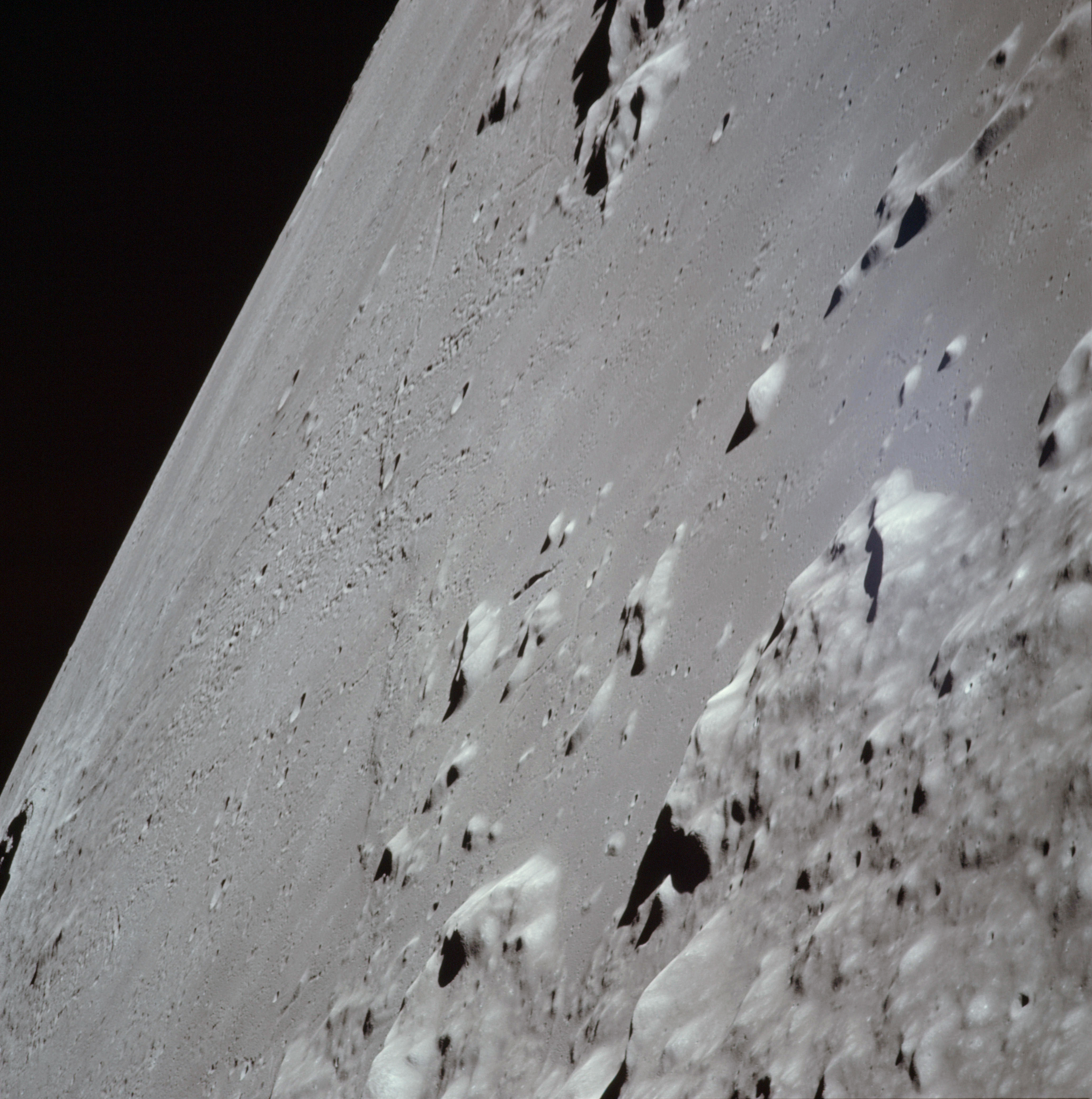
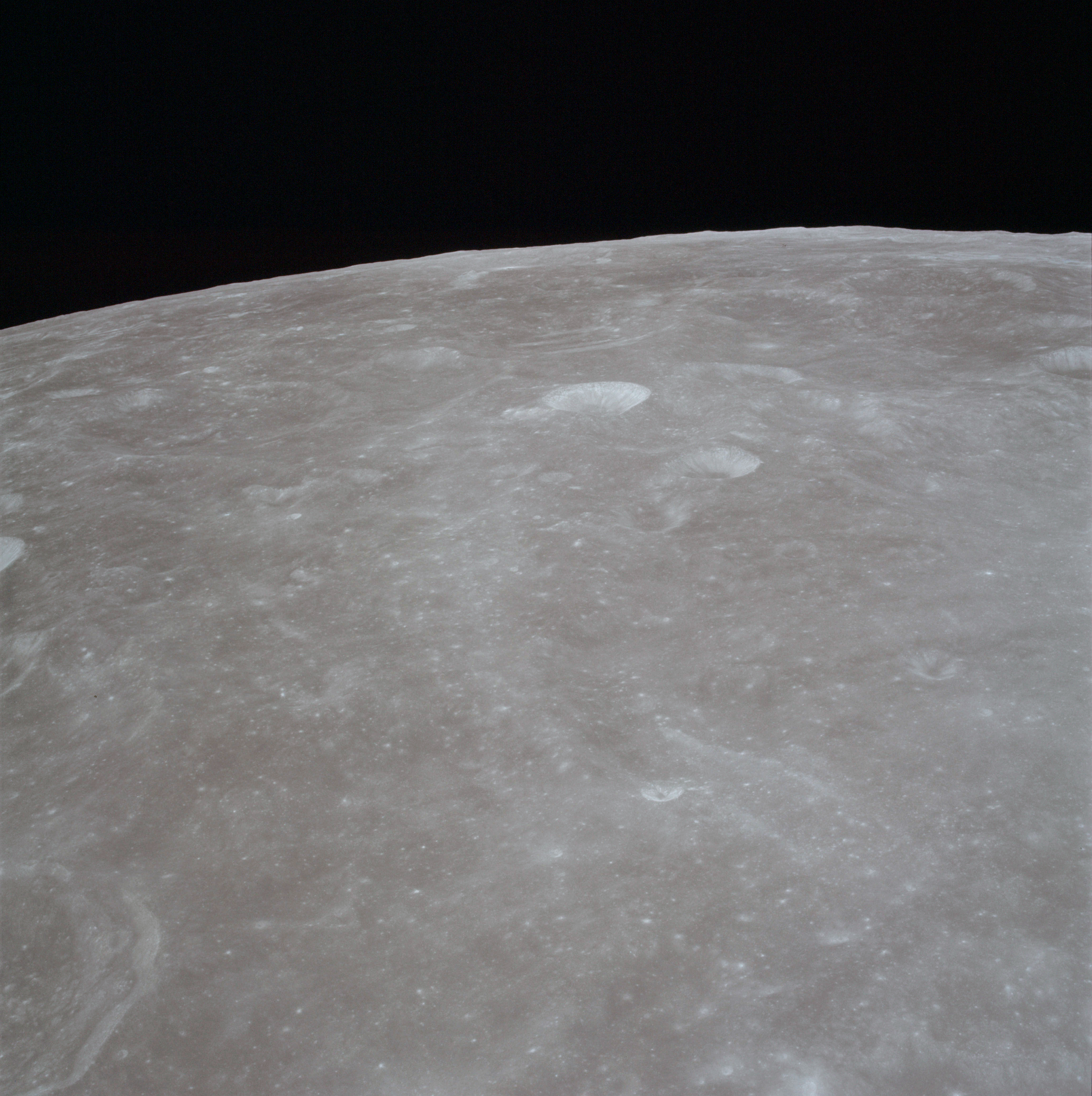
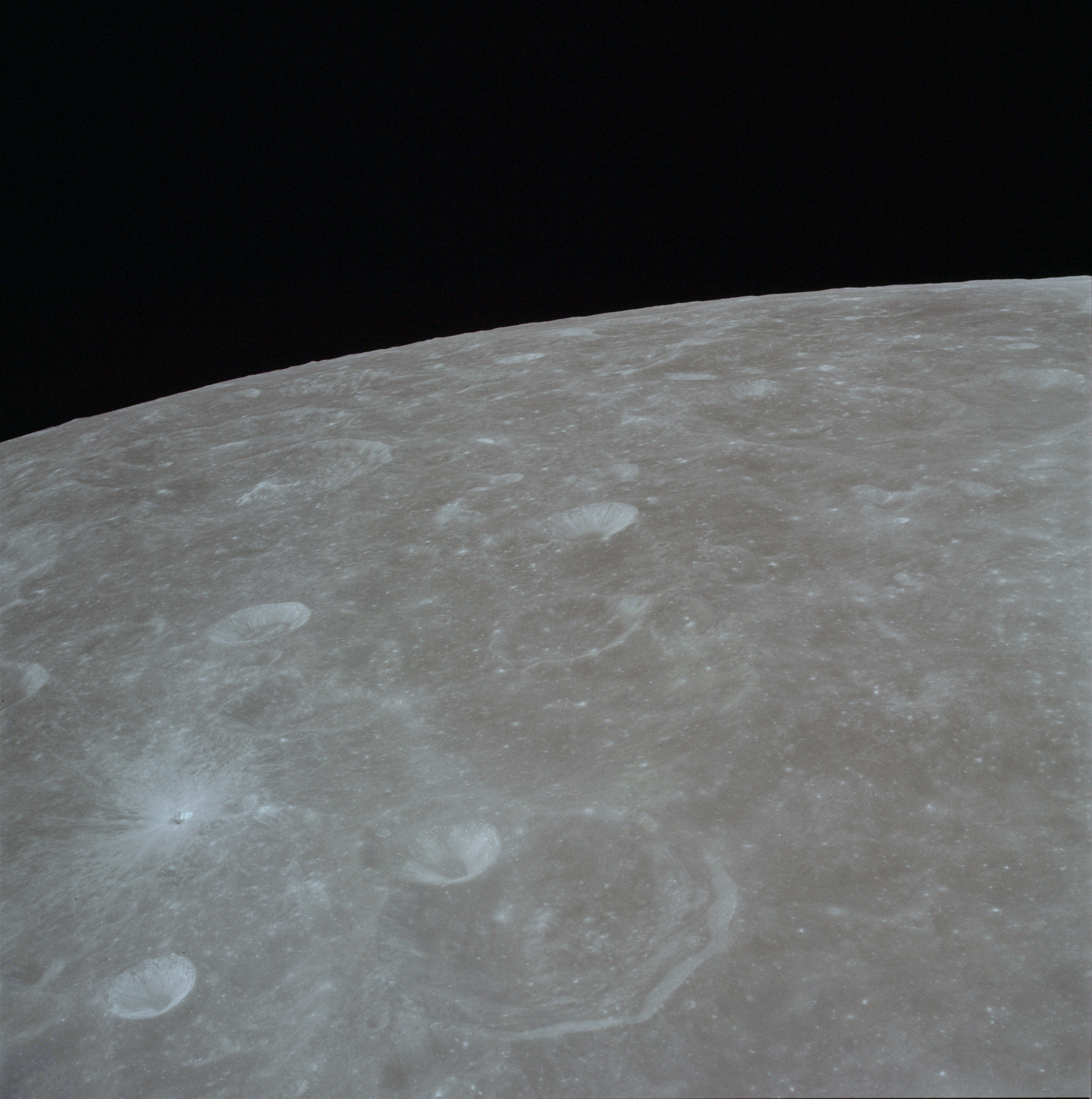
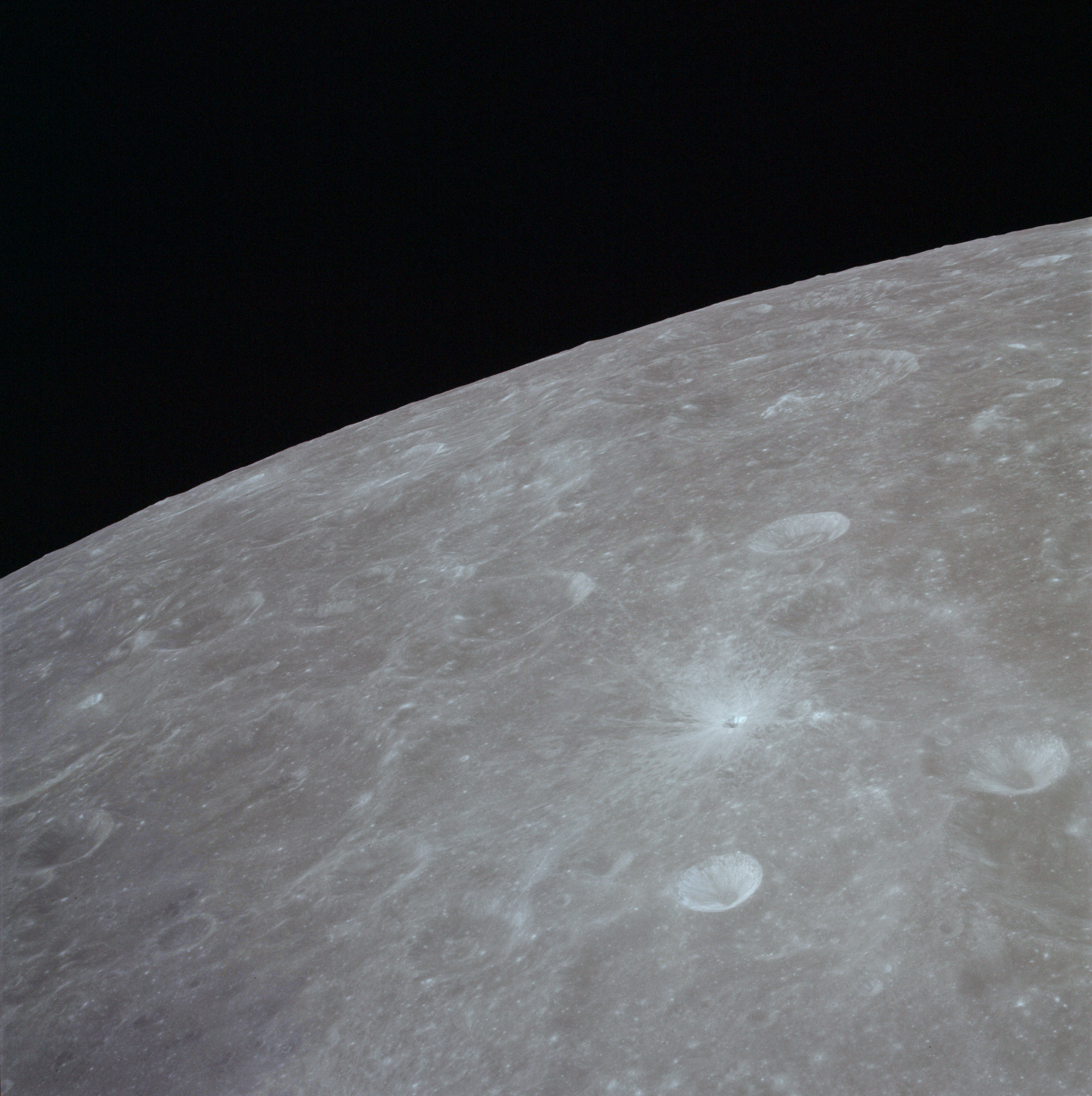
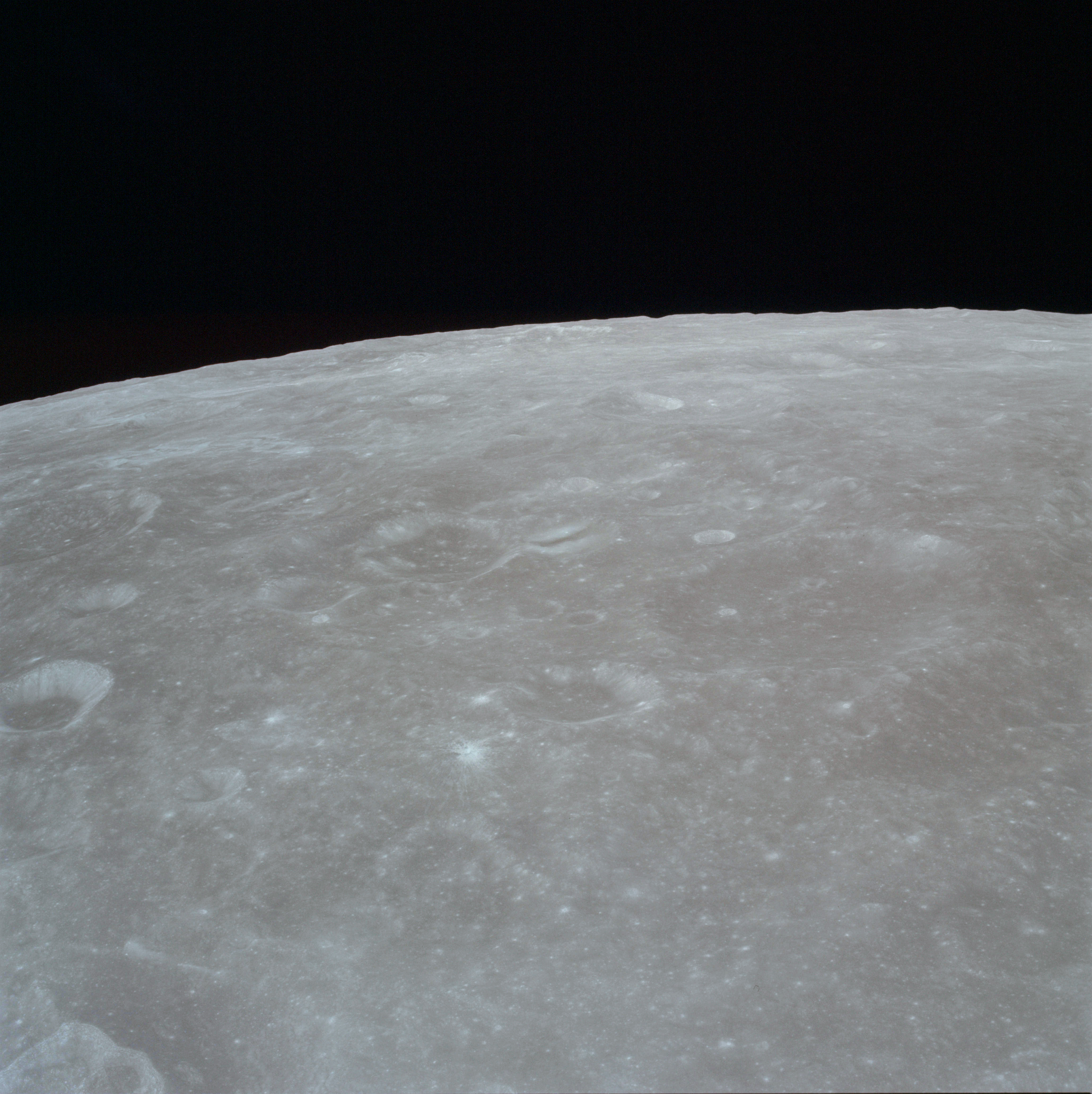
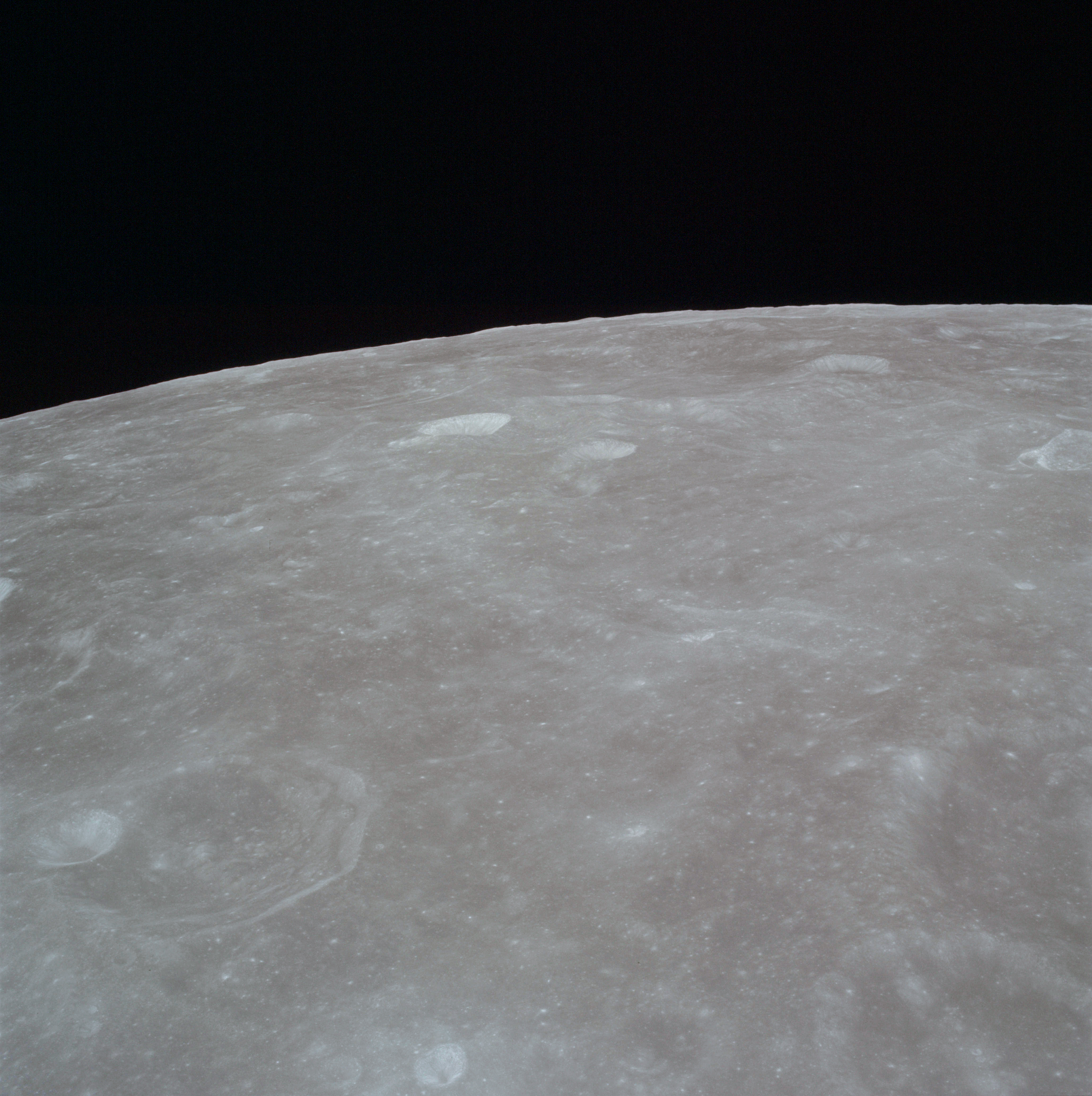
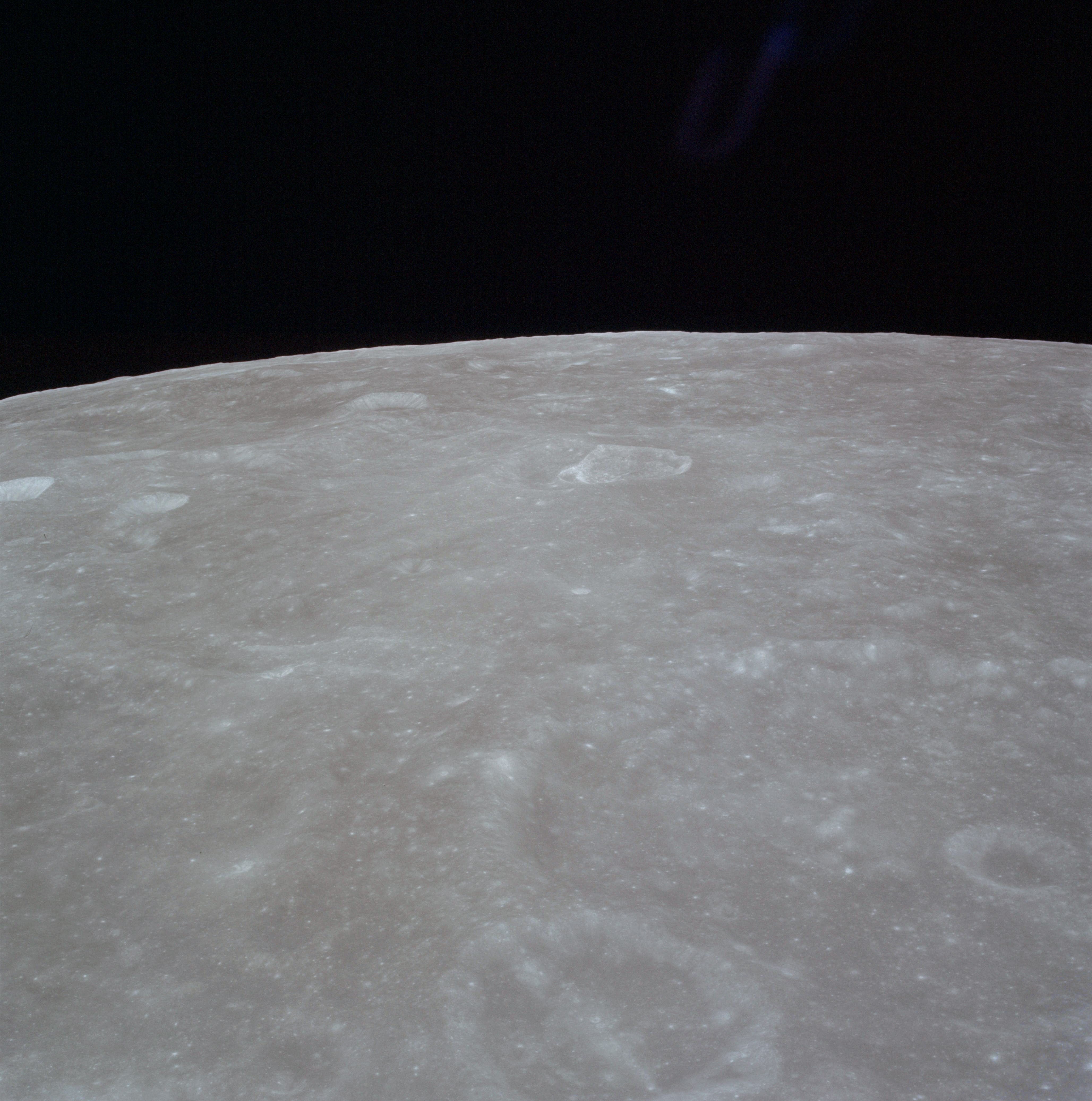
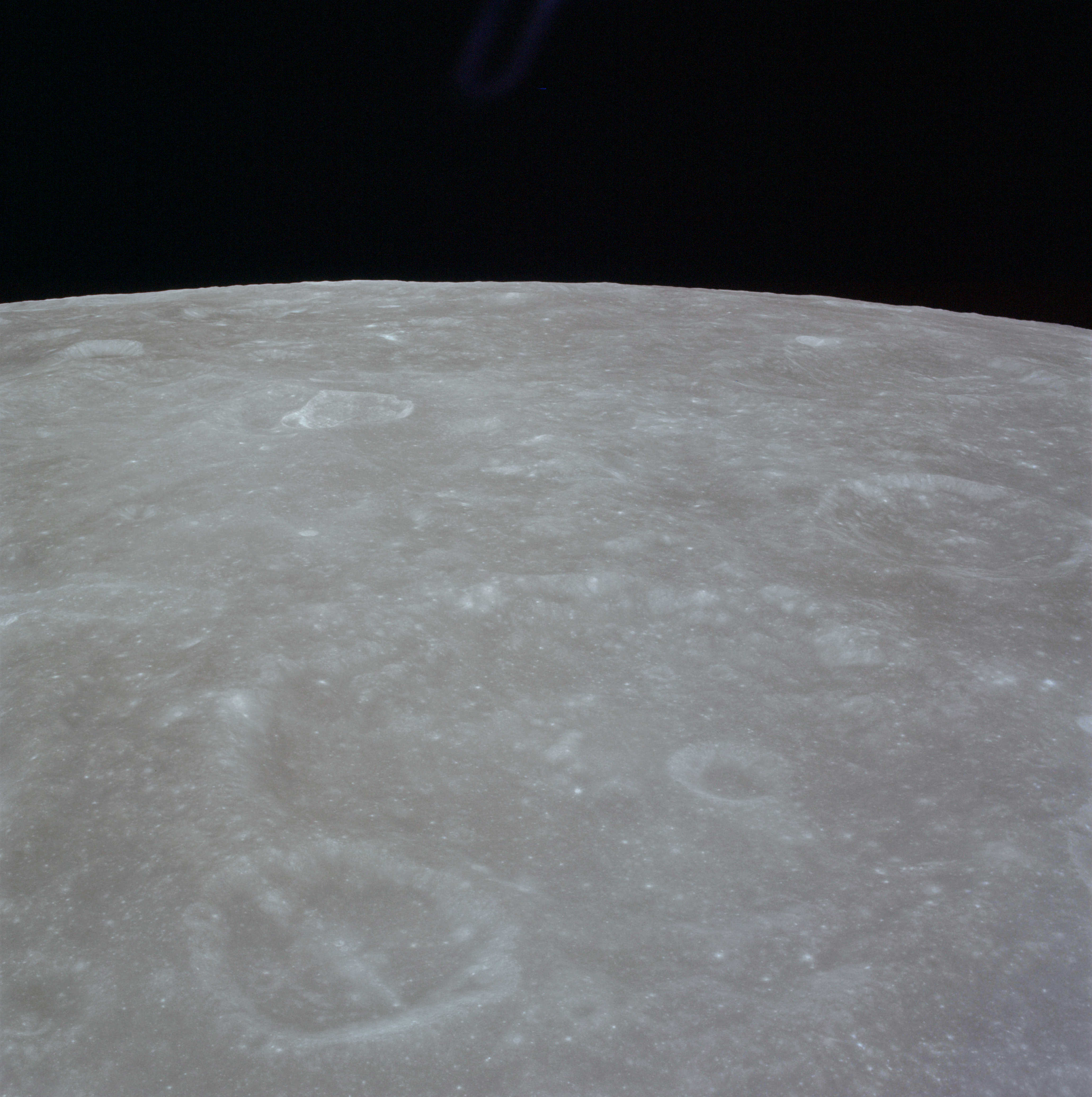
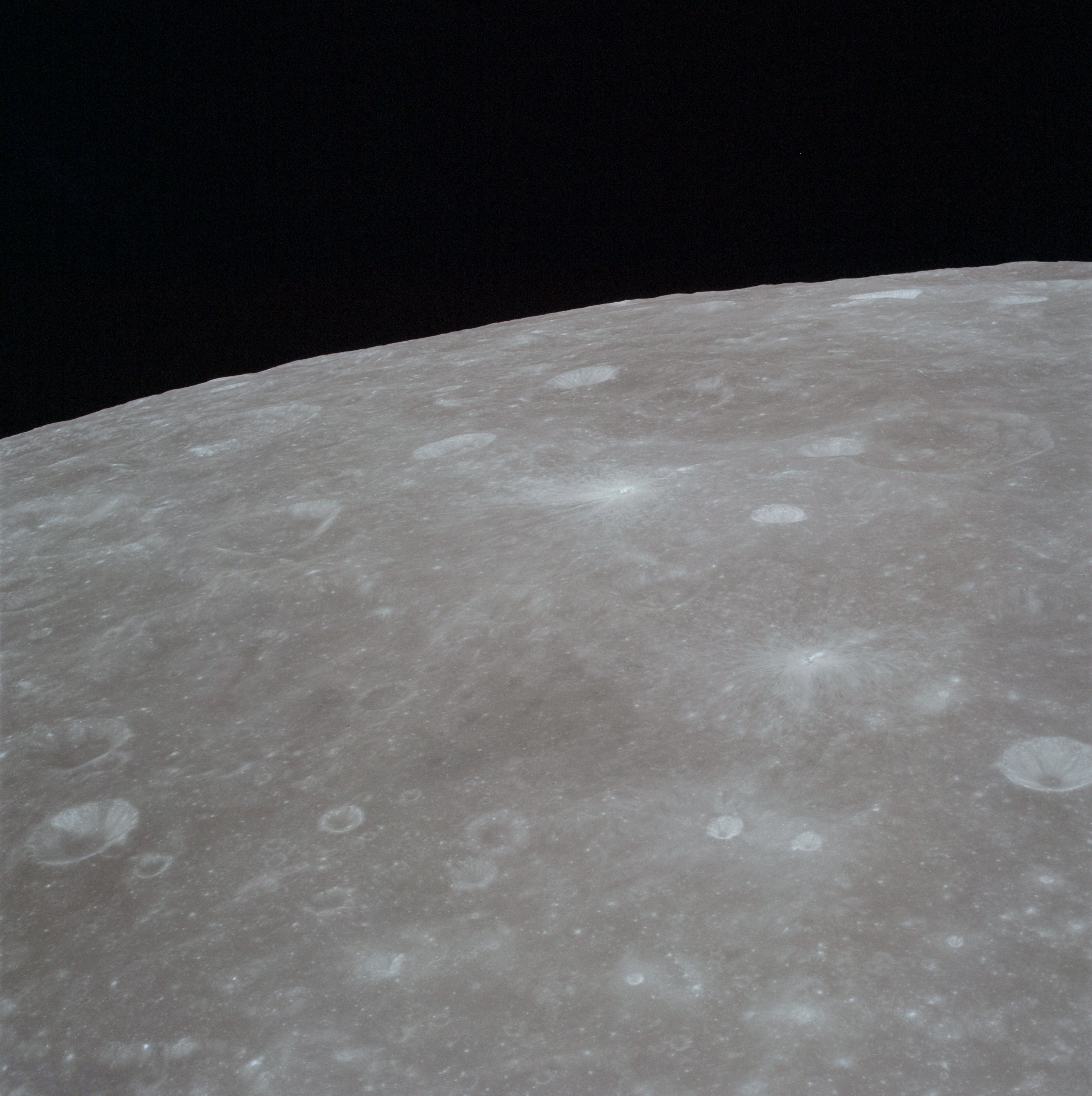
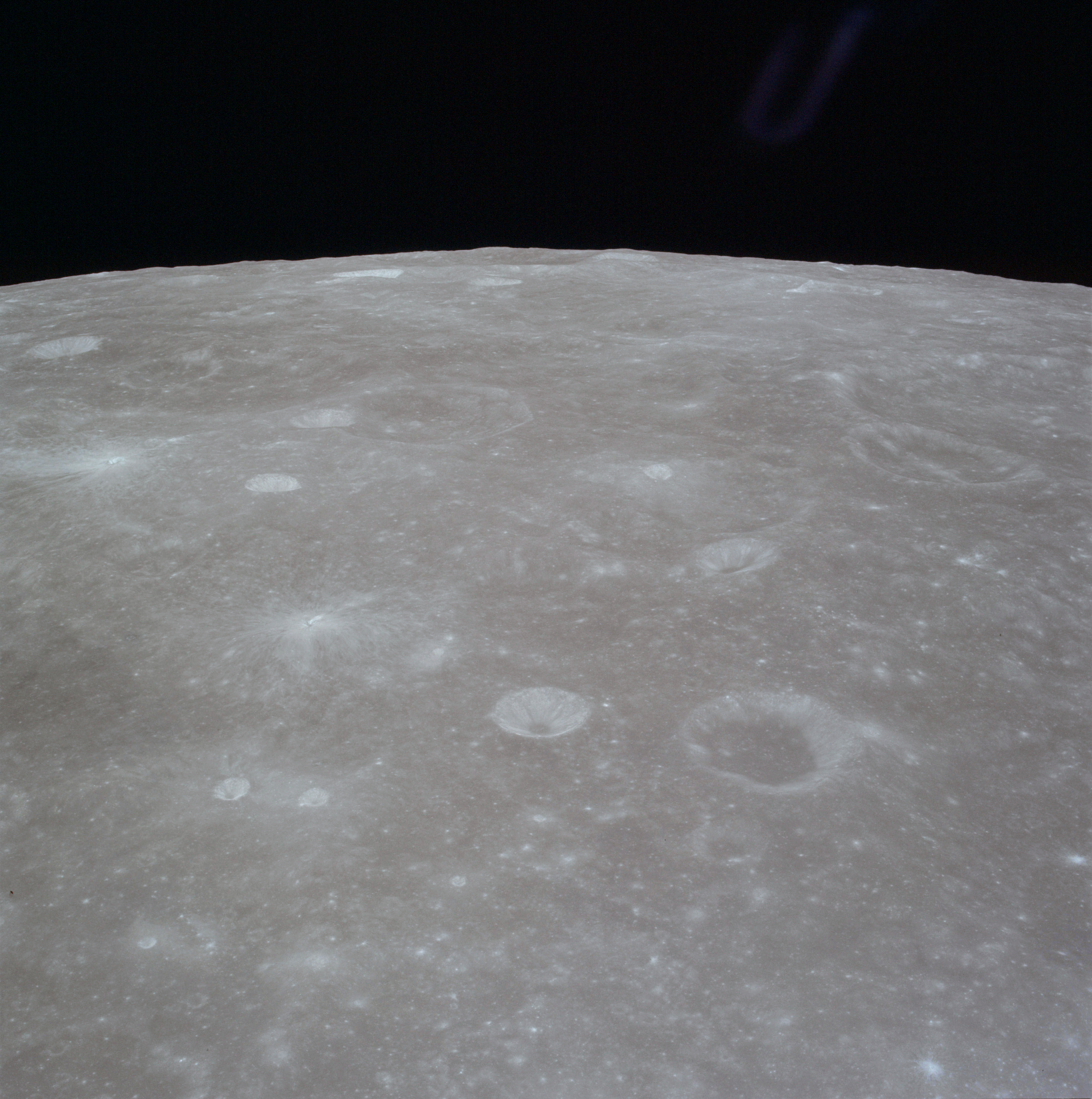
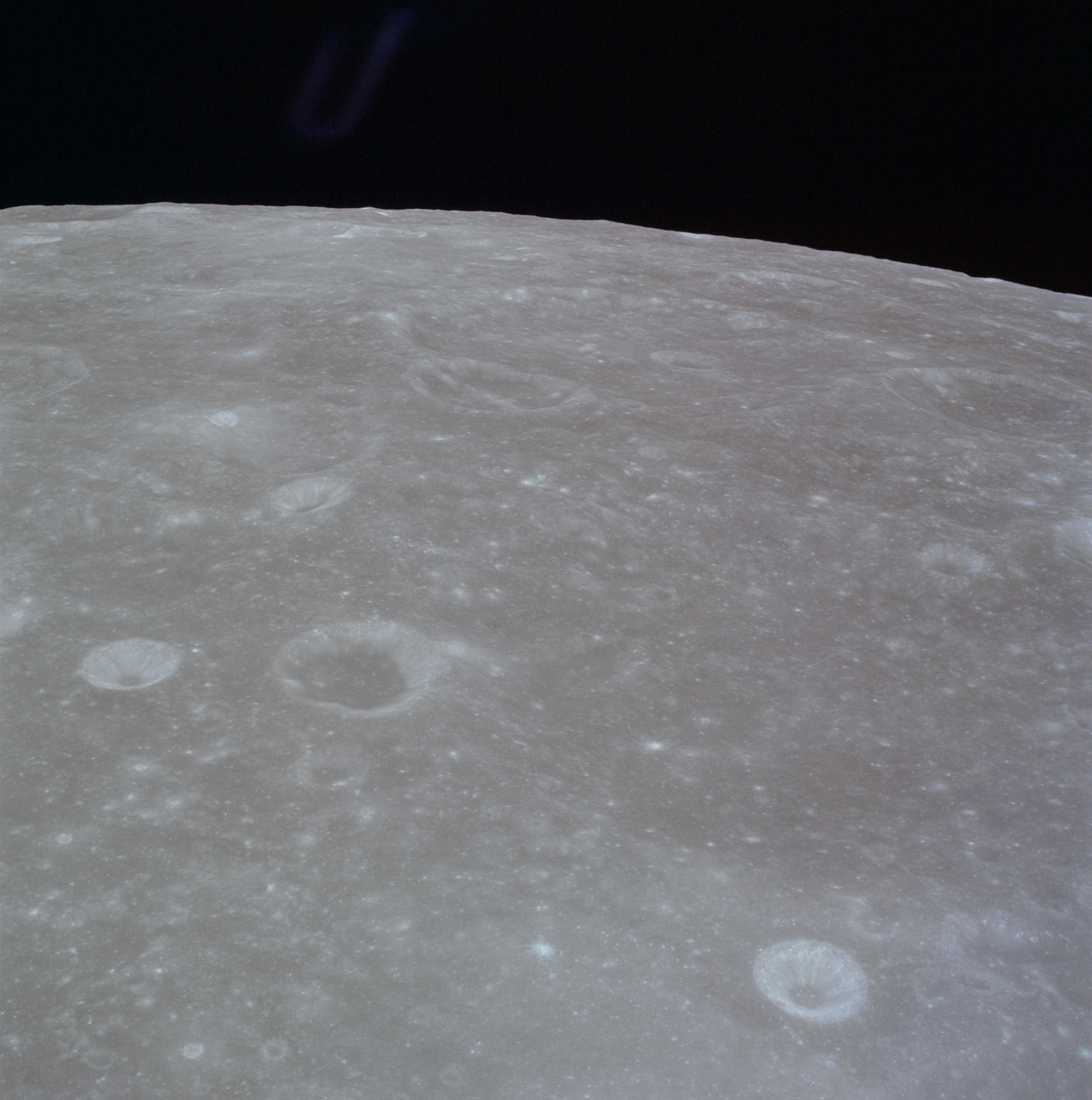
The surface crew of Apollo 17 are still in their rest period, but Command Module Pilot Ron Evans has been awake and busy for over five hours. Now into his spacecraft's 37th orbit of the Moon, he will soon appear around its eastern limb.
159:57:12 - This is Apollo Control at 159 hours, 57 minutes Ground Elapsed Time in the mission of Apollo 17. Less than a minute away now as the Command Module America, Ron Evans doing his orbital science task and orbital photography as he comes around on revolution number 37. Less than a half hour until the wake-up call is made to the crew of Challenger on the lunar surface. At that time we'll switch over to the Air/Ground-1 circuit and eavesdrop on the conversation between Cernan, Schmitt - Cernan and Schmitt and the CapCom here in Mission Control. We should have Acquisition of Signal from Command Module America. We'll come up with that line now.
159:59:21 Evans: Ah, I've got AOS with you. Okay. [Garble] Heaters Off. [Singing] [Pause.]
159:59:46 Fullerton: Hello, America. Are you there?
159:59:51 Evans: Okay. We got Reacq and Narrow now.
159:59:55 Fullerton: Okay. You're loud and clear. [Long pause.]
160:00:33 Fullerton: Ron, when it's convenient...
160:00:34 Evans: Okay. I finished up mag...
Fullerton: ...I have a couple of updates to the Flight Pl...
160:00:39 Evans: Okay. Go ahead.
160:00:42 Fullerton: Okay. On your present page, there - the UV solar atmosphere PAD, at 160:38.
160:00:52 Evans: Ah-ha. I have it.
160:00:56 Fullerton: Okay. It's T-start of 160:41:22; T-stop is 161:26:47. And remark that goes with that - you don't need to write this down - but the T-start time is biased 10 seconds prior to when we really think sunset will occur. If you see, visually - ah - Okay, my mistake that's - the time is 10 seconds after sunset, but if you see sunset visually, you can go ahead and proceed with the UV Cover, Open, as soon as you see it. But we'd like you to close the UV cover exactly on the T-stop time as written. Over. [Pause.]
160:01:58 Evans: Okay. Let's see. I'm with you. We'll make sure it gets closed at 61:26:47, but we can open it as soon as sunset comes, okay? Even though we haven't started pitching yet.
160:02:22 Fullerton: That's correct, and do you want to read back the...
160:02:25 Evans: Okay.
Fullerton: ...start time?
160:02:28 Evans: Well start time is 160:41:22. Is that correct?
160:02:33 Fullerton: That's correct; 41:22.
160:02:38 Evans: Okay.
160:02:41 Fullerton: Okay. Go to 161:34. [Pause.]
160:02:53 Evans: 161:34, okay.
160:02:57 Fullerton: Okay, and the old standard "Map Camera/Laser Altimeter Cover, Open:" cross that out. A couple lines below, at 36, cross out "Mapping Camera, Extend," and then turn the page.
160:03:15 Evans: I got them. [Pause.]
160:03:20 Fullerton: In fact, turn two pages to 163:31. [Pause.]
160:03:30 Evans: 31, okay.
160:03:31 Fullerton: At 163:31, write in "verify all command module VHF, Off." [Long pause.]
160:03:51 Evans: 63:31, verify all VHF, Off, okay?
160:03:55 Fullerton: Okay. That completes it.
160:00:00 Evans: Goody, I've got a zodiacal light coming up there sometime; [pause] blue filter, no less. Oh, I started to say, when I was coming across Aitken - Of course Aitken itself was down in the shadow, and the Sun was really shining on window 3. I took the first one f/5.6 and a 1/15, the second one 56, 5.6, I mean, at a - at a 1/30, and a third one at a 1/60, and then a fourth one at a 1/25, and the fifth and sixth ones I took off to the north - looking off to the north - out of window 4.
160:05:10 Fullerton: Okay.
160:05:12 Evans: And they were 5.6 at 1/125. I kind of doubt if - It might work, but there's sure a lot of glare on the window. If it can get through that glare, well then we've got it made.
160:07:10 Evans: Oh, the other thing I was going to tell you was that magazine Quebec Quebec - I finished that one on 114.
160:07:19 Fullerton: Okay.
160:07:20 Evans: On that pass there. [Pause.]
160:07:32 Evans: I don't know who took my water jug, but it's gone. [Long pause.]
160:08:16 Evans: Okay. Overboard drain is purged enough. I guess we'll turn that off. [Long pause.]
160:08:38 Evans: A big filter on here - here. I always leave the hose and everything disconnected and stick it back behind this rock bag. Afraid I'll kick it, break it off. You know - you know those rock bags. I unzip those and blow the air out of them every night, wake up the next morning, and they're full of air again; just like two big balloons down there. [Pause.]
160:09:09 Fullerton: How about that.
160:00:00 Evans: [Laughter, garble] [Pause.]
160:09:20 Fullerton: You can use one for the pillow you've been missing.
160:09:25 Evans: [Laughter] Yeah, that's an idea. You could use that. [Long pause.]
160:10:24 Evans: And, Houston; America. If FAO's got his finger on the next magazine - next Hasselblad mag, I'm going to use - save me looking it up, here.
160:14:09 Evans: Zero phase is going to go right over Proclus, I mean Picard this time. I'll see if that darkness disappears there, if I can still see the change in the color on it.
160:14:26 Fullerton: Okay, Ron. You can put the High Gain to Auto next chance you get and FAO advises there's no more optional film left on Mike Mike. Everything that's left on Mike Mike is scheduled up. Over.
160:14:44 Evans: Okay. I'll buy that.
160:14:53 Evans: You know you could even - as zero phase went right across Picard there, you could still see the - the darkness on the west - let's see east - on the east from 9 o'clock around to 6 o'clock, if north is zero.
160:15:10 Fullerton: Roger.
160:15:15 Evans: And [pause] if north is zero as you look at the crater, then over about 1 o'clock there's some kind of a fault area in the side of the rim, and that's another spot where the dark material drapes down into the rim and also out on the outer - outside - outside of the rim. And then you have that same type of impression. At about 11 o'clock, you've got a black streak going down inside the rim, and then it widens out going out toward a little crater out there on the outside of the rim.
160:16:03 Fullerton: Okay, you are scheduled...
160:16:05 Evans: Now, let's see...
Fullerton: ...to get a Verb 49 going now.
160:16:11 Evans: Thank you. [Long pause.]
160:16:39 Evans: Okay. Pitch is plus 12.0, [pause] 25 Enter, plus 341.00 Enter, [pause] and a plus Enter for 0 yaw 622. Press on. 50 18. CMC caged. Proceed. [Pause.]
160:17:18 Evans: Okay; let's see. We're in Auto, so we can [garble] teen. 26 on the dial.
160:18:34 Evans: Okay, we'll change 07 to 8 plus 9 [pause] 1 [pause] plus 75.
160:19:03 Evans: Vents Open.
160:19:11 Evans: [Garble] waste water dump. Must have been some stuff that's just frozen on the - the dump or something and then when the - when the jets fired too - that kicked it loose.
160:19:31 Fullerton: Roger. [Pause.]
160:19:36 Evans: Maybe that's the particles of combustion [pause] burning. [Long pause.]
160:20:11 Evans: Minus 0.05. [Pause.]
160:20:21 Evans: Degrees per - half a degree dead band. Point five up. [Long pause.]
160:21:04 Evans: Got zero, zero. Stay there and I'll try it.
160:23:13 Fullerton: Ron, this is Houston. Check Noun 79 again. We think you might have loaded R1 and R2 negative. That's the way it looked down here, anyway. [Pause.]
160:23:25 Evans: Okay, I'll check that.
Noun 79 relates to the tracking program, Program 20. There are two values. Register 1 has the rotation rate to be used in tracking, Register 2 sets the deadband.
160:24:02 - This is Apollo Control at 160 hours, 24 minutes. Switching now to Air/Ground-1 for the initial wake-up call to the crew of Challenger, asleep at this time at Taurus-Littrow. Command Module America still has some 47 minutes remaining in this frontside pass. We'll standby for the wake-up call which should be beamed up in about a half a minute or so.
The audio clips thus far have been taken from digitised recordings of the Public Affairs Office feed made at Johnson Space Center. This feed now follows the surface crew and the journal will therefore take its audio clips from a different source. These are digitised recordings of Ron's solo mission that were accessed from the National Archives and Records Administration (NARA). Unlike the JSC recordings, these seem to have been compiled by copying from one reel-to-reel machine to another to remove large quiet periods. The precise timing of the speech cannot be determined.
Evans: You know, I'm looking from this position back toward le Monnier - le Mon - le Monnier or whatever. Le Mon - le Monnier, and you can see the - well, it's hard viewing it, to see it here, but your - you can see the annulus around Serenitatis. The demarcation is about the diameter of le Monnier toward - westward from there and the demarcation of the color - the color from this observation, again, is a light tan. Darn. I forgot to get that color wheel out, but it's a darker tan than the tan of Serenitatis.
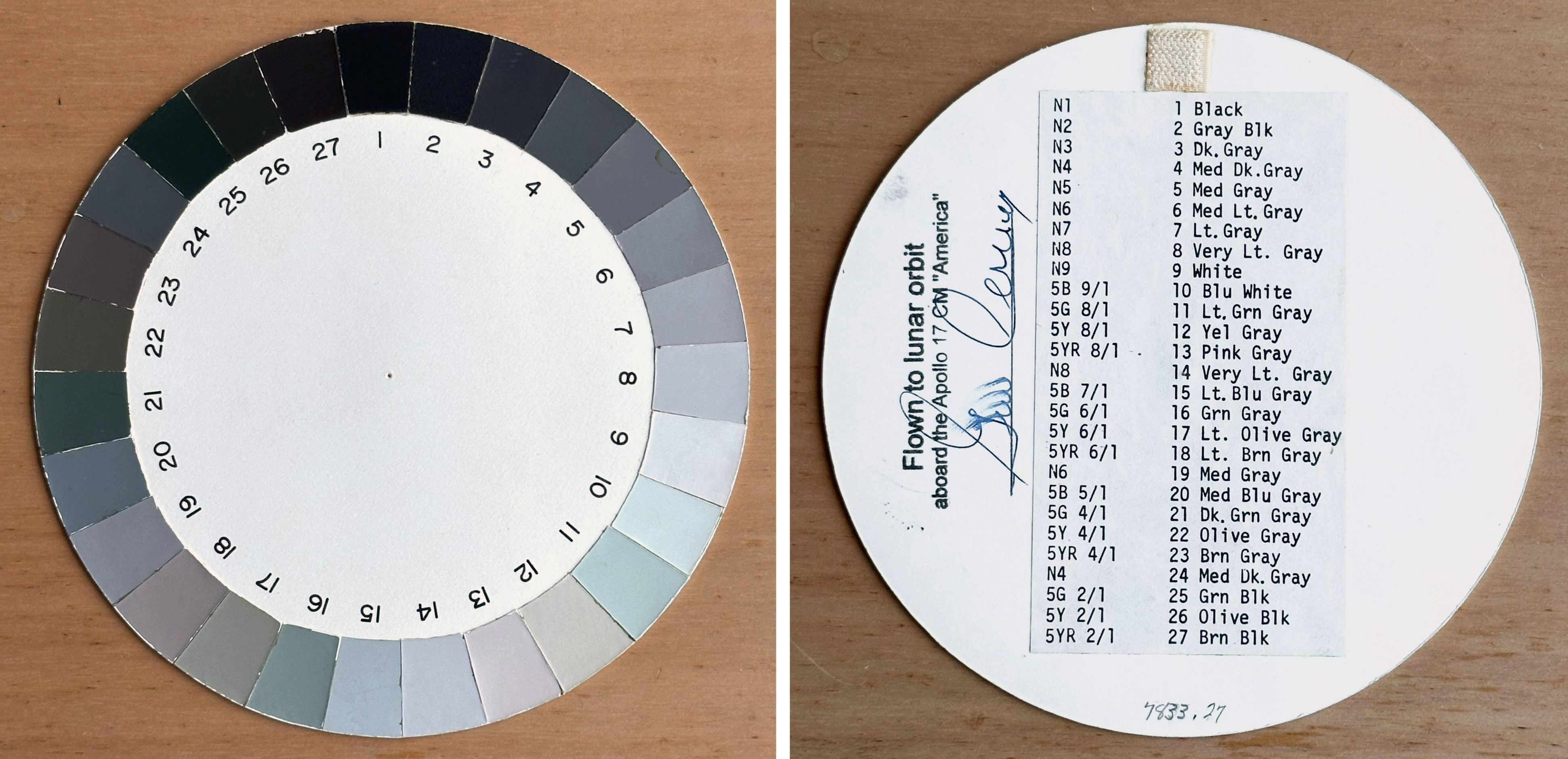
Ron has a circular chart with carefully chosen patches of grey and colour to help an observer describe what he is seeing more objectively.
The colour wheel flown aboard the CSM, front and back - Courtesy of Ulrich Lotzmann
Overmyer: Roger, Ron.
Evans: The color boundary is not associated with any rille or anything that I can see. Doesn't look like there's any topographic expression to it.
160:28:16 Overmyer: [You] might be interested, Ron. We just woke up the Challenger, and they're all doing fine.
Evans: Oh, hey, good, good. Sounds like Robert. Back on?
Overmyer: Yeah, they pressed me into service because they have - We woke up the Challenger and they needed somebody on that one, so I'm over here. Still cold...
Evans: Ah!
Overmyer:
Evans:
Overmyer: ...and cloudy.
Evans: [Laughter]
Overmyer: But we've got one blessing. It's not raining outside.
Evans: Ah, that's good anyhow. You know, even from here now I can still see that annulus around le Monnier, or le Monnier or whatever it is.
Overmyer: I'll buy that.
Evans: Pronounce those things for me, you know [laughter].
Overmyer: Are you saying that annulus extends out into Serenitatis, and you see some, kind of like, rings of le Monnier out there in Serenitatis like that?
Evans: No, they aren't rings there - they're just a - it's a diameter that extends into Serenitatis about the diameter of le Monnier.
160:29:36 Overmyer: Okay. We copy that.
Evans: And even from this distance. You know, I'm almost to the western edge of Crisium, looking back across there, and even from this distance, you can still see the - the color boundary between the two and as far - It goes up north by Posidonius, and then it kind of blends in and it will look - as far as I can tell anyhow. Going from Posidonius on around to the north side of Serenitatis. Of course, it's a long ways away, and I really can't see, but I couldn't tell a definite demarcation. It just kind of blended in from the tan to - to the dark tan.
Overmyer: Oh, Roger.
Evans: Yeah. Bessel is the one crater that really shows up out there. It's the biggest one in the - in the Mare Serenitatis, and it's also the one that has that ejecta pattern - a fresh pattern ejeeta pattern around it and that really shows up in the - in the shallow Sun as you're looking back towards the Sun.
Overmyer: Roger. Roger.
Evans: And this is the first time now, looking back toward the Sun where I've been able to see that ray from - That's supposed to be a Tycho ray isn't it - going right across Bessel in the north-south direction?
Evans: Here's 50 18. Let's see. What are we supposed to be doing here?
Evans: Get this squared away. Bright - coming in the window here, I can't see my DSKY. The old GDC - Well, this could [?] be 20 going first. Enter 2-2 - Enter - We use option...
Overmyer: Ron, if you'll stand by with us, we're going to have a roll maneuver here real quick for you, so we get the Mapping Camera out of the Sun.
Evans: Oh, okay. Which way?
Overmyer: Roger, Ron. We want a 360 - We want a 360-degree roll, 360 roll, 360, or 000; your choice.
Overmyer's wording is unclear here. It could be interpreted to mean that Ron should have the CSM make a single complete rotation around its roll, or X-axis. He will quickly correct himself. Nevertheless, Ron seems to have properly deduced the intention, that he should roll 19 degrees, from 341 to 360.
Evans: Okay. That's only 20 degrees.
Overmyer: Yeah, I didn't mean a 360 roll. Just roll to 360.
Evans: Yeah, that's right. That's what I assumed.
Overmyer: Fifteen degrees to go. Will that hack it?
Evans: How's that? Got me in the clear?
Overmyer: Ron, looks good. As soon as the Sun goes down, you can roll back to 341, as required.
Evans: Okay.
160:35:01 Evans: There's my Noun 78's are 90 - plus 90 minus 19.74. Maybe it doesn't make any difference.
Overmyer: Rog. I'm looking at them, Ron, and...
Evans: Okay; that's minus 05, plus 50. Okay?
Overmyer: Got it.
Evans: 50 41 22.00. Looks good.
Overmyer: Yeah, right on the money.
Overmyer: Hey, Ron, did you kill P20 when you grabbed the stick that time?
Evans: Ah. I don't know. I don't think so. Tell you what I'm going to do. As soon as the Sun goes down, I'll roll back to all my error needles, recall P20.
Overmyer: Ron, they're saying that when we - when you roll back to 341, you'll have to restart P20.
160:43:29 Overmyer: Just of interest to you, Ron. We are really pleased with the way that our visual display and that worked out last night during the orbital science visual. Farouk was able to feed me the questions, and I was able to get them to you. If you have any comments one way or another, if you don't want us to do it on rev 40 or not, let us know. We plan right now on rev 40 for those orbital science visuals to do the same thing going - It's the visuals through landing site down through D-Caldera, and we're going to run the same operation, since it went so smoothly down here. We hope it went that way for you up there.
Evans: It sure did. As a matter of fact, I like it very much. That kind of clues me on what to look for as you're going through, because you see so many things down there - that you - that you kind of - I do anyhow, I have a tendency to forget what the main thing that you're trying to look for is.
160:44:27 Overmyer: Good show. We're prepared to do it on this next rev, and I guess you might say even though it isn't that way in the Flight Plan, we'll probably just stand by right straight through on rev 40 where you - you pick up at the landing site and go right through D-Caldera. We'll be just standing by for that whole rev - that rev - whole piece - about 12 minutes, or so.
160:57:47 Overmyer: Ron, just a little information for you. One of those highlights of your day. When you come around AOS on this next pass, they'll be - White Sands will be standing by in a countdown on an Aero - Aerobee rocket for a UV calibration shot, and if that one doesn't go, they've got one for tomorrow, same way.
161:10:36 Overmyer: Ron, we're about ready to lose you, and at 161:30 you have a maneuver. We want to make sure that gets started on time because of Sun problems on the camera.
Evans: At 161:30. Okay.
Overmyer: Yeah, it's just a matter of doing it on time...
Evans: Okay. We'll do that.
Overmyer: ...or else we'll have Sun problems.
161:10:59 Evans: Okay.
Overmyer: And it's because the camera's out of shade.
Evans: I tell you what. I'll start that.
Evans: Yeah, I'll start that as soon as I get the clev - cover closed on T-stop. That will give us a minute or so there, too.
Overmyer: That would be real fine, Ron.
Overmyer: Okay. We've got the DSE running, Ron, as per the Flight Plan.
Evans: Okay.
Evans (onboard): [Humming and singing]
161:21:27 Evans (onboard): What kind of goodies do we have in here today? Punch. Orange-pineapple drink. That's [garble] Got a piece of Velcro on it this time. [Singing]
161:23:40 Evans (onboard): That zero-g works just like in one-g. You've got to shake these things to mix it - just shake it back and forth. Makes more little bubbles that way.
161:24:29 Evans (onboard): Find my cheese spread.
161:26:55 Evans (onboard): [Garble] UV Covers are Open - I mean, Closed. There! Just made it [laughter]. Okay.
161:30:XX Begin Lunar Rev 38
161:34:22 Evans (onboard): You look beyond Jabber [cough] u-n-i-a-n, there whatever it is. Looking into the Sun, now, and it's completely pockmarked. It's a plains-type of material though. And I guess so - You'd call it a plains-type material, or it's lighter - it's a lighter albedo than - for instance, the Mare Serenitatis or Crisium, or this type thing. It's a lighter - lighter tan. Well, as a matter of fact, the whole thing looks tan here in this type of the Sun angle. And when you get up a little bit higher, the Sun angle - it kind of changes to almost a bright - a bright tan.
Evans (onboard): 01 - a 01111. Six, seven.
Evans (onboard): Oh, get P20 going. It's time to eat. Ten - 25 - [Singing]
Evans (onboard): The serial number of the bread - a bit of irradiated ham. [Singing] Man, I've got a little urine stuff on my window over here. One or a cheese [garble]. Something like that.
161:41:10 Evans (onboard): There's Agassiz. It's a little more - little more subdued than Aitken. It means it's probably a little bit older - older crater. There's a scarp going through there. I can't tell - oh, no. It's going to be a rille. It's coming from the highlands, off toward the little crater on the south side of it. And that - well - it starts out as a rille and then looks like it turns into a wrinkle ridge. And at one point, I thought it went up the sides and into that little bitty crater. But now, I can't tell for sure if it does or not. I don't think it really does, although it continues on across to the south of that - to that small crater. And now you can see an indication of it going up the side of that crater, too. There's a small crater just to the south of Agassiz. It's on the rim of Agassiz. But it doesn't lay a mare-type flow or wrinkle ridge around the thing or maybe those are - it's a flow front going up across there.
161:42:31 Evans (onboard): But I think that small crater in - No, no, I've got to figure out a unit of deposition. The wrinkle ridge in the scarp goes through the crater floor. It also goes through the crater to the south of Agassiz.
Evans (onboard): Wonder where my map is?
Evans (onboard): [Garble] and I missed that one. Let me - Gosh, there's Tycho. Holy mackerel, you can really see that flow. I got to - load camera.
Evans (onboard): Okay, that's frame number 106 and 107 on magazine Oscar Oscar. And it's a flow that is definitely - it comes back to the north of Tsiolkovsky. I said Tycho while ago. I can see Tsiolkovsky because to the north of Tsiolkovsky flowing down the inner crater, and that's the same type of material that's on top of - Well, I'll be darn - It's the same type of material, looks like it's on the floor, and also it's been sloughed down in the crater, before the deposition of the flood itself. In other words, it's...
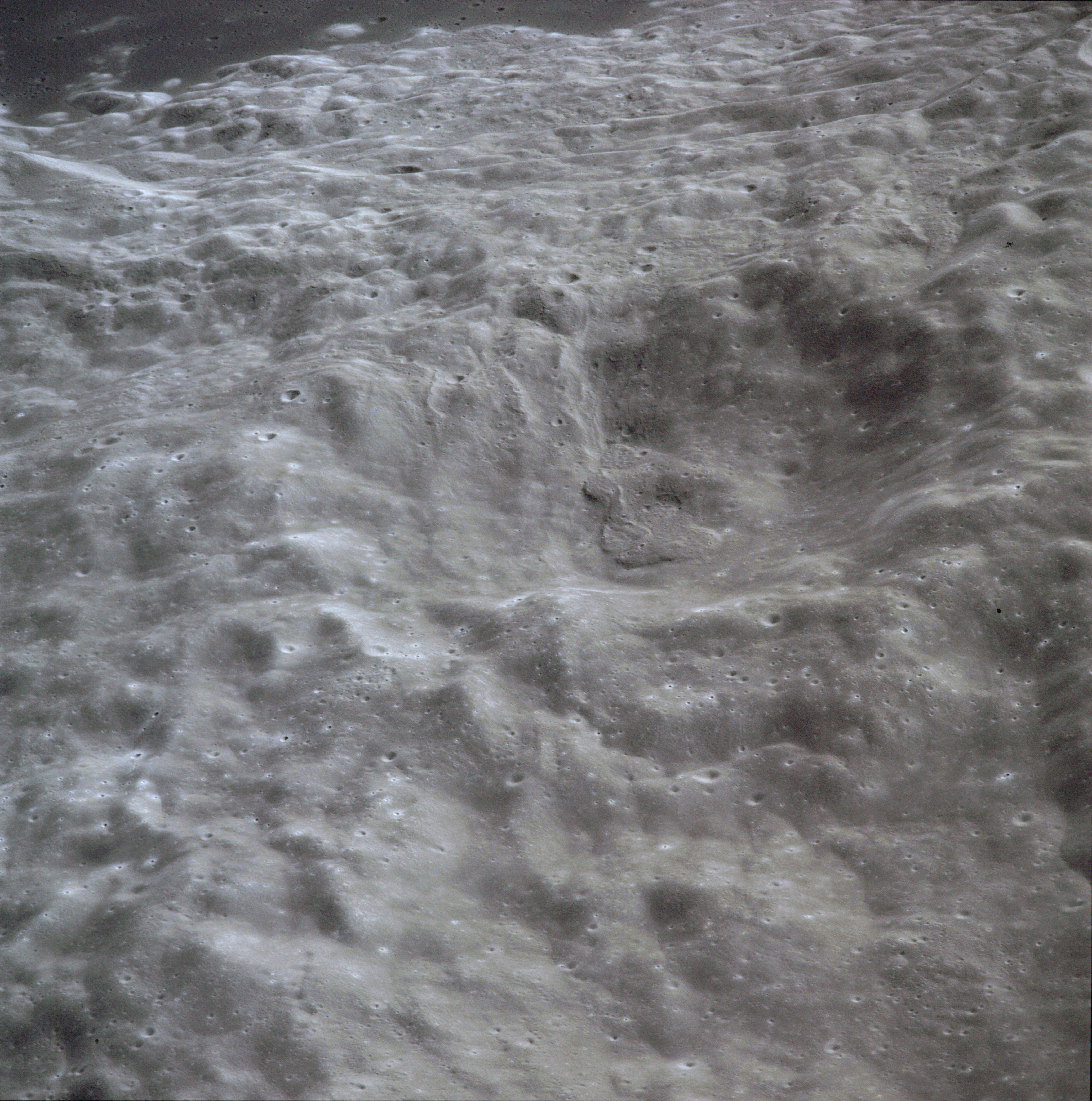
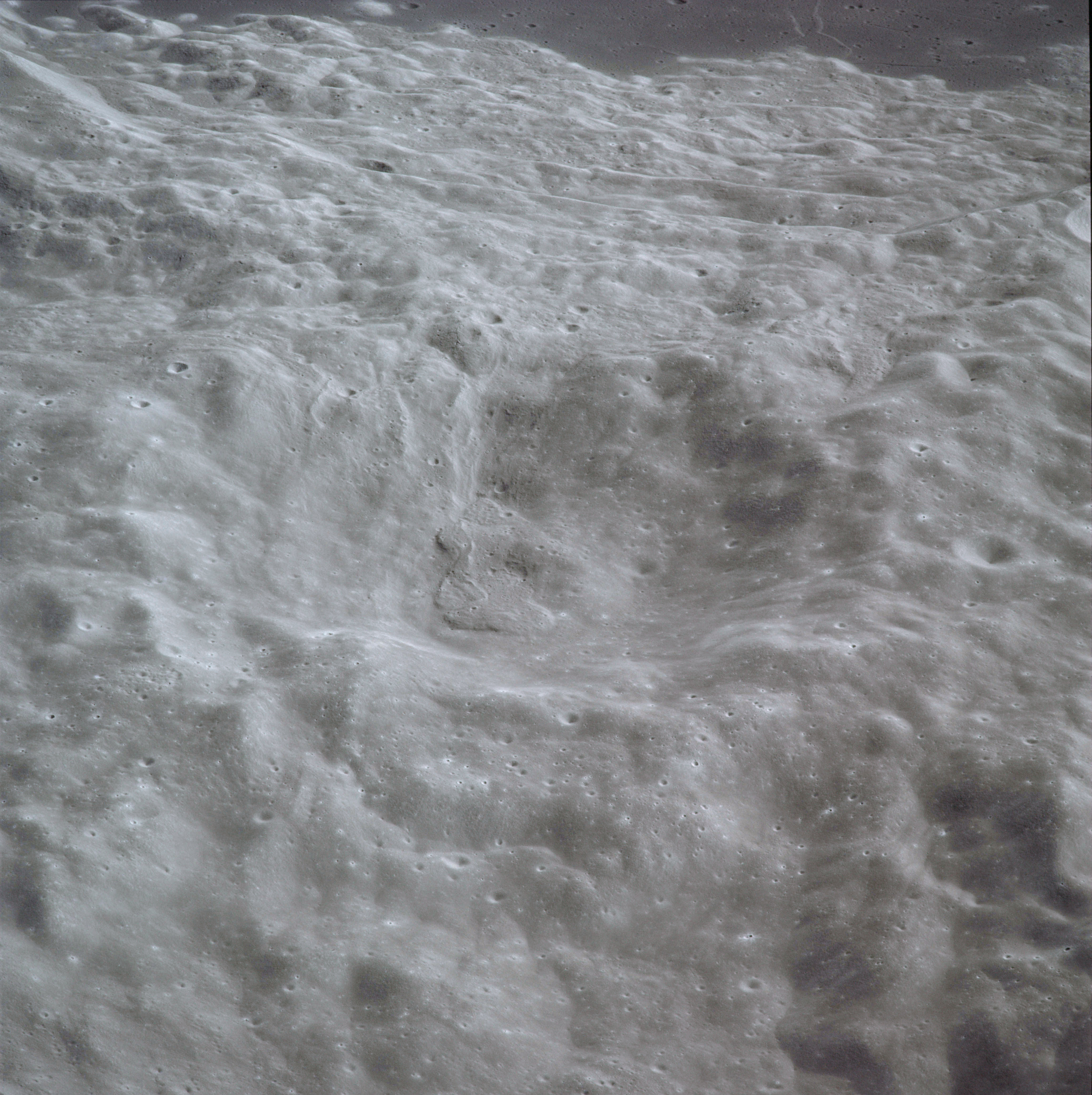
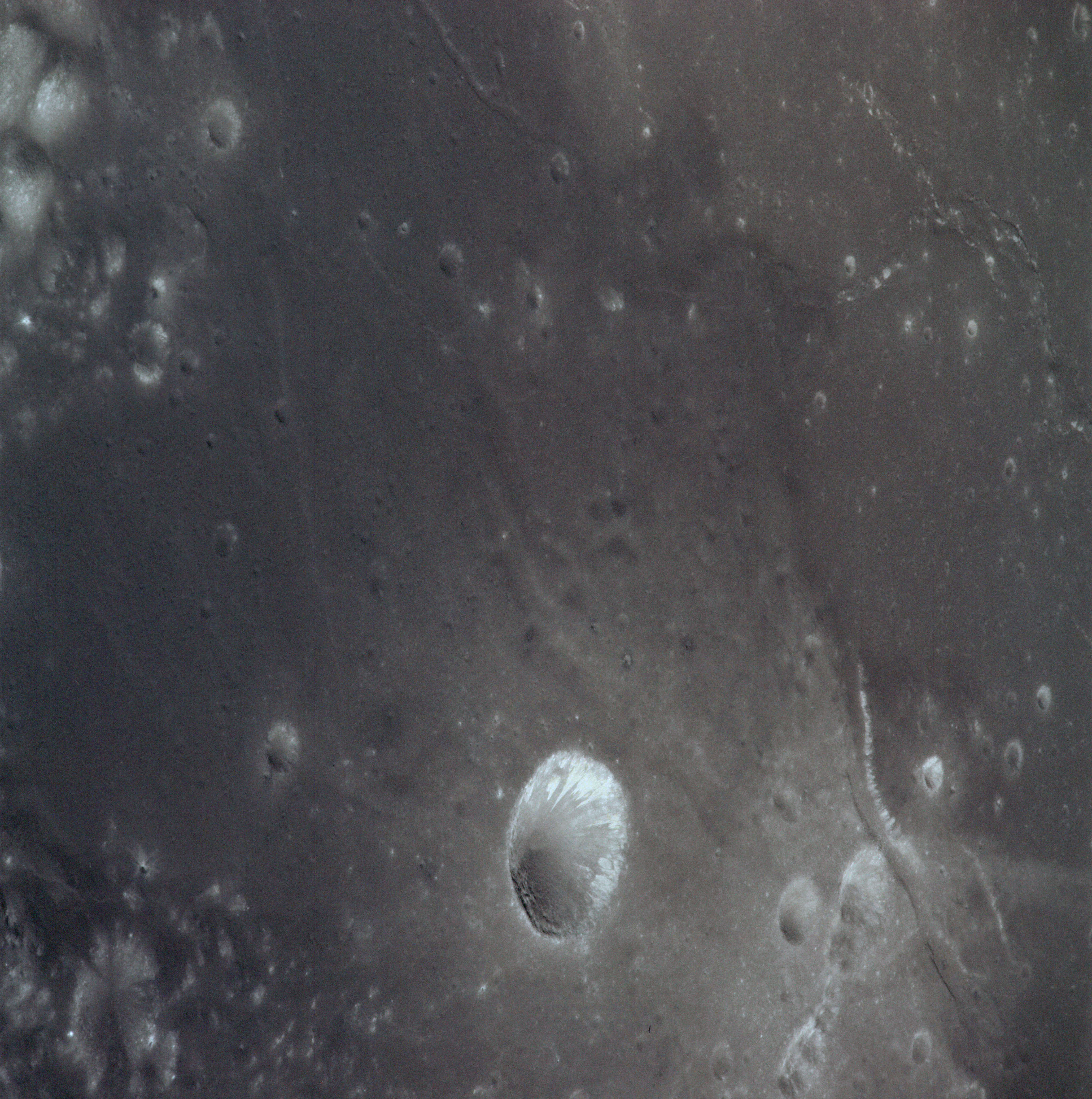
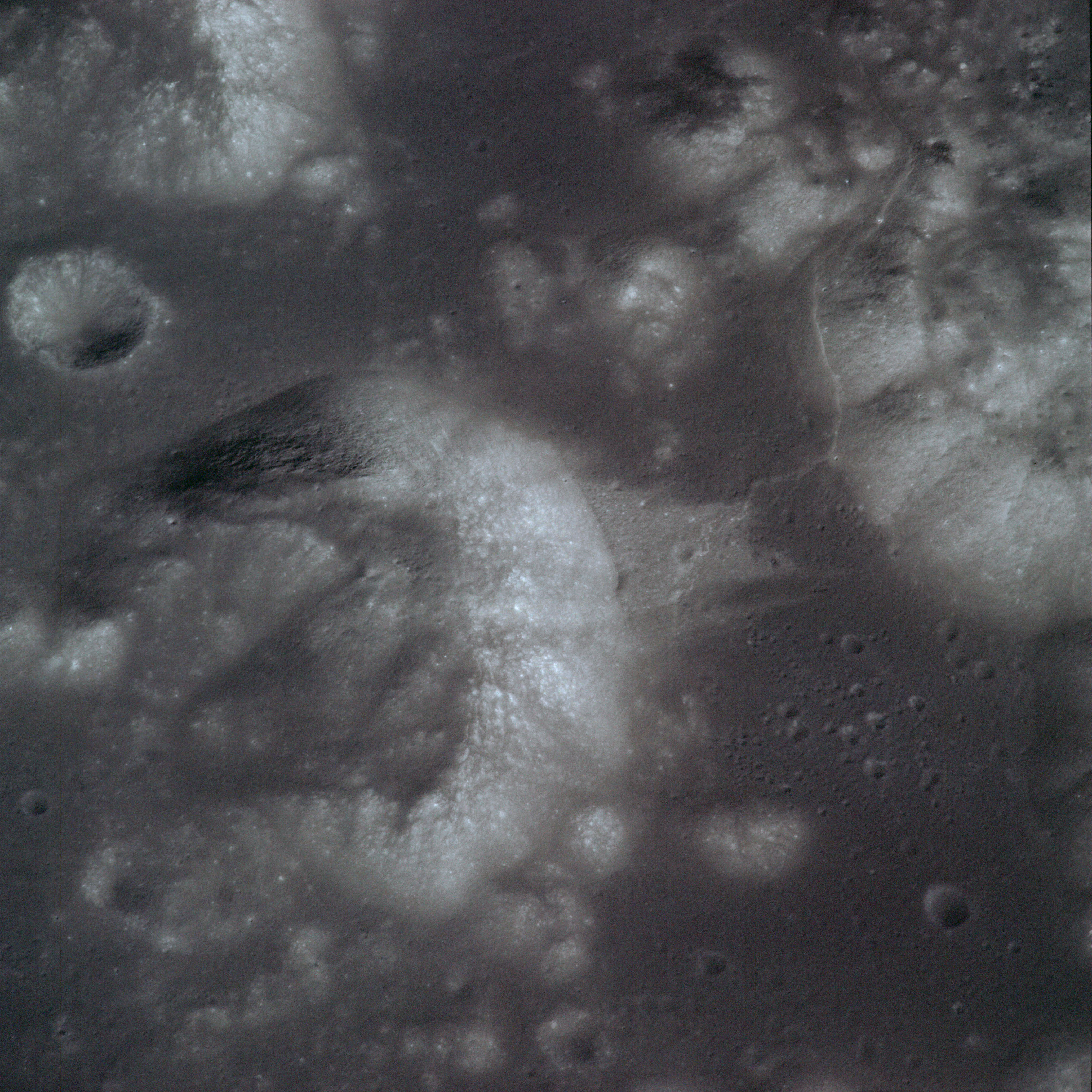
The frames Ron has taken are AS17-151-23212 and 23213 magazine OO and are of Patsaev Q, a 33-km crater outside the northeast rim of Tsiolkovsky. The crater has a large lobate flow feature, now named Kira.
AS17-151-23212 - Crater Patsaev Q and lobate feature, Kira - Image by NASA/Johnson Space Center.
AS17-151-23213 - Crater Patsaev Q and lobate feature, Kira - Image by NASA/Johnson Space Center.
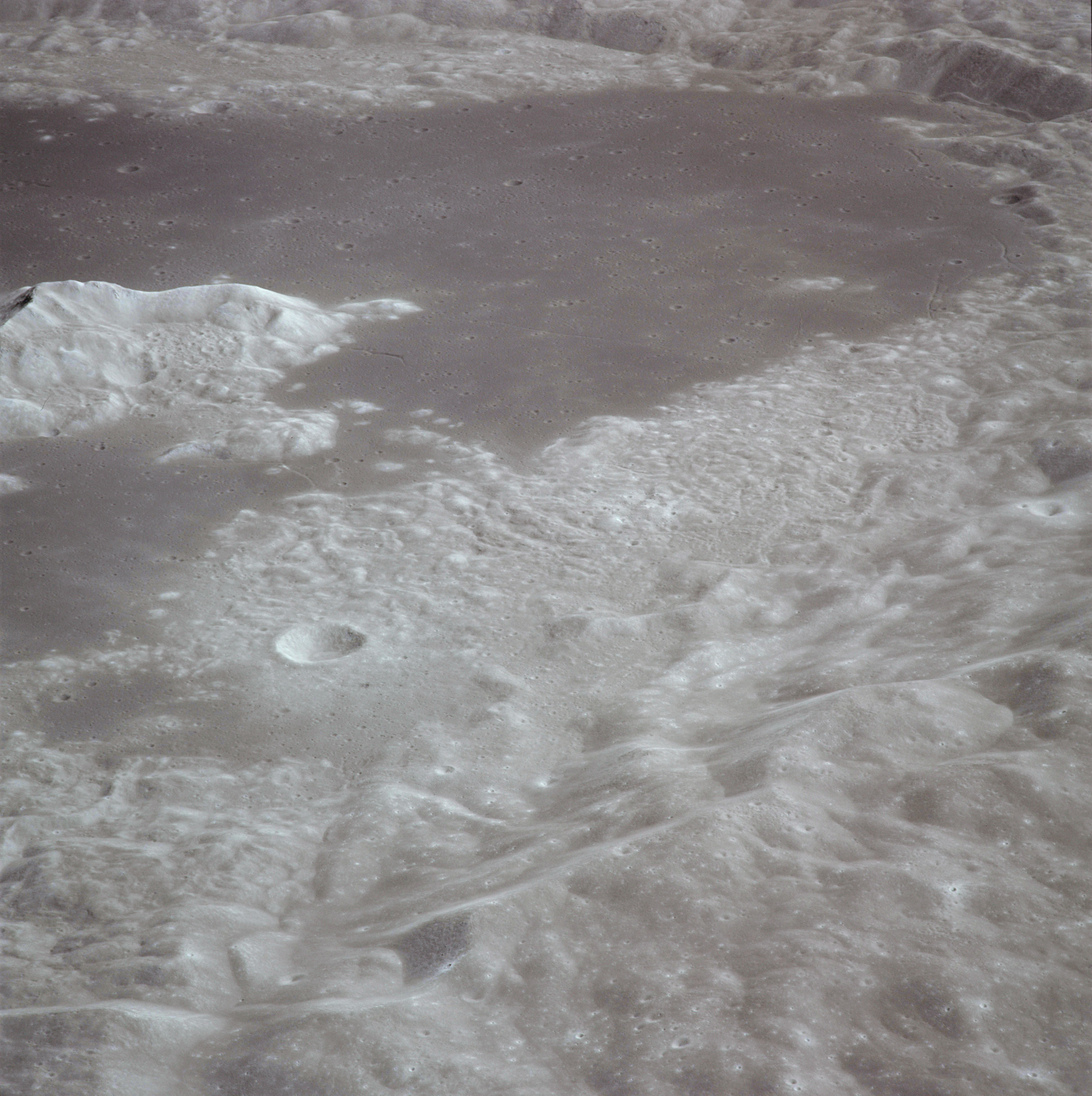
161:46:16 Evans (onboard): You just got to say it's a lava flow - tell by the material [garble]. It's got flow lines in it. It has lobate flow fronts sticking out on it, and up on the top of the crater rim, in the northeast corner - This is picture number 108, mag Oscar Oscar of the wrinkly, crackly floor of Tsiolkovsky. That's very interesting.
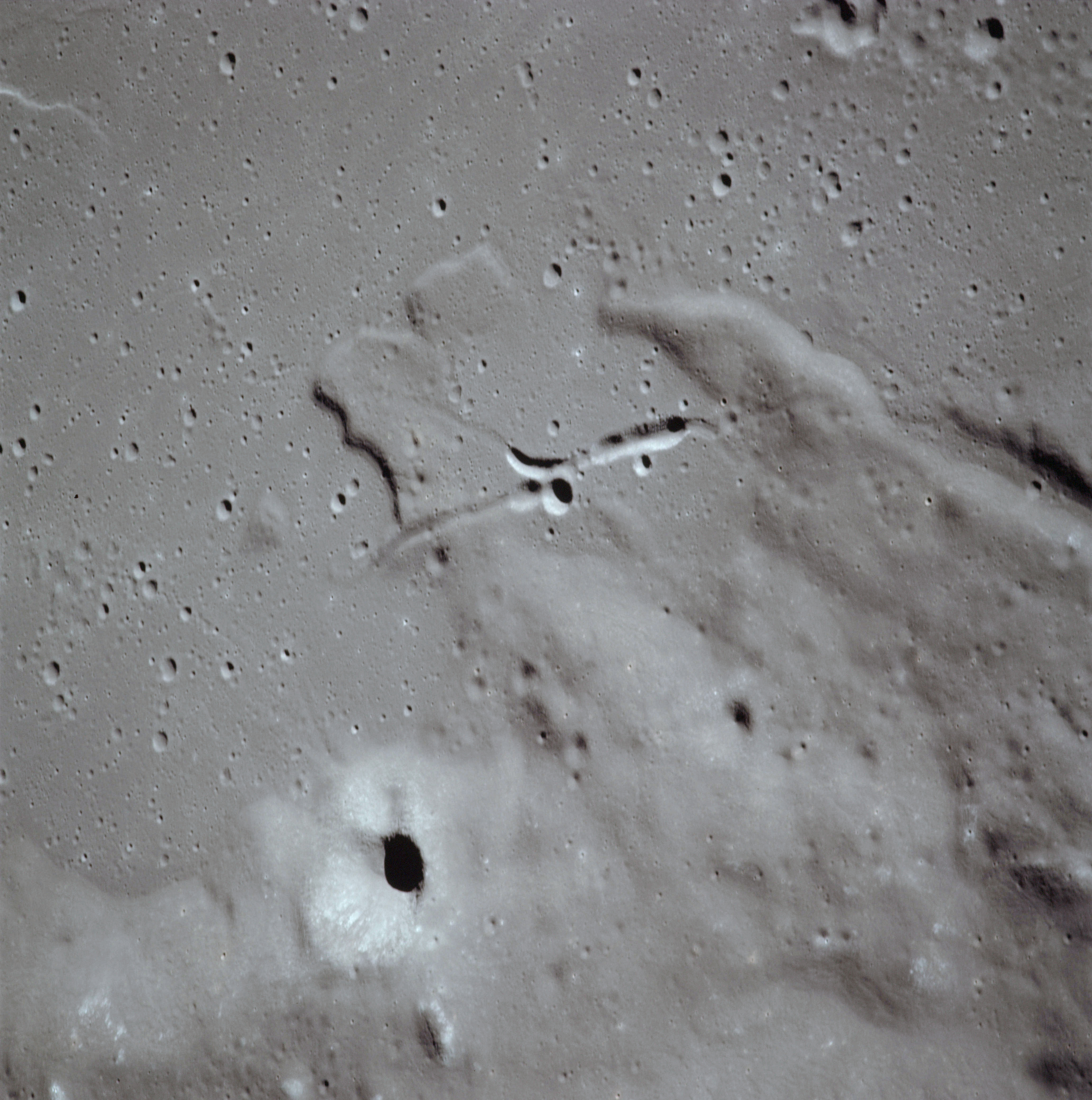
This is AS17-151-23214, looking across the north rim of Tsiolkovsky, an area that appears to be part of the crater's original floor that has not been covered by the dark mare material that is a feature of the rest of the interior.
AS17-151-23214 - Frame 108 on OO, the northern interior of Tsiolkovsky - Image by NASA/Johnson Space Center.
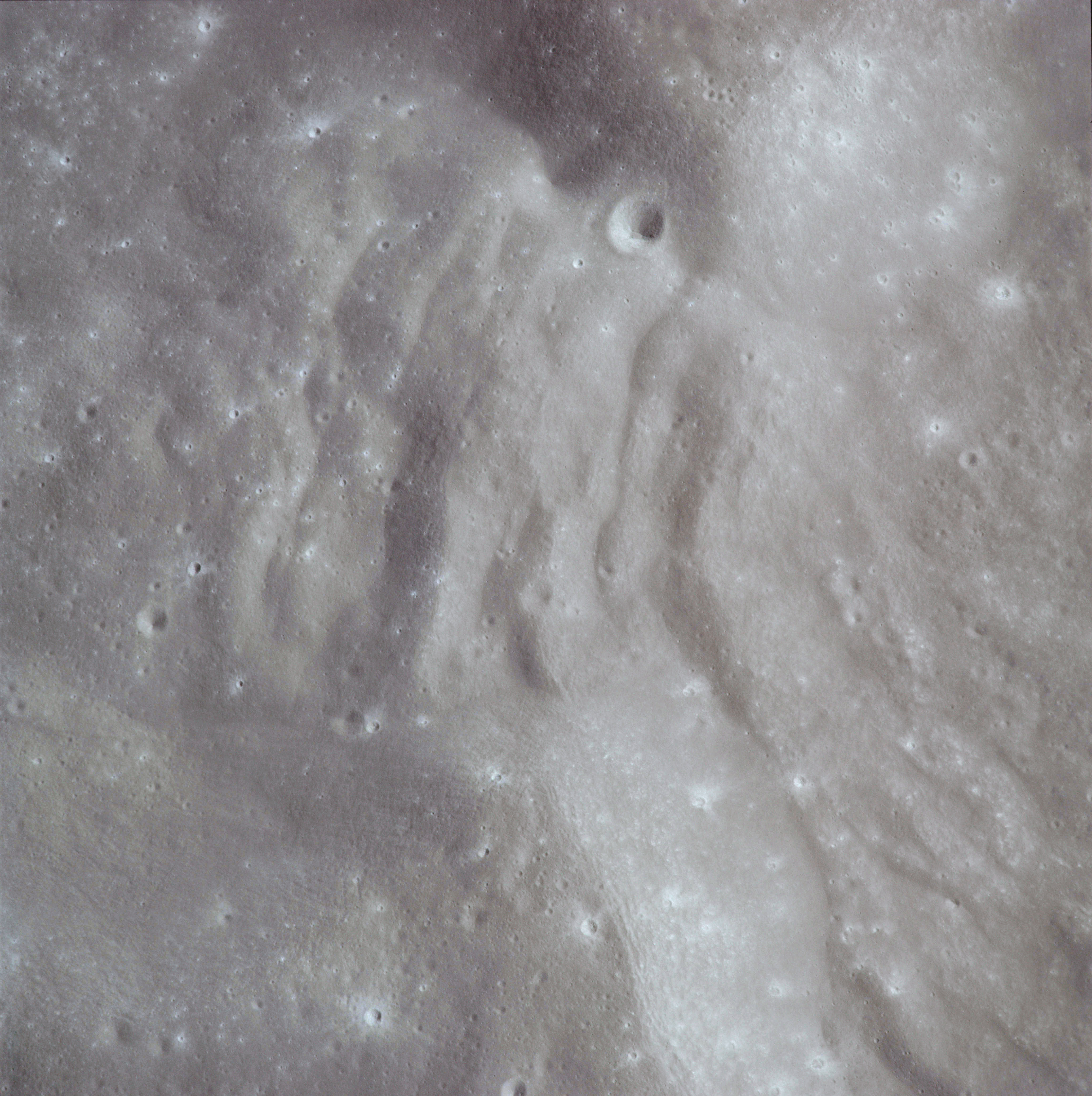
Evans (onboard): Okay, 110 is a picture just to the north of Tsiolkovsky. I don't know the name of that crater, yet. There's some interesting stuff around here. But the reason I took that picture 110 is because it looks like a flow-type crater doublet. And it is the same type of material from the floor of the larger of the doublet, and it's drifted off to the east down into the older crater - the smaller, older crater of the doublet.
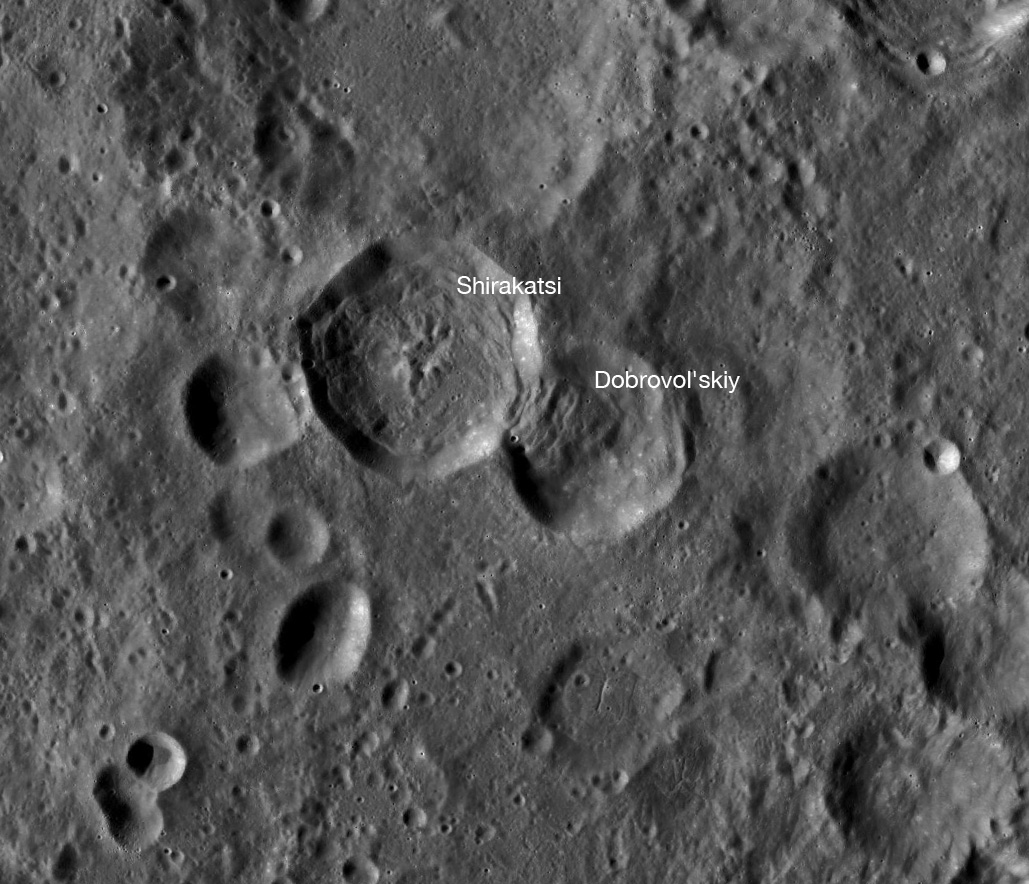
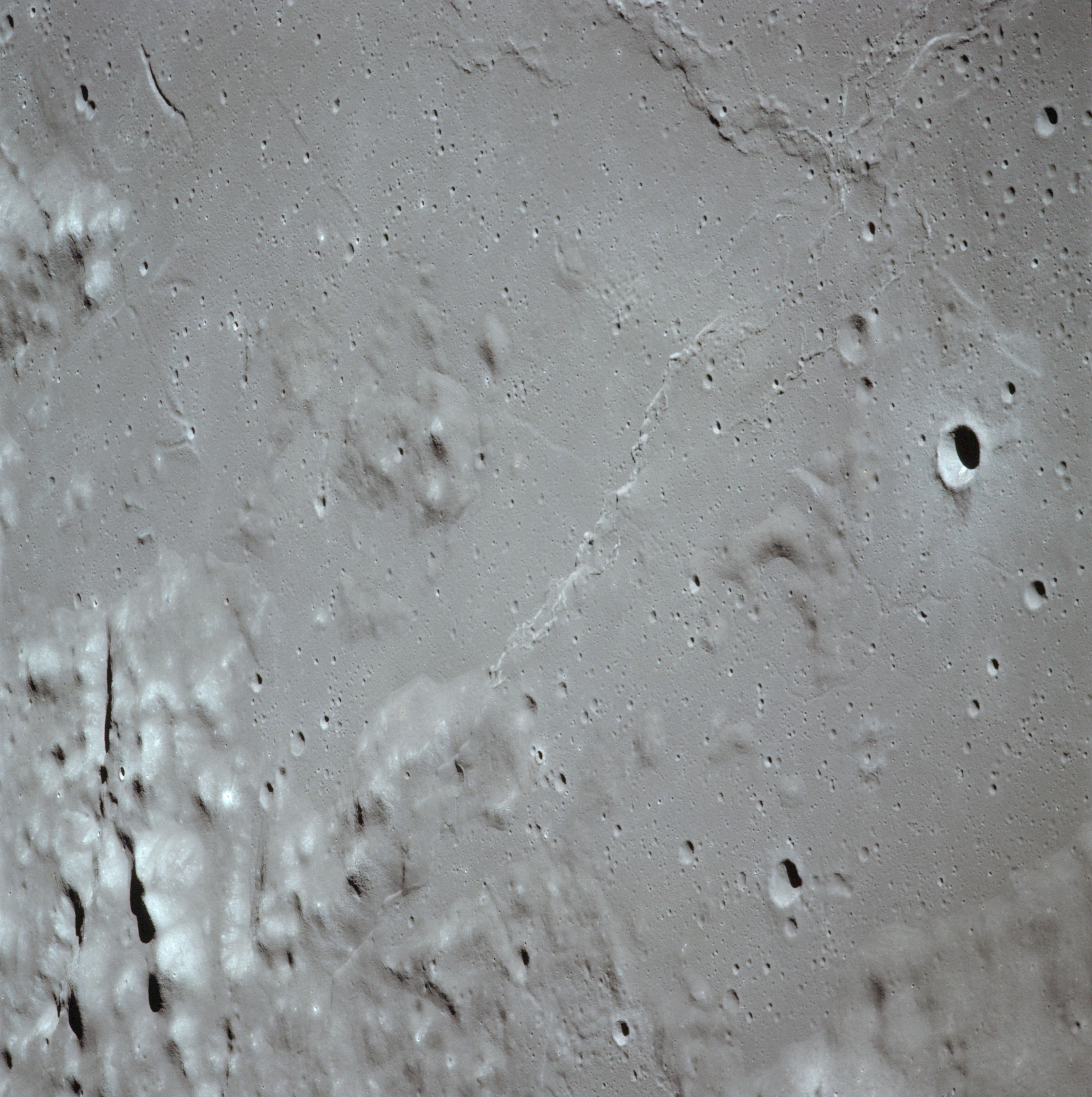
Ron is referring to AS17-151-23215 on mag OO. Over 100 km north of Tsiolkovsky are two craters that form a doublet. These are Shirakatsi, 48 km in diameter, and joined on its southeast rim is Dobrovolsky, at 38 km diameter. Shirakatsi appears to be more recent and it seems that the material that would have formed its southeast rim has slumped into Dobrovolsky.
A context image of the joined craters Shirakatsi and Dobrovolsky from Lunar Reconnaissance Orbiter. (NASA/ASU)
AS17-151-23215 - The slumping of the rim between craters Shirakatsi and Dobrovolsky into the interior of the latter - Image by NASA/Johnson Space Center.
161:49:05 Evans (onboard): I'll be darned. Yes, that landslide - No, I'll reserve judgment on that until I can get over and take a little closer look at it. But it gives the same type of flowline as comes from the - as the lava flow. It's the same albedo, same color, as the stuff in the northeast corner. I guess I better eat here, while I'm going to see this.
Evans (onboard): Find some bread and ham in here now.
Evans (onboard): Lost the craters, and now I've lost my map, too.
Evans (onboard): Where are these drink bags?
Evans (onboard): Well, I've had those for 3 days.
161:53:18 Evans (onboard): Stand on my head - Yes, I did - stand on my head, and they turn into bumps instead of craters, again.
161:57:28 Overmyer: America, Houston. Don't want to interrupt your eat period, but just would like a word from you on how the SIM bay configuration went. Did the UV cover come open? We're standing by on that Aerobee launch.
Evans: Affirm. UV Cover is Open. I think SIM bay's all squared away.
Overmyer: Roger. Thank you.
Evans: Sunrise was - that's 7 seconds, I think - after we closed both covers [laughter]. Good timing.
Overmyer: Roger. Okay, I'll keep you posted during your eat period of how the Aerobee's coming. It's due to launch at 162:10, and we need to get the 64-kilobit data here. As soon as we get that, we'll be giving it a Go for launch, but we did want to get your word on the cover.
Evans: Yeah, it's Open.
161:58:41 Evans: It's Open and verified On.
Overmyer: Roger, Ron. And they're in the count at White Sands.
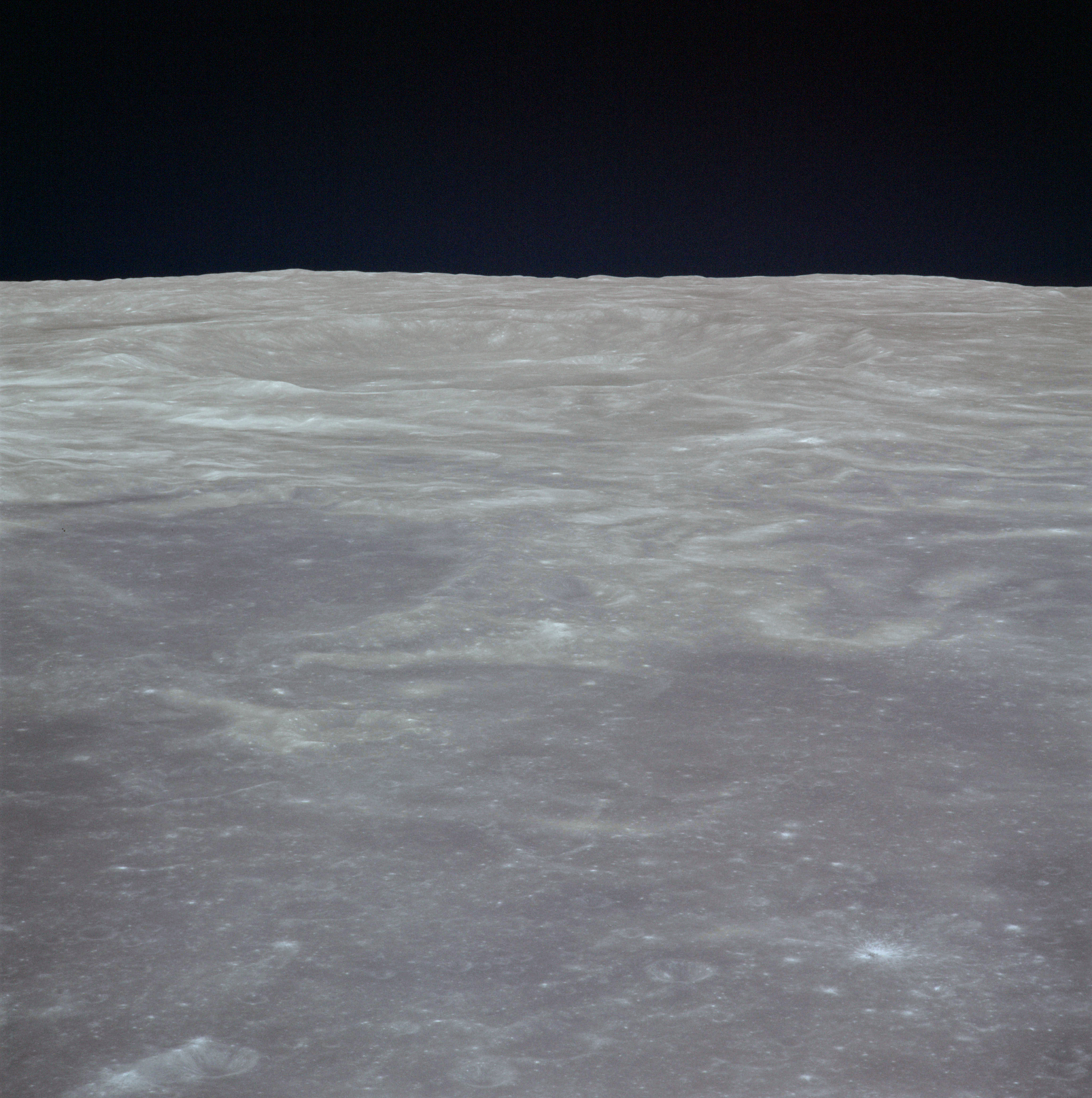
162:01:35 Evans: Okay, frame number 110 of mag Oscar Oscar was taken from window 1 off toward Lomonosov. You could really see the swirls in Marginis. They're - Trying to compare them with the same type of swirls back there in Arabia.
This is AS17-151-23216 which looks to the north across a landscape with a high Sun angle. The photograph was taken looking in the direction of Lomonosov but that large crater is beyond the horizon. Just below the horizon is the 80-km Al Biruni. The dark-floored crater centre-left is the 60-km Ibn Yunus. The dark landscape in the foreground of this image is the northern section of Mare Marginis.
AS17-151-23216 - Craters Al Biruni and Ibn Yunus - Image by NASA/Johnson Space Center.
Overmyer: Okay. We copy.
Evans: Let me take the old binocs and look out there. It's a long ways away.
Overmyer: Roger. What are you looking at again, Ron?
162:02:31 Evans: These are the swirls looking off across the - Marginis toward Lomonosov and - let's see, what's that other sea? Big - big crater just to the northwest of the Neper?
Overmyer: Okay, let me look at it here.
Evans: About the same size as Neper.
Overmyer: I got a poor map, Ron. All I show is - next to Neper, you have the Border Sea which is northwest of Neper, it's called the Border Sea. I don't know if that's the proper term you want or not.
Evans: Yeah, that's - that's - that's what I mean. I think that's - Mare Marginis is a round one up there. I think that's what it is.
Overmyer: Yeah, I think so, too. I - Soon as I get a hold of...
Evans: And in that case - Yep, my map doesn't go up that way, either, so - or the one I have out.
Overmyer: Okay. Stand by.
Evans: I think Marginis is a circular basin.
Overmyer: Yeah, Mar - Marginis is the name; right.
Evans: And then, just north of that is...
Overmyer: You got a big - big one called Goddard...
Evans: Yeah, and then north of that is - Yeah, okay. But in the case of Marginis - there's a brand new crater just in the northeast quarter of it - I mean northwest quarter.
Overmyer: Okay. Brand new car - crater in the [garble] Marginis.
Evans: It almost looks like that - in the northwest quarter of Marginis, and it's about - let's see, I'm guessing - 100-kilometer size, probably.
Overmyer: Okay. We copy that...
Evans: Hey, no, 50-kilometer size.
Overmyer: Rog. You've never seen that before on any of the maps?
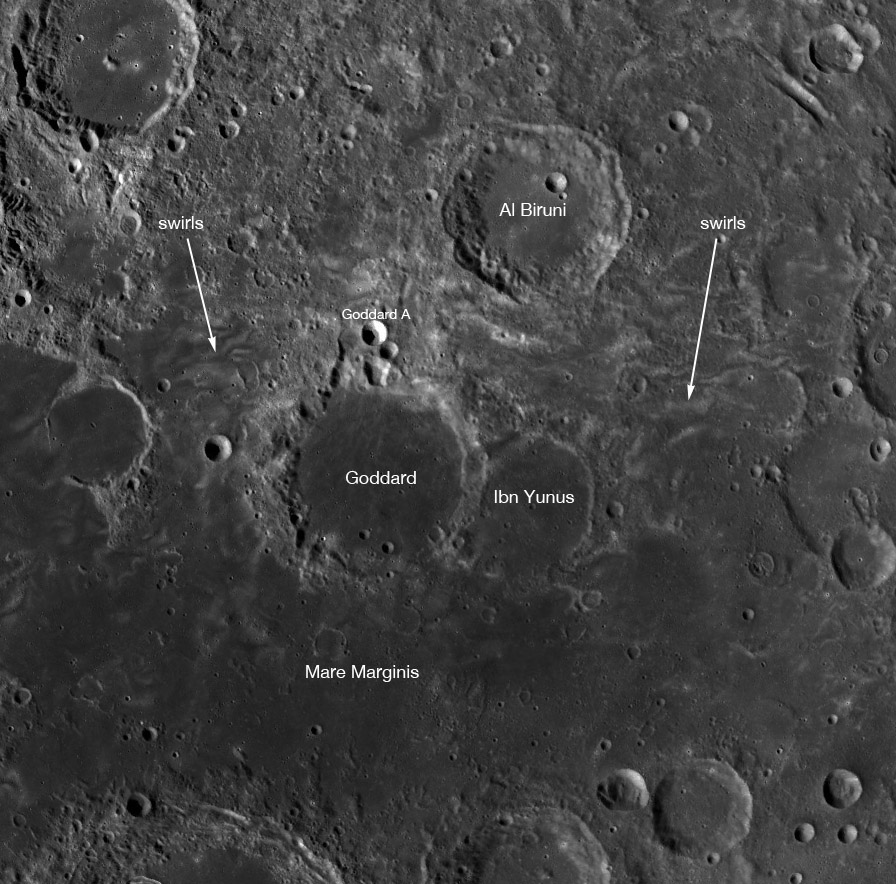
Evans: But you know, it's - that - Well, no. I've got to look on the map. I'm sure it's there, because that's what's causing all the swirls going across Marginis.
LRO image of the northern part of Mare Marginis and the swirls that run across between Al Biruni and Goddard. (NASA/ASU)
Overmyer: Okay, do you see a color-texture difference between the swirls across Marginis there?
Evans: Yeah, the color - the texture is hard to - you just can't get any texture out of it. There's a dark - a dark gray. And then the swirls seem to be around this dark gray - the dark gray areas. The swirls, of course, are a light, light - light, light tan.
Overmyer: We'd like - Stu and I would like to know, do you think the swirls are ejecta from that new crater you've seen?
162:06:20 Evans: Well, yes. The swirls in that one crater seem to be in Marginis, and I hope that's Marginis. I want to look at my map here in a minute and look for sure: but they seem to be emanating essentially radial from that bright crater - going out across the mare.
Overmyer: Roger. Just a reminder, Ron, we don't want to tear you away from your window if you don't want to, but this is your eat period.
Evans: No, that's all right. I'd better grab...
Overmyer: And we're T minus 3 at White Sands and counting.
Evans: Better munch on something here. Hey, good.
Overmyer: Ron, if you were in the simulator right now, I'd have you adjust your mirrors.
Evans: [Laughter] Yes, so you could tell which - where I'm looking, huh?
Overmyer: No, sir, so you could look - you know what we used to adjust the mirror for down at the simulator all the time.
Evans: [Laughter] Yes, I know what you mean. Uh huh!
Overmyer: I guess what I'm saying is I need a mirror down here on my console for those of us in the peanut gallery here.
Evans: [Laughter]
162:08:49 Evans: Okay, the crater I was talking about was Al-Biruni - is the one that's got the swirls across coming from it. And then off in the northwest corner, just outside the rim, that's a very bright crater. It shows up on this - contingency chart. So that was Al-Biruni. Goddard's got a lot of - of swirls in it also. No, wait a minute. Goddard was the one I was talking about, not Al-Biruni.
A bright crater directly north of Goddard is Goddard A.
Overmyer: Okay. Goddard. Roger; got you.
Evans: What? Yeah, Goddard is the one I was talking about. Crater size is more relative on that one, and there weren't any craters on the floor so that had - that had to be Goddard.
Overmyer: Okay, we just had lift-off at White Sands.
162:12:26 Evans: You know, I'm looking north of - along Crisium. Okay, yeah; there's Picard and Peirce. And you get the - same - same pattern that looks kind of like a swirl. Looks the same - same type of albedo as a - as a swirl with light places and dark places. The only difference being that you can definitely tell that these are ejecta from Proclus because the pattern is somewhat radial, you know, from Proclus itself. And then you've got the same thing, there's a crater up on the north - north rim...
Overmyer: Roger. We got you.
Evans: ...[garble] Crisium, just outside of it is about a 50-kilometer crater again. And it's a very bright one. And there the rays cross the Proclus swirls - or rays. Here you have to definitely call them - call them rays instead of swirls, and yet they look the same way. And the only - the only distinction is that in Crisium they go essentially radial. They have a direction to them, whereas the ones over there in Marginis and - next to Fermi or somewhere off in that part of the country are - They don't have any particular direction to them.
162:17:44 Overmyer: Okay, Ron. White Sands just called us and they got a good data take on their - Preliminary report shows a good data on the Aerobee.
162:21:39 Evans: You know, I'm looking out of window 2 now, and you can definitely get three different color textures on the thing. You've got the - that light tan of Serenitatis, and then you've got the - an annulus ring that stops somewhere in about the middle of the two ridge systems that go around. And then you come down south in the landing site area and the two dark things change - Ah, I can't quite see it anymore. The landing site is a darker - more of a gray, and it go - goes on - goes on up - There's a subdued crater; there's kind of a - The rilles go on up there, and then there's a filled-in crater just to the west of one that's about 20 kilometers in diameter. And that's about where the dark-gray material ends, right on the edge of that crater. And then you run in to the annulus that goes all the way around Crisium. I mean - not - not Crisium - or around Serenitatis.
Overmyer: Serenitatis, Roger.
Evans: Ouch!
162:23:33 Evans: Frame 110 and 111 were taken, just now, out of mag Oscar Oscar - one of the landing site, and one north of the landing site, trying to get the color distinction between the three of them there.
Overmyer: Roger; we copy.
AS17-151-23217 - Crater Clerke and the easter margin of Mare Serenitatis. Catena Littrow is a row of pits lower right. The transition between the two tones of the mare is visible to the upper right. - Image by NASA/Johnson Space Center.
AS17-151-23218 - The Apollo 17 landing site in the valley of Taurus-Littrow is lower right. Ching-Te crater is upper left - Image by NASA/Johnson Space Center.
162:27:41 Overmyer: Ron, do you have your Flight Plan handy? I've got an update and stuff like that. I don't want to interrupt eating. If you don't have it, we'll get it after the eat period.
Evans: Okay. Just a second here; I'll get it.
162:28:31 Evans: Okay, 113, 114, and 115 were taken on the western edge of Serenitatis. I'll get unwound from the cord here in a little bit and I'll [laughter]. You know if we design another spacecraft, we got to have something with a - so you don't have to be tied up to this crazy cord.
AS17-151-23219 - Frame 113 on OO. Western rim of Mare Serenitatis. The crater lower left is Sulpicius Gallus A - Image by NASA/Johnson Space Center.
AS17-151-23220 - Frame 114 on OO. Western rim of Mare Serenitatis north of Sulpicius Gallus A. Wrinkle ridge at top of frame is Dorsum Gast - Image by NASA/Johnson Space Center.
AS17-151-23221 - Frame 115 on OO. The gap between Montes Apenninus and Montes Caucasus where the plain or Mare Serenitatis meets Mare Imbrium. The eastern rim and ejecta blanket of Aristillus is cut off lower left - Image by NASA/Johnson Space Center.
Overmyer: Roger. Copy that. Hey, look, there's no hurry - hurry on the Flight Plan. Just keep doing what you want, and I'll call you at about 162:40.
Evans: Let's see, where are we now? I've got...
162:29:14 Overmyer: We're at 162:29.
Evans: Oh, that's right. Yeah. I'm not doing anything. Okay, I'm ready. Go ahead.
Overmyer: Okay, what we want to do is, we have to take a look at the data longer, so at 162:45, we want to put in "Mapping Camera, Retract" at that point. "Mapping Camera, Retract".
Evans: Okay.
Overmyer: And that will delete it over at 163:05. You'll just delete it from that point.
Evans: Okay.
Overmyer: And the zodiacal light photo PAD, which is over there at 163:10 about - is 163:10:49. That's 163:10:49.
Evans: Okay. Zodiacal light T-start 163:10:49.
Overmyer: Okay, the only reason I want to get that up to you is that "Mapping Camera, Retract" there at 45 - We have to take a good long look at that data, you know. You know the problem we're having with it.
162:30:25 Evans: Oh, yeah, uh huh. Okay.
162:31:23 Overmyer: Okay, Ron, if you're near there, High Gain to Auto.
Evans: You want the Laser Altimeter, On while we try to retract that?
Overmyer: That's a negative, Ron; Just let it run.
Evans: Okay. Will do.
Overmyer: They're going to stay running until over at 163:35 or so is where they - they go Off, and we're - we're just going to retract the camera.
Evans: Okay. La - Laser Altimeter still putting out good data? As far as we know, anyhow?
Overmyer: Yeah, the only problem we had was when your toe caught it that one time. It's been good all along.
162:42:06 Evans: Okay.
Comm break.
Overmyer: Ron, we'd like H2 Tank 1 Fan, On, please.
162:44:02 Evans: Okay. H2 Tank 1 are going On.
Overmyer: Roger. [Long pause.]
162:44:56 Evans: Okay; let's try to retract the old mapper: huh?
Overmyer: Roger. We're ready. You were watching it.
162:45:03 Evans: Okay. Track Extend, Off; 5, 4, - Well, let's see, I'll start it at 15 - 45:15; 13, 14...
162:45:18 Evans: Go.
162:45:22 Evans: Got a barber pole.
Overmyer: Okay, we see motion, Ron.
Evans: Very good.
Overmyer: Ron, we've got one change to the Flight Plan. We should have got it to you sooner. At 163:40, we want to change that Verb 49 maneuver, because we want the Lunar Sounder to look at the SEP at the landing site.
SEP refers to the Surface Electrical Properties experiment that has been deployed by Gene and Jack on the surface. Like the SEP, the Lunar Sounder investigates the nature of the subsurface by studying the propagation and reflection of radio waves from various layers below the surface.
Evans: 163:40, okay. Go.
Overmyer: Okay, let's change this to roll, 115; pitch, 297; yaw, 0.
162:52:23 Evans: The - Since we're having a little trouble with that, why don't I put the Track Extend switch to Off on that one?
Overmyer: That's okay, Ron.
Evans: Okay. We'll just remember it's retracted.
162:53:11 Evans: Houston, America.
Overmyer: Go ahead, Ron.
Evans: Okay. It's like we're running a bit - a bit beyond what it might take to do this here. Why don't you check with Bob Mercer and see if we can get by without using the - Call that one, that frame - that's - the protect frame. Either that or how real is the 40 expose - usable exposures on the front of the film? How much protection - how much room is there to - gravy - before he came to his calibration films?
Overmyer: Okay, we're checking on that, Ron.
162:54:12 Evans: Okay. That, or he may want to skip one of the 60-second exposures in there somewhere, you know.
Overmyer: Rog, Ron.
162:54:39 Overmyer: Ron, our film record down here indicates you've got three more frames on there than you need for the zodiacal light, or do we have a bad number somewhere?
Evans: You may have. Because I'm - let's see, ready to take - yeah, I've only got 11 more pictures on here. I'm sitting on number 30, ready to take picture number 30.
Overmyer: Okay. Understand you're sitting on 30, ready to take number 30. And you've got 11 pictures left.
Evans: Yeah; so that's 30 - 11 pictures, the way I count it. Unless there's some, you know, a little gravy between the 40 usable frames.
Overmyer: Okay, Ron. There are 44 useful frames on that mag, so you can go from 30 to 44 in getting data.
Evans: Ah ha! Okay, that's good. We can get the whole works, then.
163:04:07 Overmyer: Roger, Ron. We're probably going to lose you early here. You're looking good as you go around the horn. We went around the room, and everything's - all systems are Go. Just a reminder on this next back side that there is no recording so there will be no DSE recording of voice on this back side.
164:02:16 Evans: Houston, America here. Sorry, but I didn't have my hat on.
Overmyer: Roger, Ron. No problem. We've got a Flight Plan update whenever you're ready.
Evans: Let me get the cameras squared away here first, okay?
Overmyer: Okay. Just give me a call.
Evans: I've been looking out the window, and I took - I took the four before 120 on the horizon across Arabia - with an 80 millimeter.
Frame AS17-151-23222 contains no image. There are three images (rather than four) and they are looking in a north to northeast direction. These are AS17-151-23223 to 23225. The subsequent image on the roll is further east so must have been taken on a later orbit.
Overmyer: Roger.
AS17-151-23223 - View northeast towards crater Al-Khwarizmi. The two smaller bright craters are Al-Khwarizmi K and M, Crater Saenger P is cut off lower left - Image by NASA/Johnson Space Center.
AS17-151-23224 - View north towards crater Saenger (nearly invisible in this high illumination). Centre foreground is crater Saenger P - Image by NASA/Johnson Space Center.
AS17-151-23225 - View north towards crater Erro D. Crater Erro is lower left and Moiseev is upper right with the distinctive central peak. Small bright craters either side of the ray crater are Saenger X beyond and Saenger R in foreground - Image by NASA/Johnson Space Center.
Evans: Mike. Mike Mike. There he is. That was on mag - mag - mag Oscar Oscar, by the way.
Overmyer: Rog.
Overmyer: See Arabia?
Evans: Yeah, it was a pretty - pretty good hit at it. It doesn't really - for - You've got to study it.
Overmyer: Okay. We don't want to talk you into something.
Evans: [Laughter] That's right.
Evans: ECX [means CEX, that is colour exterior film] 20 intervalometer, f/4, 1/250 [garble] 19 frames. Okay. We're starting with 143. Mike Mike.
164:05:50 Evans: Okay. All set for a Flight Plan update here.
Overmyer: Okay, Ron. It's a couple of short items. Let's see. First of all, at 164:35, just anywhere in that area, we'd like you to service your biomed harnesses if it's convenient. We're getting pretty ratada-ratty data on you, now.
Evans: Oh, I just put a new one on last night.
Overmyer: Okay. They think you need to service it with some jelly or something.
Evans: [Garble]. A sponge, I guess, huh? I guess they could dry out. Okay.
Overmyer: Roger. Okay the next Flight Plan update is at 166:36.
Evans: Okay. Go.
Overmyer: Add a Verb 49 maneuver to Lunar Sounder HF target attitude at 166:40. The angles for the Verb 49 maneuver are as follows: 142, 269, 359.
164:07:25 Evans: Okay. That's to be - Okay. It's a Verb 49 to 142, 269, and 359, and that's for the pass where we pull film through there, huh?
Overmyer: Roger. 166:40 is the time of that maneuver. And it's after - There's a note after that - resume nominal Flight Plan.
Evans: Okay.
Overmyer: That's it. You've got everything up to date. And you're aware, I assume, that we have a total alternate Flight Plan laid out if we should have to jettison the an - high - the antennas.
164:08:17 Evans: Yeah, you bet. I don't know what it is yet, but [laughter].
Overmyer: And, Ron, FAO - just a reminder on that maneuver I just gave you - to start it at - at 36 to be in attitude by 164:40. Say again; 166:40.
Evans: Okay, 166. Okay. Figured it was, but - okay, I guess that - I stay in that attitude, then, I guess that's what it is, isn't it? Through the best of the SEP?
Overmyer: Affirmative.
Evans: Best of the receive only? Okay.
Overmyer: And just for your information, your buddies on the surface are out walking around the Rover right now on television.
Evans: Hey, good deal.
164:10:10 Evans: Tacquet up to Bessel E or Men - Tacquet to Menelaus. Go right along the pass. Calderas change at Cannon [?] Rilles. Across - 2.8, isn't it? 1/250. The terminator's there.
164:14:49 Evans: Well, I'm just trying to match my color wheel with Crisium, and nothing matches.
164:14:54 Overmyer: Rog. Seems a few other people have found that, too.
Evans: [Laughter]
Ron is trying to use a circular chart to objectively pass on the tones and hues he is seeing out of the window. A difficulty with this arrangement is that the lighting by the Sun of the lunar surface is different to the lighting inside the spacecraft of the chart. The spacecraft's interior lighting is by fluorescent lamps which are notoriously greenish in their output and do not have a smooth spectral spread. This makes useful comparisons very difficult.
The colour wheel flown aboard the CSM, front and back - Courtesy of Ulrich Lotzmann
Overmyer: Hey, Ron. You're already aware, I'm sure, that - with this different attitude you've got, your look angle on D-Caldera photos here are going to be pretty - pretty marginal, and CM-5, I guess, is still the best window; But it's - I guess we're going to go ahead and get them, but it may be marginal.
164:15:21 Evans: Okay. I'll see. I was - I was wondering about that, really.
164:19:10 Evans: You know, the Crater Dawes has got - starting from the top going down the rim, there's a kind of a light-tan layer, it's a concentric layer that goes all the way around; and then you come into a lighter - it's almost to the white that it looks like on the hills and all round the landing site. And this first layer goes down maybe - let's see, as you look at the total distance in there, about a third of the distance; and then the white layer - concentric layer that goes all the way around, and this is in the western wall I'm looking at now, and it goes down to - to about a half of the distance, not quite half of the distance from the top of the rim down to the bottom. And then the lower portion of it, the lower half, a little better than a half really, is kind of a tannish gray - has a tannish-gray albedo to it. It's all streaked. And of course, the bottom of the layer, the bottom of the crater itself is - filled with - Well, oddly enough, it's the same color of material that's - that's laying around the edges of the crater. It has some radial rings around it, which gives an indication of a subsidence of some kind, or a sliding down the hill. That's really the first crater where I've been able to see any sort of layering in the walls. Now the first layer on the north side and also on the south side, in the dark brownish layer of the thing, you can see parts that are jugged, jagged, and sticking out. In other words, there's a slight change in slope in it. Looks like it's a very steep slope, which would indicate that it's a fairly con - compacted type of material in the first layer. And then the slope changes in the white layer on down a little bit more. And the white layer seems to sort of combine and maintain the same type of slope as the dark-grayish tan - layer - the bottom, or from halfway down to the bottom of the crater.
So that readers can follow along with Ron's description, this is a mosaic of images from the Lunar Reconnaissance Orbiter that shows the interior walls of Dawes.
LROC mosaic of Crater Dawes - Image by LROC/ASU
164:22:00 Overmyer: Roger, Ron. Did you tie in some of that ejecta material to the layer at the very bottom of the crater, like an overturned flap or something?
Evans: Yeah. That's - that's what it looks like.
Overmyer: Roger. Got you.
164:22:17 Evans: The ejecta material is about the - Yeah, that the - Okay, here we come on - Well, it's an odd angle, but I guess it will work. Good. I want to get some of the - 30 and let's see. The first one started at Tacquet. I'm going to whip her back one and get one of - back the other way, because that's kind of a change in - in the color. The color of the area changes right at the Tacquet Rille to - to the brown - browns. This - I forgot my little "gouge," here. It goes north of Malinius [sic], doesn't it?
164:23:04 Overmyer: You come up Tacquet, and then you go right near Bessel E, up in - you follow those ridges along into Bessel, there; Bessel E, rather.
Evans: Follow the - follow the rilles? Okay.
Overmyer: You're north of Malainius [sic], Menelaus I guess.
Evans: Okay.
164:23:32 Overmyer: And you cross just a little...
Evans: That's definitely a volcanic field.
Overmyer: ...bit south of Sulpicius Gallus. Say again, Ron?
Evans: Okay, south. I was going to say that - that's definitely a volcanic field or a deposition. And it's - You have relief with it from Tacquet on up to even Men - Menelaus.
Overmyer: Roger. Understand.
Evans: Bob, you say we cross to the south of Sulpicius Gallus?
Overmyer: Yeah, just about; just a little south of Sulpicius Gallus and the Haemus Mountains. Cross the Haemus Mountains, and then you're right over D-Caldera.
Evans: Okay. I think I got D-Caldera a while back with a 250 lens, too.
Overmyer: Good show.
164:24:51 Evans: Now, these Haemus Mountains have the same color tones, and what have you, as the - that field from Tacquet to - to Menelaus.
164:25:40 Overmyer: When you're a little bit past D-Caldera, you - on to - There's a line between the Sea of Vapors mare? and the Apennine Mountains. That's where you change to f/2.8.
Evans: Okay. Yeah, that is pretty good. We're going to hit D-Caldera, anyhow.
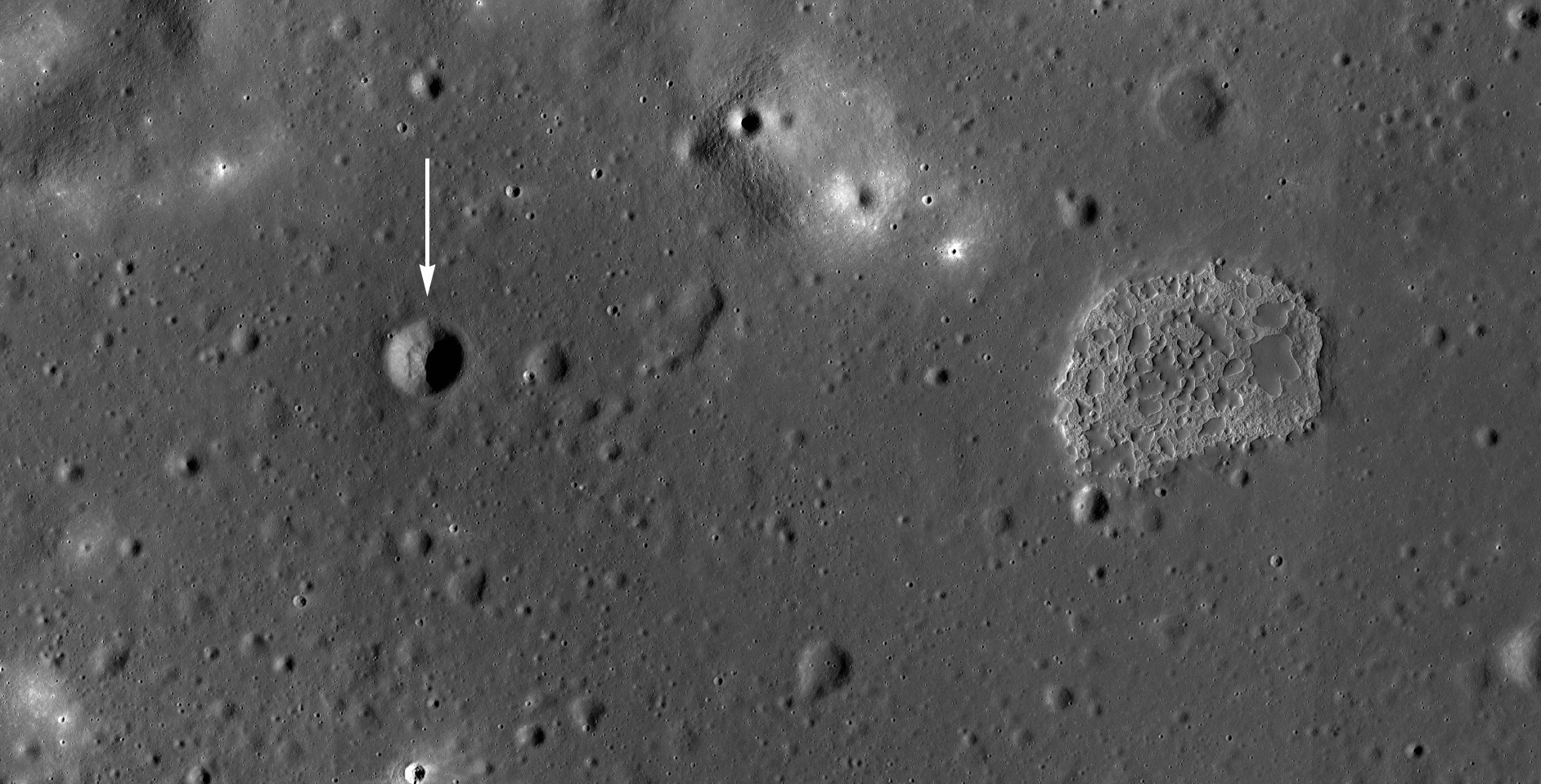
Evans: [Cough] There's a Cannon Rille. You know, there's a dark halo crater just to the west of D-Caldera. It's about 1,200 meters or so in diameter, if my scale's right. About fourth of - fourth of the size of D-Caldera.
What sounds like Cannon Rille may be Rima Conon, about 100km west of D-Caldera (Ina). The crater near D-Caldera is 1,000 metres across so Ron's visual estimate is pretty good.
Lunar Reconnaissance Orbiter image of Ina (D-Caldera) and the dark halo crater (arrowed) mentioned by Ron - Image by LROC/ASU
164:27:43 Overmyer: Okay, Ron. I don't show that on my map.
Evans: Okay. I think it might be on the picture there. I'm not sure. I'll have to get a better look at it before...
164:27:57 Overmyer: Okay. And, as you cross this mare that you - just to the west of D-Caldera, you'll switch - as you get across, and up into the Apennines, you'll switch to f/2.8.
Evans: Okay. Boy, that Cannon Rille's sure got something sticking up on the west side of it, there. They ought to take a look at that picture. Looks like a spire sticking up on the left side, because it creates a tremendous shadow. And, it's a perfectly round - Suppose that could be a crater? [laughter].
164:28:54 Overmyer: Ron, you want f/2.8; and then, up here when you get to the Apennine Mountains, the line between the Apennine Mountains and - the mare up there, you want to go to 1/125.
Evans: Okay. 1/125. Okay.
Overmyer: Stay at 1/250 until you get across the Apennines there.
Evans: Man, oh man. Look. I think those are the La Hire flows or something out across there. They really stick up. You can sure see the flow fronts and the - You know, in the Imbrium, you can see the flow fronts and - the rilles a lot better than you could in Serenitatis. They must be bigger.
164:30:12 Evans: 2.8 at 1/125.
164:30:56 Evans: Eratosthenes is just - being - picked up.
Overmyer: Rog. Rog. The terminator is going to go right across it on the next pass, right across the eastern edge of Eratosthenes.
Evans: Oh. Okay. That's all we're going to get.
164:31:28 Overmyer: Okay, Ron. Due to the Lunar Sounder saturating from the SEP, we would like to change the attitude; and, right now, go to that - the Verb 49 maneuver attitude that we called up for 166:36. We'd like you to go that now. Over.
Evans: [Laughter] Okay. The old SEP is saturated. Let's see. What was the attitude?
Overmyer: Okay. I can read it to you. It's roll...
Evans: 42...
164:31:55 Overmyer: ...142, 269, 359.
Evans: 269, 359. Okay, CMC in Auto; [garble] Proceed.
164:32:37 Evans: Hey, this is interesting. Mag Mike Mike, we're on 172.
Overmyer: Roger. We copy mag Mike Mike on 172.
Evans: [Garble] they just put that decal for the heck of it. Do I use the rest of them for targets of opportunity?
Overmyer: Stand by. I'll check with Chuck here.
164:33:47 Overmyer: Ron, we don't think Mike Mike's got anything left on it, but if you - if it is, you can use it for targets of opportunity. It's not supposed to have.
Evans: Well, it's probably only got one or two of them left here, you know, and I'll just keep it handy, and take them 'til - until the thing turns red, you know?
Overmyer: Roger.
164:34:09 Evans: The next one might be the last one [laughter].
Evans: Is there any way the Surgeon there can tell which - which two things are out of service or is it all three of them or - You know, those things come in packages of twos, not threes.
Overmyer: Okay. Why don't you say it again, Ron? I just punched up the Surgeon here. Why don't you say it again, please?
Evans: Okay. Is there any way that the Surgeon can tell which lead needs to be fixed or which two leads, because the sponges and all those things come in packages of twos, you know?
164:41:07 Overmyer: Hey, Ron, we just talked it over down here. The EKG is good and just forget the ZPN for another day. Just go EKG and forget the ZPN. That's compliments of Dr. Z.
Evans: Oh. Hey, beautiful. No wonder it looked kind of erratic, because I didn't even have ZPN on [laughter].
164:41:43 Evans: Yeah, last night I moved those - moved all three sensors on the EKG to different spots and put some of that cream stuff on them, and I think that helped.
Overmyer: Roger. He can tell and he noticed that. And it's improved their signal on the EKG part.
164:57:17 Overmyer: Ron, we're about ready to lose you in about 10 minutes. Everything's fine. We'll make one more final go-around the room before you go out of sight. I'm watching your buddies down there. They're up against a rock, which is about twice as tall as they are, and they're trying - pounding away on the side of it. Doesn't look like they're having much luck getting anything off of it, but they're beating on it.
Evans: [Laughter] Tell those guys, they don't roll a rock down a crater - They're supposed to do that for me.
Overmyer: Rog. I think - I think Jack got the nickname "Twinkle Toes" last night. He's bouncing around very graceful. Every time he'd hit the rock, he'd fall over down there.
165:03:43 Overmyer: Ron, everything's looking good as you go here to LOS; no problems at all. Your buddies are down at station 6 right now.
Evans: Oh, okay. We thank you much.
Overmyer: Okay. See you around the other side. On the Flight Plan schedule now...
165:04:01 Evans: [Chuckle] Okay.
Very long comm break.
165:18:32 Evans (onboard): Test 1, 2, 3, 4; 1, 2, 3, 4; 1, 2, 3, 4. Okay; so that's the transmitter that's not working on this staging. [Garble]. Yes. Something's happened [garble].
165:19:04 Evans (onboard): Test 1, 2, 3. I'll give it another lick; I thought I could still hear something.
165:19:14 Evans (onboard): [Music]
165:28:XX Begin Lunar Rev 40
165:47:24 Evans (onboard): At about - at about 165:31 or 32 in there, I used mag Mike Mike and took frame 173 and 174 looking north from [garble]. Last one was in the vicinity of Lara Crater.
165:53:03 Evans (onboard): Okay; it's mag Oscar Oscar. Frame 120 is looking back at a kind of a brownish streak on the crater. Where in the world is that crater? Let's see. Brownish streak surrounded by two - gray-type things. The brown streak looks like it - crat - Okay; that's a [garble]...
165:53:46 Evans: Houston, America. Roger. Loud and clear.
Overmyer: How you doing up there, Ron?
Evans: Okay; real fine. I just saw a - part of these rilles-type things, and it's got a light-brown - well, dark-brown - it's almost a mare-type coloring - heading in the southeast-northwest direction. And it's down from - [garble] there's Saenger, east of Saenger yet. Let me find it on my map.
165:55:12 Overmyer: Down east of Saenger there, you get into the first ring of Arabia or the second ring of Arabia there.
Your friendly journal editor has no clue what is being referred to as the first and second rings of Arabia.
165:55:26 Evans: Yeah. Hey, you know this is - Let me get this picture. This is the first time I've really been able to see that first ring of Arabia.
Overmyer: You think - think you saw it, huh?
Evans: And it shows up as - Yeah. It - I'll take two of them. First, I'd better get the dark slide out. The way the Sun is shining on the darn thing, and it shows up as a bright - I'll be darned! That's amazing! It shows up as a bright ring, just like we got it drawn on the map. You know, you - you get a brighter albedo all the way around to the top of the ring. That was frame 120 through - or 122 through 124 on mag Oscar Oscar.
It is presumed Ron is referring to four images on magazine OO, AS17-151-23226 to 23229.
AS17-151-23226 - View northeast. Crater below centre is Buisson V. Buisson is to the right. Buisson Y and Z are in the centre of the image. Three craters at left of image are (front to back) Firsov Q, P and Firsov - Image by NASA/Johnson Space Center.
AS17-151-23227 - View northeast. Craters a lower left are Saenger Q and P. Bright crater in distance is Al-Khwarizmi K - Image by NASA/Johnson Space Center.
AS17-151-23228 - View east. Bright crater cut off on left is Al-Khwarizmi K. Saha W is centre foreground and irregular crater in distance is Saha E - Image by NASA/Johnson Space Center.
AS17-151-23229 - View east. Crater Saha W is left foreground and irregular crater in distance is Saha E. Saha J is centre right - Image by NASA/Johnson Space Center.
165:56:35 Overmyer: Okay, Ron, we've got a - a Flight Plan update and a Lunar Sounder PAD, if you want to take it before we get into the visuals here.
165:57:51 Evans: Okay. Frames - last three frames before 128 were also looking east. Okay, we had an update, huh?
There are four additional images on magazine OO that seem to finish this sequence sequence, AS17-151-23230 to 23233. All are looking east.
AS17-151-23230 - View east. Bright crater lower right is Fox A. Two craters lower left are (front to back) Erro T and V - Image by NASA/Johnson Space Center.
AS17-151-23231 - View east. Prominent craters in foreground are Fox A (centre) and to its right, Fox - Image by NASA/Johnson Space Center.
AS17-151-23232 - View east. Craters Fox A and to its right, Fox foreground left. Bright crater lower right is Purkyně D - Image by NASA/Johnson Space Center.
AS17-151-23233 - View east. Craters Fox A and to its right, Fox foreground left. Crater at centre of image is Saha W - Image by NASA/Johnson Space Center.
Overmyer: Lunar Sounder PAD is at 166:40 on the Flight Plan. Let's do that one first, okay?
Evans: Okay.
165:58:19 Overmyer: Okay. T-start time, 166:42:12; T-stop time, 47:10.
Evans: Okay. T-start, 166:42:12, and T-stop is 47:10.
Overmyer: Good copy. I've got the lunar sounding - grazing attitude Verb 49 at 167:28.
Evans: 7:28, okay.
Overmyer: We're tweaking up that attitude a little bit; it's 283, 063, and 328. Over.
Evans: [Laughter] That's really tweaking it up. 283, 063, and 328.
Overmyer: Roger. And over there at 167:55 where - the antenna retract bit?
Evans: Yeah; right.
Overmyer: Okay. It's pretty obvious we want to take "HF antenna 2, retract" and move it above "HF antenna 1." We'll call for the retract - make sure we're ready, and we'll also cue it on our cue, Ron. What we want to do is look at HF antenna 2 retract all the way, and get the times, et cetera, and then we'll go ahead and retract HF antenna 1.
Evans: Oh, okay. Sounds reasonable.
166:00:11 Overmyer: Okay, Ron, we're all just standing by. That takes care of the Flight Plan updates, and we're just standing by for your visuals. This pass you're to concentrate on the landing site and the D-Caldera, you know?
Evans: Okay.
166:00:39 Overmyer: Ron, we want to concentrate on the small-scale features, and your binoculars may be what you need. We want to look at the dark-halo craters in the site area and examination of D-Caldera with the binocs.
Evans: Okay. That sounds like a good idea. We'll see what we can - [Laughter] That's crazy. I go over in inertial attitude, and every time I look out the window, I've got to look in a different direction.
Overmyer: Rog; we understand.
Evans: [Laughter] It's funny. [Long pause.]
166:02:14 Overmyer: Hey, Ron, when you come up on the landing site, we would like you to concentrate on Shorty Crater and F Crater and then the other dark-halo craters. As you know, as I told you last night, Shorty ended up with some orange-colored material that looks an awful lot like a Fuma - fumara - a vent anyway - fumarole. And it looks...
Evans: Fumarole.[Laughter]
Overmyer: ...an awful lot - Yes, okay [laughter]. Looks an awful lot like it and what we're trying to do is see what you see from there, and that may give us some correlation on some of these other ones.
166:02:49 Evans: Okay. I got to take a look and see which one's Shorty.
Overmyer: Ron, it's the dark crater on the slide, the dark crater on the slide.
166:08:50 Evans: Oh, I hope we got a Pan Camera picture of that - what the - Condorcet [?] or [garble] or something like that, the one I was describing had a little bit of diamond down in it?
Overmyer: Roger.
Evans: Because what that - little diamond turned out to be with the binocs - It's a dome of material in there, and the reason it looks like a diamond is because you have slide material or talus-type stuff that's slumped down around it. And in that dome-type material, there are three or four black spots in it. I call it black; they're really a - I con - I kind of consider it a greenish - greenish black, you know?
Overmyer: Roger.
Evans: I sure hope we - If - Why don't you check with Farouk and see if our Pan Camera coverage covers that - that crater? I think it probably did. That's an interesting one to take a look at anyhow.
Farouk El-Baz was responsible for training the J-series Command Module Pilots in aerial geological observation.
166:10:12 Overmyer: Ron, Farouk thinks it is on the Pan [Camera].
Evans: Very good. [Long pause.]
166:11:02 Evans: You know, in the eastern wall of Picard - I'm looking at it with the binocs now, and you can definitely see the first part of it up there has some vertical ensearpments [sic] - escarpments along the edge of it. And the vertical escarpments are kind of in irregular layers - well, just kind of like you would suspect if you - you eroded out a bunch of lava layers. In other words, they're not continuous, but they're kind of intermingled along, and they go about - oh, a third of the way down from the top of the rim, down to where the talus starts sliding on into the - into the crater.
166:11:56 Overmyer: Good show. We'll tie that - tie that up with what you gave us last time on Picard.
Evans: Okay.
Evans: All these dark-halo craters in the - in that one picture by that little diamond we've got up there by Yerkes. The one that's farthest to the south looks like an impact type of crater. In other words, you've got a definite ejecta lopping out around on those. The one that's hard to look at in the middle of my picture, but I think it's probably the second one down from the top. It has rounded ridges - rounded rims, and - coming up on the side here I don't know if I am going to be able to see it until I go by it. It has rounded - a rounded rim. The ejecta pattern or the dark halo is about twice the size of the - or up to one crater diameter. And it doesn't - it's - it's either a highly eroded impact-type crater, or it's a volcanic-type structure. And, to me, it doesn't look like a highly eroded impact one. Again, that's a little one we can probably pick up ground truth, so to speak, off of the Pan Camera film.
166:15:38 Overmyer: Ron, are there any similarity between the highlands, west of Crisium and those east of Serenitatis?
Evans: You know, I loo - that's just what I was looking at. And the ones east of - west of - well - yeah, east of Crisium and west of - No.
Overmyer: West of Crisium...
Evans: What I was looking at was the...
Overmyer: ...and east of Serenitatis.
Evans: Yeah, west of Crisium and east of Serenitatis. Those are different - seem to be a different type of highlands, and I want - I want to check the other ones when I go by, but it looked like when I was coming up on - on those west of Crisium, they're more of a tan-type colors, smaller - undulations smaller - They have a corn-cob effect, I guess is what you'd call it - what I call it anyhow. Smaller - smaller ears of corn or smaller mounds closer together as - as opposed to, when you get over to the landing site - The ones on the landing site seem to be more - raised, I guess. In those, you still have a - a group of the small mounds and what have you, but they're a little more massive; you get more of an appearance of a dark flow - or a dark albedo between the mounds and between the bumps.
Overmyer: Roger. Good show.
Overmyer: Are you getting the landing site into view now?
166:17:34 Evans: I got it in window 2. [Long pause.]
166:17:51 Evans: Okay. I've got Shorty in the - picture. It looks like a sharper crater than any of them in the Pentagon complex. The other thing that looks sharp, just like that one, is F Crater. [Long pause.]
166:18:48 Evans: Switch back to the other window.
Evans: They kind of find that orange stuff on the north side of it?
Overmyer: Let me check on that, Ron. I'll be back with you in a second. I don't think so; their stop was at - station 4 was on...
Evans: [Garble] I'll get [garble].
Overmyer: Station 4 was on the south side of it.
Overmyer: Just go ahead with what you see and...
Evans: I'd say they just barely got into the stuff, then, becau - But it - but it looks like - kind of the north rim of it has more of a - a tint of a different color to it.
Evans: I - [garble] my pictures.
Overmyer: Is the color differentiation concentric around the - the crater or is it just in - in splotches?
Evans: No. It's just in the - kind of the north side of it.
Overmyer: What would you say the color is there? Is it one of the different tans?
Evans: Yeah, the color - [chuckle] Yes, it's a kind of a different - Would you believe kind of an orangish - tan through this - mic - through these binocs? I got to take another look at that when I go by the next time.
Overmyer: Roger. I'm with you.
Overmyer: Ron, when you get back - when you get done with this, we'd like you to sketch - when you get a chance, the color variations - just some thoughts on where the color splotches are with respect to Shorty, in particular.
Evans: Okay. The - I'll do that when I finish up here.
Overmyer: Rog. Did you get a chance to look at F Crater?
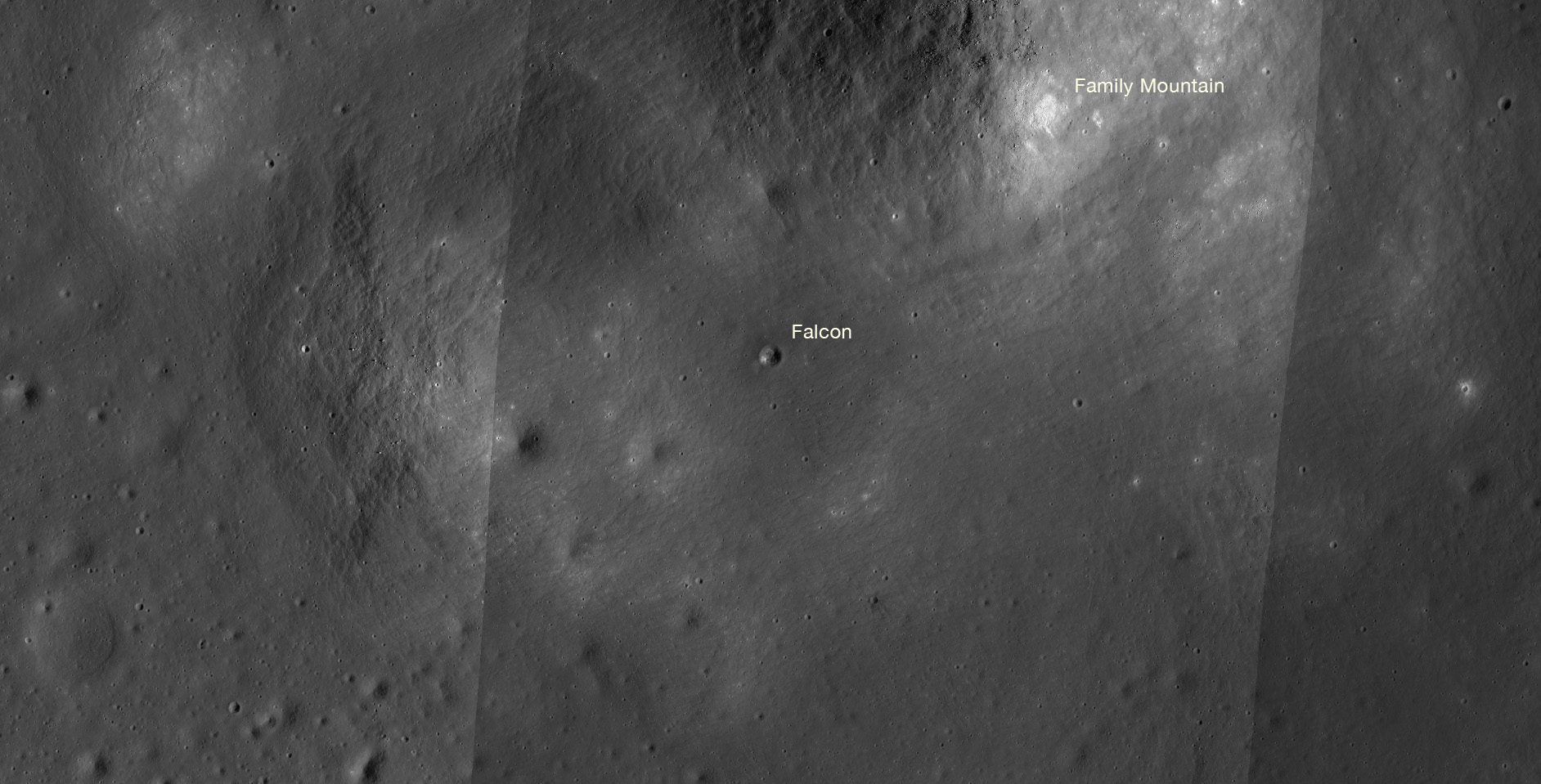
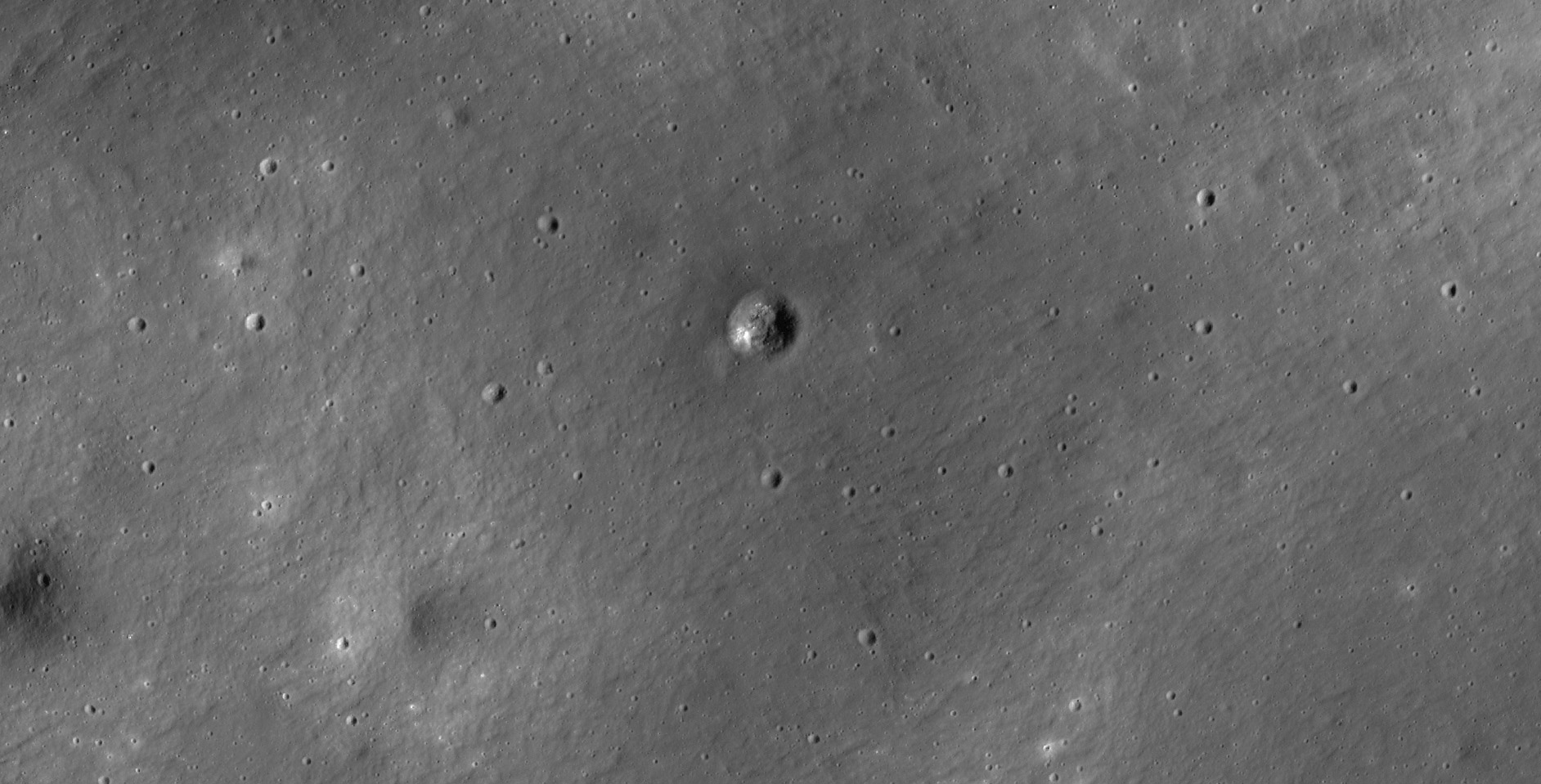
The feature they are calling F Crater is mentioned and shown in the CSM Lunar Landmark Maps (PDF page 31). It lies southwest of Family Mountain and 9.5 km WNW of Shorty. Modern mapping names it Falcon.
LROC image of F Crater in context with Family Mountain - Image by LROC/ASU.
Close up LROC image of F Crater, now called Falcon - Image by LROC/ASU.
166:21:50 Evans: Yeah, F Crater is - is sharp - just like - Shorty. I hope I was getting F Crater. F Crater's about the same size as Shorty, isn't it? If not, I was getting one between Family Mountain and...
Overmyer: Just about the same size, Ron. Maybe just a tad bigger.
Evans: Yeah.
Overmyer: Ron, is there a cone associated with F Crater?
Evans: I didn't get a chance to look at it that much. I'll have to check it the next time.
Overmyer: Okay. Have any thoughts on how - what's its origin?
166:23:02 Evans: I'll have to look at F Crater again the next time I come over on the thing, because I spent most of the time looking at - Shorty.
Overmyer: Okay.
166:23:14 Evans: You know...
166:23:32 Evans: This - this formation again from - Tacquet on down to Menelaus or Melinor [sic]. Just went over that again, and I was looking at it with the binoculars, and I saw one sharp crater in the area that had a - an ejecta - almost the same color as the stuff around Shorty.
166:24:16 Overmyer: Roger, Ron. You might point - pinpoint that crater between Tacquet and Menelaus when you get down here.
Evans: Okay.
Evans: Boy, oh boy, D-Caldera is going to be - between all the windows.
Overmyer: You have any flow scarps in that unit - near that Menelaus Crater?
Evans: No. I'll tell you what. There aren't any scarps there at all. That's why - That's another thing I was looking for, it's just a gradual degradation or gradual change in the color.
Overmyer: You have any topography changes with respect to that color?
Evans: Yeah, but the - the - No, the topography change is just a gradual - gradual change - with - There's a mound - There it is. I got to switch to all the windows.
Overmyer: Are - are you able to get up on the D-Caldera?
166:26:07 Evans: Yeah, I got D-Caldera into my sights now. The mounds - all blotches in the center - are the same type of material - same type of material as that surrounding the D-Caldera itself. Down in the caldera, the gray blocky-type of stuff - and you know what? I'd almost say that - You know how water drops kind of form on a - on a - on a surface as you - as you - Have you ever had a high spot and something kind of slowed up - up to it, high spot - and water kind of flowed up to and didn't quite stick to it - you know it doesn't stick to it, all in one spot...
Overmyer: Roger.
Evans: ...but it would leave a - a depression due to a surface tension as you come on up there - and then you have kind of a little - little bubbles that - float across there, and that's what that looks like to me.
Overmyer: Roger. We copy that. Keep - keep going; that sounds great.
Overmyer: How about the dark-halo crater west of the caldera?
166:27:59 Evans: Hey, I'm finding out with - with the binocs, your observation is - is cut in about a half, and I'm going to have to get that the next time over.
Overmyer: Rog. You think the dark halo crater is any relationship to those marelike patches in the caldera itself?
Evans: No, I don't think so. Just a - because the color differences are - or the color is completely different. So that - that's what - that's an open question on that one, and I'll have to find out the next time around.
Overmyer: Any thoughts about the light-colored annulus around D-Caldera.
Evans: No. I couldn't see a light-colored annulus.
Overmyer: Okay. Hey, we need a Recorder, On, here on the Lunar Sounder.
166:29:16 Evans: Oh, okay. Let's see. Recorder is - The Recorder is On.
Overmyer: Okay, Ron, let me read you some questions here real quick on D-Caldera. Determine the color difference between D-shaped expression and it's surroundings. I think you pointed some of that out. You got any more comments on that?
Evans: Okay. There is nothing - surrounding D-Caldera - that looks anything like the - the silver – silver-gray material that has depressed. It's definitely depressed with - with respect to the surrounding terrain. The little bumps that are in D-Caldera are the same color and the same - smoothness - kind of - smoothness as the rest of the material - the mare material surrounding the area.
Overmyer: Okay.
166:30:17 Evans: I could not detect the - an external annulus around the caldera itself.
Overmyer: Okay. Do - do you feel that any of the material on the caldera is related to the material in the immediate vicinity?
Evans: The smooth-looking - let me get my picture - the smooth-looking - bumps in there are definitely - doesn't look to me like they're the same material as the stuff in the whole area.
Overmyer: Okay.
Evans: They're smooth - tannish.
Evans: You know, if I look at that picture, the dark-colored stuff looks to me like it's a depression, you know? And it's - and it's the other way around. The light - light - the light-colored light-albedo stuff in the picture is the part that's depressed and the darker portions that looks like the - the material surrounding the area is the part that's raised up.
Overmyer: Roger. We copy that. [Garble] on D-Caldera, do you have any view of any more of this terrain below you, or are your windows pretty well messed up?
166:32:17 Evans: It just got dark.
Overmyer: Okay.
Evans: Yeah, I - I stopped talking just about the time we got to the terminator.
Overmyer: Okay. Good show.
Evans: Let me - let me go back to a map and make sure I was talking about F Crater.
166:33:03 Overmyer: Ron, I think if you put an order of priority on some activity here, as far as the geology goes, you might consider sketching out on Shorty - with just a rough handle on where you thought you saw some of the coloring differentiation up on the northern side of Shorty - and also give some thought on F Crater, if you will. I know you didn't get a chance to look at it because - If we can tie up the - what you see from orbit on Shorty to what we know we've got from the ground truth, we might really have something here, as far as matching up on some of these other craters.
166:34:04 Evans: Guess I can change the DAP here and get that out of the way. [Long pause.]
166:35:04 Evans: Well, let's see, just kind of fouled that one up. Really wanted 142, narrow dead band, don't you, at 142, 269, and 0 - and 359? Thought we were already in that attitude.
Overmyer: Ron, you might want to trim your attitude that - you were not to go to that Verb 49. That was the deleted at one thir - at 166:36. That Verb 49 was deleted, and your attitude is back to the - 142, 269, end 359, and you might want to trim that up.
Evans: Just did it. Thank you, Bob. I'd have done it by myself if I hadn't gone to CMC Free, but I'd forgotten we were already in that attitude.
Overmyer: Rog. No sweat here; you got a minute or so before we're in the Lunar Sounder attitude for the Marius Hills there.
Evans: Okay; 166:42.
166:38:16 Overmyer: And, Ron, you may be interested that, after we got the Lunar Sounder unsaturated there with the different attitude, we - we could detect the SEP in the Lunar Sounder data.
Evans: Oh, very good. Kind of proves it's working anyhow.
Overmyer: Yeah, that's for sure. Everybody seems to be pretty tickled with what they're getting so far. Just hope the film comes out as well.
Evans: Oh, I'm sure it will. People out at Goodyear out there at Litchfield Park do a good job.
166:40:39 Overmyer: Ron, we got 30 seconds to T-start.
Evans: Oh, thank you.
166:41:50 Evans: Operate; she started at 42:12. Okay. Recorder's On; Radar is On. Go to work.
Evans: 9...
166:42:12 Overmyer: Mark.
Evans: ...10, 11, go. Hey, it worked out fine [chuckle]. Must have hit it 3 seconds early.
Overmyer: Rog. I still haven't figured out how to time this thing, I guess.
Evans: [Laughter] No, that was good. I got the mark the same time I did it.
Overmyer: Okay, and you can relax, Ron, and I'll give you a call at 40 - about 30 seconds prior to 47:10, so you don't have to sit there and watch for anything.
Evans: Okay, I'll...
Overmyer: Got to earn my pay down here somehow.
Evans: [Laughter] Boy, you already have, I'll tell you.
166:46:37 Overmyer: Okay, Ron. We're about 30 seconds from T - from Lunar Sounder Standby time.
Evans: Okay; 7:10, Operate to Standby.
166:47:06 Overmyer: 5 seconds.
166:47:09 Overmyer: Mark.
166:47:14 Evans: Got it.
166:48:10 Overmyer: Okay. There's your 1 minute, Ron.
166:48:16 Evans: Okay. Recorder is going Off, not to Heaters.
Overmyer: Roger. Good show, Ron. Farouk just came out and said a real good show. He's real excited about what you saw there, and we're real pleased with it.
Evans: Okay. I think I said north, but as I look at the map - the orange distribution goes generally about a - a crater diameter to the north, but it essentially starts - Well, if you'd cut a - on a 60-degree angle - from Dog Sierra at 63 - cut a 60-degree angle there and then - and then make that go around - out about a crater diameter.
Overmyer: Okay. To the north at Dog Sierra at 63?
Evans: Yeah, Dog Sierra 63; that's on the 400-meter scale there.
Overmyer: Yeah, I've got it.
166:49:50 Evans: On TL-50. And, at the right-hand side - if you're looking at the thing from the bottom, the righthand side is 0 - go up 60 degrees. You're 60 degrees up from the horizontal and 30 degrees down from the vertical. It'll be something about like that.
Overmyer: Okay.
Evans: It had kind of a brownish-orange tint to it.
166:51:57 Overmyer: Ron, I guess one of the things that at least goes through Stu's and my mind on that Shorty Crater - and I think you dispelled it when you say it goes out like in a 60-degree angular cone away from it. -_ But the question we'd really like to be thinking about - Is that a concentric coloring around there, like it might be just a layering from a flap ov - you know, a turned-over flap or something like that, or whether it just seems to be some sort of a - I don't want to say flow, but something that would give it direction that one - the one 60-degree direction like that.
Evans: Yeah, I see what you're saying. And - It all - almost looked to me like it was gradational, as you, - as you went away from the crater. In other words, more - more orangish - more orangish closer - closer to the crater than as you got away from it.
166:53:05 Overmyer: Okay. We're - we're ending up looking at future passes, not today probably, but for the future and see if we can fit in one or two more observations to you here, where we can set up the back room like we had in all the - if you'll go along with that, and if we can fit it in, would you like to do that?
Evans: Oh, sure. The crater that I described as looking comparable to Shorty, I don't think is the one on Family Mountain. I think it's the one on - bright dot - about the same size dot as Shorty on the 17-1 leadin for the - 17-1 for the landmark tracking.
Overmyer: Okay.
166:54:15 Evans: I think Family Mountain is the bigger of the two mounds to the west of the landing site, isn't it?
Overmyer: Stand by a minute, Ron. Let me clarify that. Rog, it's west of the landing site, and I believe it's the bigger of the two.
Evans: Yeah. Okay. The one that I said that looked like Shorty is kind of between the two mounds, and that's the one I looked at.
F-Crater, now known as Falcon, is indeed between two mounds, one of which is Family Mountain.
Overmyer: You say it looked like Shorty or looked like the other one?
Evans: [Garble] a little bit.
Overmyer: F Crater or Shorty?
Evans: Looked - looked like Shorty.
Overmyer: Okay. [Long pause.]
Overmyer: Ron, we'd like the H2 Tanks 2 and 3 Fans to On, please.
166:55:48 Evans: Okay, H2 Tank 2 Fan is On now; Tank 3 Fan is On.
Overmyer: Roger. Thank you. [Long pause.]
166:56:53 Overmyer: Ron, I just might draw your attention to the Flight Plan at 167:20, in that area where the Lunar Sounder finishes up, and it says that there will be no SIM bay or PCM data recorded until 169:03 and then you have to Configure the DSE there. Just want to draw your attention to that.
Evans: Okay. That's a good point. [Long pause.]
166:57:33 Evans: Hey, when you all drew that 60-degree angle, were you making that 63 degrees up from - not 60 - 60 degrees up from line 63?
Overmyer: Yeah. I - I didn't know how to handle on 63, but I took a point at Dog Sierra and 63 and kind of - caught - created a 60-degree cone away from the crater at that point. [Long pause.]
Evans: No, you want to create a semicircle. That's the center of the sem - Well, let's see. With the flat half of the semicircle along the line that goes through Dog Sierra 63 and Dog Whisky 57.
Overmyer: Dog Whisky 57? Roger.
Evans: Right.
Overmyer: Okay. I've connected a line...
Evans: Connect a semicircle to the right of that line.
Overmyer: Okay. To the right of that line or - to the north side of that line?
Evans: Yeah. Actually, it will be kind of to the northeast, but to the north side of it, yeah.
167:02:03 Overmyer: Ron, we're going to lose you shortly, and all the systems look Go here. I've got a bet with EECOM that you'll get everything in the Flight Plan. You won't miss anything for me.
Evans: [Laughter] Okay. We'll try that. Hey, before I go, take a look at Crisium and Serenitatis, 3 of 5; and the second one down from the top - or second one from the north, is the one I was looking at as that - is described as - as a partially subdued and - I mean a rounded-type thing with - with the kind of breaches in the side of the wall - what I consider breaches in the side of the wall.
Overmyer: Okay. We got it. Crisium, 3 of 5, second one from the north, huh?
167:02:47 Evans: Yeah. And the other one's not even circled; it's just north of the - the one in the bottom, and that's the one that - impact-type, because it's got ray - ray material, but it's a fresh impact bringing up bluish - bluish-type material.
Overmyer: Okay. Good show. You're - you're saying that the two of them are distinctly different from - when you're viewing. One's impact and one is possibly volcanic there?
Overmyer: Stand by for HF 2. We're changing some data points here.
Evans: Okay.
Overmyer: I'm sorry; HF 1.
Evans: [Laughter] Okay, no problem.
Overmyer: You should hear - hear it in the room when I make a comment like that. I get 14 people saying, "1 not 2."
Evans: [Laughter] Well, I knew what you were talking about.
168:01:14 Overmyer: Okay, Ron, if you'll give us a hack, we're - you're Go for HF Antenna 1, Retract.
Evans: Okay, just a second. [Chuckle] You know that's funny. I can't remember which one I can see out my left window over there.
Overmyer: Believe you and I could call it Anten - Antenna 2...
Evans: I hope it's number 1.
Overmyer: If it's still out there, it better be 1.
Evans: That's what bothers me. That's what I'm saying. If it's still out there, it better be 1. Okay. I'll give you a countdown on this one here. 5, 4, 3, 2, 1...
168:02:04 Evans: Mark it. Barber pole.
168:02:15 Overmyer: We've got ... - -
168:02:16 Evans: It's going in.
168:02:17 Overmyer: - - ... indication of motion that it's going in. Rog. Is that the one you can see?
Evans: Yeah. I can't anymore. It was gone. I could only see about - I don't know, 6 or 8 - maybe 8 feet of it sticking out there. Started to move and it's gone.
168:04:23 Overmyer: Ron, we can see stall current now. Can you give Antenna 1, Off?
168:04:30 Evans: Okay; it's Off.
Overmyer: And you do not have a sight. Is that so?
Evans: It was [garble] compared to the other one.
Overmyer: Say again?
Evans: That was affirm. I did not.
Overmyer: I got about 9 seconds when they called stall current; 9 seconds difference in the other one.
Evans: Gee, it ought to be pretty well in there then, hadn't it?
Overmyer: Yeah, it should be.
168:05:30 Evans: Ready for Pan Camera Mode to Standby?
Overmyer: Stand by; let me ask OSO. Stand by on that, Ron.
Evans: Wilco.
168:06:07 Overmyer: Ron, we're analyzing the data on the antenna that - We're 1 second out of the tolerance that Stan had established for determining at the end.
168:07:44 Overmyer: Okay, Ron, Pan Camera to Standby.
168:07:50 Evans: Okay, Pan Camera. [Garble] standby. Errr - Power is coming on. Barber pole. Gray. [Long pause.]
168:08:58 Overmyer: Ron, you can turn HF Antenna 2, Retract, switch to the Off position.
168:09:05 Evans: Okay. Thank you. Sorry.
Overmyer: Ron, on X-ray X-ray, is it still in - -
Evans: He says we're 1 second off? - Yeah. Go ahead.
Overmyer: If X-ray X-ray is still in the Nikon, you should shoot off one frame as a protect frame, and then you can just keep shooting on all the rest of them until it won't pull anymore. And you'll feel that, of course. And those are your options.
Evans: Oh!
Evans: Don't get too happy. It might just pull one - one frame and be done.
168:11:23 Overmyer: Ok - okay, Ron. You got your steno-maphic [sic] tools out up there? Because we got a Flight Plan update for tomorrow - the trim burn or the bagel burn, I guess.
Evans: Okay. Ha, ha. You know what I did on that camera? I forgot it. I wound it up in there. I haven't had a chance to take the film out yet. But I wound it back in the can [chuckle].
Overmyer: Okay, well; sorry about that. Okay, let me tell you, Ron, we're - all that data analyzed says we got a good retract on HF antenna 1. We're going to fly nominal Flight Plan the rest of this - tonight, and then all this update I'm talking about is for tomorrow morning at 180:15.
Evans: Ah ha! Outstanding. I figured you should come to that real good conclusion.
Overmyer: Yeah, we think so, too...
Evans: Okay. [Garble]...
Overmyer: ...Boy, you should have seen the Flight Plan changes we would have had.
Evans: [Laughter] I can imagine them.
Evans: Over there; okay.
Overmyer: Say again, Ron; I cut you out.
Evans: I was just going to say that - running Volume 3 tomorrow morning.
Overmyer: Okay, and it's at 180:15; 180:15 is the first one.
Evans: Okay.
Overmyer: Okay, I know I told you we wouldn't update the ones in the block, but the very first one is inside the block so you - where it says "LOPC target load." Just cross that out and make that "Trim target load."
Evans: Oh, okay.
Overmyer: And below the update block - the next block - as part of that block, add "Trim PADs." We' ll be coming up with you with trim PADs.
Evans: Okay.
168:13:02 Overmyer: Okay, the first one is at 180:20. Add "P00," and below it, add "Verb 49 maueuver to P52/trim attitude."
Evans: Okay.
Overmyer: And put a note: "Maneuver will take 14 minutes."
Evans: Okay.
168:13:54 Overmyer: Okay, we're going to give you the High Gain angle numbers and the Verb 49 maneuver numbers tomorrow morning. They'll probably change on latest updates, so we won't give anything for the - You can just put three blanks for the roll, pitch, and yaw there with that Verb 49 maneuver. Okay, if you go down the page...
Evans: Okay.
Overmyer: You go down the page to 180:27. Delete - Cross out "CMC Mode, Free; P00; CMC Mode, Auto; Limit Cycle, On; Attitude Dead Band, Min; and Rate, Low." And delete that note that starts "Do not stop Orb Rate early (avoid gimbal lock problems)" over there right next to that. Just delete all that.
Evans: Okay; got it.
Overmyer: Okay, on the next column, 180:40, delete the Verb 49 maneuver.
Evans: Okay.
Overmyer: Okay; at 180:44, add "UV Cover, Close."
Evans: "UV Cover Closed," 180:44. ·
Overmyer: Roger. And at 180:45, if you can fit it in between the O2 fuel cell purge and that, add the following: "UV, Off; IR, Off, and enable all jets."
168:15:46 Evans: Okay, after "IR Cover, Close," we'll put "turn the UV, Off; the IR, Off"; and then enable all jets before the fuel cell purge, huh?
Overmyer: Well, if you can fit it in there wherever it's convenient; Rog.
Evans: Okay.
168:16:04 Overmyer: Okay. At 180:58, where it says "Configure DSE," change "High Bit Rate" - cross it out, and make it "Low Bit Rate."
Evans: Okay; Low Bit Rate instead of High Bit Rate.
Overmyer: Okay, at - over on the next page at 181:15, add the following.
Evans: Okay.
Overmyer: "Pre-SPS burn - burn sim prep cue card." Let me read that again. "Pre-SPS burn sim prep cue card." Another statement: "Secure equipment for trim/LOPC."
LOPC is the Lunar Orbit Plane Change manoeuvre that Ron will make in order to realign the plane of his orbit with the landing site. Due to the rotation of the Moon, his orbital plane is no longer aligned with the landing site and this difference is increasing. The LM ascent stage has very little margin in its performance and it is prefereble for the CSM to bring itself to match the orbital plane that the smaller spacecrft will ascent into. Typically, such a plane change burn is carried out at right angles to the spacecraft's velocity vector, and while over the equator.
Evans: Okay. At 181:15, we'll do the Pre-SPS burn sim prep cue card and secure the equipment for trim/LOPC.
Overmyer: Roger. And right after that, put "P30 - P-30."
Evans: Okay.
168:17:37 Overmyer: Okay. And you might as well scratch out those words where it says "Eat period" on that line, and down at 181:23, add "P41 - P41."
Evans: Okay, P41.
Overmyer: Okay. At 181:33, add "Trim burn - Trim burn."
Evans: Okay, trim burn.
168:18:20 Overmyer: Okay. At 181:35, add the following: "Verb 49 maneuver to LOPC burn PAD attitude."
Evans: Okay. Verb 49 to the LOPC burn PAD attitude.
Overmyer: Roger. At 181:43, add "Report burn status."
Evans: Okay.
Overmyer: Okay. At 182:15 on the next page - 182:15, delete "Pre-SPS burn sim prep cue card; IR, Off; UV, Off; enable all jets; secure equipment for LOPC." Delete all those because you've already done it.
Evans: Okay.
Overmyer: Okay. At 182:20, delete the note which says "PCM data will not be recorded during LOPC." Delete that note.
Evans: Okay.
168:19:58 Overmyer: Okay. And then the last...
Evans: [Cough]
Overmyer: ...one is just a general comment, Ron. As you can see, we're cutting into your eat period, and you're going to be awful busy, and your eat period is very short. So, right at wakeup, while you're working, you might be considering getting eat things ready to go up with - ready to eat. You know, just as you're doing your postsleep check and that, you might be getting some food out. You're going to be busier than the proverbial one-armed paperhanger there.
Evans: Okay. That's probably a good idea [chuckle].
Overmyer: And we wanted that up to you so that you might get a chance to look at it this evening or the rest of this rev and make some thoughts or pull your thoughts together on that burn in the morning and see if we've covered all bets.
168:20:57 Evans: Okay. So far it looks pretty good here. We'll have some different High Gain angles there at 181:00. And you're going to give those up anyhow.
Overmyer: Okay, at 181:00...
Evans: You can send those up with the - well, for the next AOS there.
Overmyer: Yeah. We see that. Okay. We'll have to be calling that up to you tomorrow as you go around, I guess.
Evans: Oh, won't that - well, that'll be the same, because the LOPC burn attitude should be the same as nominal.
Overmyer: Ah, yeah. Rog.
Evans: Or about.
Overmyer: Yeah; you're right.
Evans: Okay, so that's all right. I'm sorry.
Overmyer: Ron, just to make sure. You understood the reason why we have to do this trim burn or ham burn or whatever you want to call it?
168:22:11 Evans: Yeah. As I understand, the mascons didn't work the way we thought they would.
Overmyer: That's about the size of it.
Evans: It didn't get down into a circular orbit. Let's see. Just glancing through here, it looks to me like we're going to do the trim burn in the LOPC REFSMMAT, right?
The REFSMMAT (Reference to a Stable Member Matrix) essentially refers to the orientation to which the platform is aligned to. It is an orientation with respect to the stars. The crew have different orientations for different parts of the mission, chosen so that by aligning the platform per those REFSMMATs, the 8-ball displays in front of them will be easier to interpret.
Overmyer: That's affirmative, Ron.
Evans: Okay.
Overmyer: And, Ron, just - I think you realize it, but all this has been checked out in the CMS down at the Cape already, and it's all been run. And there's no gimbal lock problem as far as we know.
Evans: Hey, outstanding. Okay; good.
Evans: Yeah. Those guys in the CMS down there do good work.
168:26:17 Evans: You know that crater - that circle next to D-Caldera - has a lot of blocks - blocks - blocky material laying around it. That - little bit of a terrace that I could just barely see on the west side of - western rim - down inside the western rim.
LROC image of the dark, blocky crater 6 kilometres west of Ina, known then as D-Caldera - Image by LROC/ASU.
Overmyer: Got you. I didn't think you were going to be able to see anything with the attitude. I'm surprised you can see anything at all.
168:27:09 Evans: Yeah. I was, too. I just happened to look out, and there it was.
Overmyer: Just talked to El Lago a few minutes ago, Ron, and all the neighbors are out - are at your home around the squawk box, listening. And Jan said to tell you that Jaime and Jon will be out here at - with us tomorrow. We're going to all - They're going to watch the burn from here - the LOPC and the trim burn.
Evans: Oh, hey, good deal! Yeah, I've got some real fine neighbors down there, I'll tell you that.
168:28:59 Evans: You know, I look at that D-Caldera from a distance - I can still see it in the binocs - and I keep trying to look for some hint of a topographic expression, a topographic rise surrounding the caldera. And I can't see a hint of a shadow, difference in the color, or anything. It's just flat out in the middle of a flat plain, and it's a D-shaped depression slumped down. There's no rise around the rims - or anything.
Overmyer: Roger. Got you. Must be frustrating, because it's supposed to have some topographical expression, huh?
Evans: Yeah; right. You know, it's supposed to have something. But it looks like it just fell right out of the flat plain, you know. It took part of the - took part of the plain with it, because there are these bubble-looking things down in the caldera.
168:31:06 Evans: How many frames in the next Nikon mag do I have to diddle with?
Overmyer: Okay, we're running that one through FAO here. Stand by a moment, Ron, on that.
Evans: Okay.
Comm break.
168:33:23 Evans: For the ejecta pattern of Eratosthenes, you can just see it looking back into the Sun now, and the terminator is right - right in the middle of Eratosthenes now. And you can sure see the classic impact ejecta pattern around it. It goes out for - you know, almost two crater diameters as we can see the topographic expression. You can see the scalloping or scouring as it's gone back across there, due to the shadows that are created in the low Sun angle.
168:34:07 Overmyer: Ron, at your convenience, we would like H2 Tanks 1, 2, and 3 Fans, Off. H2 Tanks 1, 2, and 3 Fans to Off.
168:34:20 Evans: Okay. I'm going to turn off all the H2 Fans. There's 3, 2, and 1, are all Off.
Overmyer: Good show.
Evans: I took a bath last night. I think I'll try to shave tonight. Starting to itch underneath this helmet.
Overmyer: Roger.
Overmyer: You mean you're not going to come home with a beard, huh?
Evans: Well, Jon wanted me to, but I can't seem to get past the itching stage.
Overmyer: Just be comfortable. Just be comfortable. You got another week to go.
Evans: [Laughter] I know it. I've already shaved once. And when you - when you start to shave, you can only - you can only put that brushless shaving cream on - oh, maybe a third - a third of your face and start hacking on it there because it dries out real quick. So you put on a little bit, then scrape it off with a razor, then get some more on and then scrape it off.
Overmyer: Rog.
168:37:10 Overmyer: Okay, Ron, FAO's data says that on magazine Yankee Yankee, we have 20 unscheduled frames that you can use prior to the scheduled photography. After the scheduled photography, anything that's left will also be yours.
Evans: Oh, okay. Yankee Yankee must be the next one up then. I can change - put that in, huh?
Overmyer: That's affirm, Ron. You can go ahead and put it in and shoot 20 and then you have to hold the rest for the scheduled photography.
Evans: Okay, will do.
Overmyer: I can see your thoughts there, Ron. You're going to get those 20 shot up before Jack ever gets up there, huh?
168:38:03 Evans: [Laughter] Oh, that is a good thought. No, it's just that every once in awhile at these terminators, you know, you - you have some real good shots, and we just can't schedule them, you know, all the time, because sometimes you can't do it. But you take one or two shots of each terminator when it comes by, you get some real good pictures.
168:44:51 Evans: Okay, magazine Yankee Yankee is in the Nikon - finally.
Overmyer: Roger.
Evans: I think I mentioned here the other night, didn't I, putting that magazine in there - you know, it's a real critical tight fit. And you get it pushed in there just right, and then in zero g, the thing bounces back out of the way, you know - before you can get the back on there.
Overmyer: Roger. You don't think the...
Evans: Good camera, though.
Overmyer: You don't think the Nikon was designed for zero gravity, huh?
Evans: [Laughter] No, it works great. Sure something to be said about a removable magazine cassette though.
Evans: Okay. I was looking over this transfer list - at about 184:00, and I don't remember Gene or Jack leaving their helmet stowage bags back to me. So I think they must have them in the LM - in Challenger.
Overmyer: Okay, we'll make a note of that and check it out tonight.
Evans: Okay.
168:58:07 Evans: Well, let's see, probably about time to P20 here. Plus-X forward, SIM bay attitude; 2 Enter Enter, plus 5 Enter. X, okay, Proceed. Noun 78 - Well, that's already loaded. 52.25; plus X is 180; okay? Except we're going to do - half a degree deadband, 2 Enter - 2½ degree deadband, I mean. Plus 2.50. [Garble] number 50 is the Moon. And right now, we'd like to orbrate around the Moon. [Garble] - 2 [garble]
Journal contributor Frank O'Brien informs that Noun 78, relates to Program 20, the universal tracking program, as we can see from Ron's comm. The three values in teh registers are:- R1: Yaw angle for P20 (gamma), R2: Pitch angle for P20 (rho), R3: Azimuth constraint for P20 (omicron).
169:00:39 Overmyer: Hey, Ron, do you have your volume 3 handy?
Evans: Yes, as a matter of fact.
Overmyer: Your last call about the helmet stowage bags. Where - whereabouts in volume 3 is that?
Evans: At 184 - about 19.
Evans: Took...
Overmyer: Okay, we got it. Thank you.
Evans: They got suited and took their helmets and gloves with them over in the LM - took their helmets and gloves with them over to LM, and they said they were going to send them back. But I don't think they ever did. We all got busy, and so they've still got them over there somewhere.
169:04:30 Overmyer: Ron, we're going to lose you in about 1 minute, and you're looking great. No problems at all.
Evans: Okay, we'll see you on the other side there, Bob. Thank you.
Overmyer: Rog, Ron. And at 169:51 or thereabouts, we'll see you.
Evans: Okay.
Overmyer: And you'll be eating, so we won't call you. But we'll be standing by.
169:53:49 Evans: Okay, Houston. This is America. Once we get the antenna set right, it is easy to lock up.
Overmyer: Roger.
Evans: How would you like - how would you like to have some P52 stuff?
Overmyer: Standing by. All ears.
Evans: Okay, Noun 71's - excuse me - are 6 and 42; Noun 05, 0.01; Noun 93, plus 0.053, minus 0.011, minus 0.039. And I torqued at 169:21:00.
This P52 platform realignment exercise used stars 06 (Acamar. Theta Eridani) and 42 (Peacock, Alpha Pavonis). Noun 5 tells Ron and Mission Control the difference between two angles; the known angle between the two stars and the measured angle that Ron obtained by his sightings.It is a measure of his sighting accuracy. 0.01° is considered good. The final three numbers, collectively Noun 93, are the angles through which the platform's three axes had to be rotated, or torqued, to restore proper alignment with the desired REFSMMAT.
Overmyer: Roger. We copy, Ron. And, Ron, while you're there we'd like H2 Tank 1 Fans to On.
169:54:52 Evans: Okay. Tank 1 H2, Fans 1, are On.
Evans: I got too much junk. It won't all fit in one jettison bag. [Long pause.]
Overmyer: Ron, just to update you on several things that happened while you were on the back side this time, the surface crew is at the LM and did their - they're in the close-out procedures there. And they unveiled the plaque and read a message to the school children of the world, And they received a telephone call from Dr. Fletcher, who said he'd been in close contact with the White House and was following - they - the White House was following the journey very closely and expressed the good wishes of all people down here to all of you up there.
169:57:31 Evans: Hey, that's mighty fine, by gosh.
170:13:04 Overmyer: Ron, sorry to interrupt you eating, but could you take the H2 Tank 2 and 3 Fans to On? We're trying to get the pressures up prior to sleep.
170:13:16 Evans: Okay. 2 and 3 are On.
Comm break.
170:14:39 Evans: You know, through these glasses, Stoney [means Shorty] still looks like it's a light - light tannish-orange. And it's - doesn't come all the way down to the center of the crater. It's kind of tangent to the north edge or tangent to the edge - it's perpendicular to the scarp line, itself, as it goes down through there.
Overmyer: Roger; copy.
Evans: Man, it's hard to see that...
170:16:09 Evans: Every time I focus on F Crater [laughter] I jiggle a little bit, and I can't focus.
Overmyer: Roger. Sounds like you use binoculars at a football game, huh?
Evans: [Garble] stablize binocs.
Evans: Yeah, these - you know you need the 10-power, but you sure need something to stabilize it.
Overmyer: Roger.
Evans: You know, I looked down here, - Oh, boy! Just between Tacquet and Menelaus and off to the west of Menelaus, there's a crater that's about 10 kilometers in diameter. And just to the right of it is out in the brown stuff, there's a brand-new sparking-fresh impact crater that has brown ejecta on it. And then some of the other craters - that crater happens to be right on the edge of the brownish-type material, right over one of the rilles. Hope I can mark that on a picture on the map. And some of the other craters about that same size, around the area, out in there, and they have the light-colored ejecta just like the normal small impact craters - recent impact craters out in the Mare Serenitatis itself.
170:20:56 Overmyer: Roger, Ron.
Overmyer: Ron, we'd like to get ready - started on some of these state vectors earlier - this state vector, and the jet-on monitor. So if you'll get Accept, we'd appreciate it.
Evans: Okay, you can have it, now. That it? Yeah, let's see. Clear the computer for you.
Overmyer: Ron, just for my information...
Evans: There you have it.
Overmyer: ...I'm sure we - the back room's got it. Could you pinpoint that new crater between Tacquet and Menelaus? Is it what - like halfway between, or something like that. Is it on a check line? Or is it in the rilles there from Tacquet, say east - west of Tacquet, but in the rille area.
170:21:53 Evans: It's - Let me get my map.
Overmyer: Oh, that's all right, Ron. It's not that - don't need it that close. Don't want to interrupt your eating.
Evans: No, that's all right.
Evans: That crater is closer to Menelaus - Melanoff, whatever it is.
Overmyer: Okay.
170:22:49 Evans: And it's almost directly east of Menelaus.
Overmyer: Roger. I'll put a mark here and mark it on my map so you can look at it preflight - postflight.
Evans: Okay.
Evans: You know, I was looking at D-Caldera and you got a lobate - a lobate flow front sticking down in the crazy thing. I'll be darned.
Overmyer: Must be amazing up there. That whole scene seems to change as that terminator is shifting - each rev is something is different in each area, because of that - Sun angle, I'm sure...
Evans: Yes.
Overmyer: ...But, boy...
Evans: You know, it's almost like - what I originally said, you know, like - maybe there's a high spot or a dry spot and you try to wet it, you know?
Overmyer: Rog; I understand exactly what you're talking about.
Evans: The flow has come up to it - Yeah. That's what it looks like. Just like that.
Overmyer: Kind of like a waxed surface, where you throw water on it and it - and the surface tension gathers it together in various lumps and the rest isn't clear.
Evans: Yeah. Yeah, that's it.
170:24:47 Evans: And the part that the waxed surface - so to speak - in analogy there, is a light bluish-gray.
Evans: Picture number 1 on the Nikon was looking south along the terminator in the rilles east - west of Eratosthenes.
Evans: And the picture number 2 is looking toward Timocharis.
Overmyer: Say again. Looking towards where?
170:28:12 Evans: Timocharis.
Overmyer: Okay.
Evans: Timocharis is right on the terminator now, the middle...
Overmyer: Rog. Got it.
Evans: On that crater that has the definite tan ejecta blanket, if you'll go - directly north - directly north of the center of the crater Auwers, A-u-w-e-r-s, until you come out about one of those rilles there in the Tacquet area, that's about where it is.
Overmyer: Roger. Got it.
Evans: Well, I had better get busy and start eating, I guess.
Overmyer: Rog. You've got to eat here and then - Well, don't get too busy eating. You've supposed to have been eating. I've got to read you up a TEI-55 PAD, if you want to take that...
Evans: Oh. [Chuckle]
Overmyer: ...then you've got to do your presleep checklist and we'll see you...
Evans: [Garble] there's enough time to get everything done that you want to get done.
Overmyer: Rog. Okay, the computer's yours - back to Block.
170:30:55 Evans: Okay, going to Block. And you say you have got a TEI PAD, huh?
Overmyer: Rog. TEI-55.
Evans: Okay.
Overmyer: Okay, it's SPS/G&N:...
Evans: Copied.
170:31:15 Overmyer: ...36076; plus 0.56, plus 0.80; 196:58:46.51; Noun 81s: plus 2785.7, minus 0957.1, minus 0174.6; roll of 179, pitch is 085, yaw, 343. Rest of the PAD is not applicable. Sirius and Rigel are the set stars, but we got a little difference on the hour line. Tonight's hour line is 136:16:00.34; four jets, 12 seconds. I've got three comments. First comment...
170:32:19 Evans: Okay. Go.
Overmyer: ...longitude of the TIG, minus 156.91 degrees. This PAD assumes a trim burn and a LOPC-1 burn. And this PAD assumes a lift-off REFSMMAT. Over.
Evans: Okay. The last note was assumes lift-off REFSMMAT, huh?
Overmyer: That's right.
Evans: Okay, TEI-55. SPS/G&N; 36076; plus 0.56, plus 0.80; 196:58:46.51; plus 2785.7, minus 0957.1, minus 0174.6; roll, 179, 085, 343; Sirius and Rigel, 136, 160, 034; four jet; 12 seconds; longitude at TIG equals minus 156.91; assumes a trim and LOPC burn; and a lift-off REFSMMAT.
170:34:00 Overmyer: That's a good readback, Ron. Okay, it's all yours on the Flight Plan, and - Ron, we might point out that, if you get going into the presleep checklist here, in the VHF comm configuration. Get that done, then there's a break - you'll lose comm and you'll have a 15 - 20-minute break, you can jump into your eat and then go right to bed.
Evans: Oh, okay.
Overmyer: Ron, my last call, I promise. I need - Here's your H2 tank configuration. We want H2 Tank 1 and 2, Fans to Off. H2 Tank 3 Fan to Auto. And you can delete cryo stir from the presleep checklist.
Evans: Okay. I've got Tank 1 and 2 Fans, Off. And H2 Fan number 3 to Auto.
Overmyer: And delete the stir from the checklist.
Evans: Okay, we'll do that. We'll delete the stir.
Overmyer: Okay, and we'll be standing by for your onboard readout...
Evans: Okay, here's the pan - Oh, okay. May as well get those there. Let's get the VHF...
Overmyer: Roger. We concur on that.
170:35:03 Evans: [Garble] on panel 9. Okay, it's Receive. And, we're in Duplex Alpha. And Squelch B is - Whooh! About 5, that cuts out the noise. I don't know if I'd ever hear them or not, but, anyhow, it cuts out the noise. Okay, let's see - Bat C is about 36.7. Pyro A: barely below the line, but we'll say 37.0, and pyro B is 37.0. Okay, looks like it's in good shape.
Evans: Okay, quantity in RCS Alpha, about 79; Bravo is 76; Charlie, 78; Delta is 80.
Overmyer: Okay, we got them. I don't know what they're advertising down here, but on one of the big screens here for the science group, they've got three, four signs put up now. it says the "Marines are looking for a few good men," "United States Air Force is a challenge for the bold," and "Fly Navy," and "Stay in school."
Evans: [Laughter]
Overmyer: The first thing they put up was...
Evans: Putting all the good things up, huh?
Overmyer: Roger; well, the first thing they put up was "Marines are looking for a few good men" and Deke gave me a dirty look, there.
Evans: [Laughter]
Overmyer: By the way, the troops are getting into the LM right now.
Evans: Okay, they're all ready to crawl back in, huh?
170:39:02 Overmyer: That's affirm, Ron. That closes it all out and you can just precede [sic] through your checklist and we'll stand by, if you want any calls. We'll see you tomorrow. And, the Doctor's just...
Evans: Okay.
Overmyer: ...wanted one question - whether or not the cream had done any good on those spots where the ZPN was? Has it made it feel better?
Evans: Yeah, it did, as a matter of fact. And, I forgot to look and see if it is still red.
Overmyer: That's all right. As long as it made it feel better.
Evans: There's a little bitty spot that must have been the center of it. It's only about one-eighth of an inch in diameter. It's still a little bit red, but the rest of the redness is all gone. And it doesn't itch any more.
Overmyer: Real good.
Evans: I think I am going to have to use a different mag than what's listed down there for the Hasselblad. I got November November and it's already got 160 frames on it.
170:41:58 Overmyer: Okay, let me look at FAO here. He's - he'll give me the word.
Evans: Okay.
Overmyer: Ron, you should use Kilo Kilo in place of November November.
Evans: Okay. It's sitting there with 65 frames on it.
Evans: [Humming]
Evans: Okay, Houston; America.
170:44:07 Evans: Go ahead, Ron.
170:44:10 Evans: Okay. The mike is cutting out on my lightweight headset. But I - but the earphone works real good - works okay. So I'm going to wear the earphone and the lightweight headset, and I'll keep the other - the other one hooked up - you know, this comm carrier hooked up on a different system, so if I need to talk, I can pull the comm carrier over. But I'll be sleeping, [garble] I'll have to pull the comm carrier over to talk to you. But I can hear you is what I'm saying - [garble] the headset...
Overmyer: Yeah. No problems - no problem, Ron. You're not breaking up to us. You know better than we, though, so - no sweat.
Evans: Yeah. No, that's on the lightweight headset that I'll be wearing tonight.
Overmyer: Rog; copy.
170:44:53 Evans: I'm wearing the comm carrier now. But it itches if you sl - if you leave it on all night, you know?
170:45:17 Evans: Okay; get the onboard readouts, recycle the fans; we'll save the potable water - Waste Management Overboard Drain - okay, that's Off; Waste Stowage Vent valves are closed. Battery Vent, by the way, is in Vent. How about a battery readout? [Garble] Alpha is 1. - Okay, Optics are Zero [garble] Optics is [garble]. Optics are stowed. Cabin Pressure Regs, two...
170:46:36 Overmyer: Hey, Ron, we didn't - we didn't copy your battery manifold - or battery manifold readout.
Evans: Battery manifold? It was 1.2, about. And it was that last night, too.
Overmyer: Okay. Thank you, sir. You've just made EECOM very happy.
Evans: Okay. I don't know when it was 0.6 up there, but I looked at it last night, and it was 1.2.
Overmyer: Roger.
170:47:19 Evans: Cabin Repress valve - I haven't kicked them off. I think one of them was closed. Okay. Tunnel Vent valve should still be off. Okay, it's Off.
170:55:07 Overmyer: Hey, Ron. We hear an intervalometer going off every 20 seconds...
Evans: That right?
Overmyer: ...It's timed out exactly right. Do you have the intervalometer running or something?
170:55:17 Evans: [Laughter] No; I can't figure out what that is.
Overmyer: We can't either. Because we hear...
Evans: It times it every 20 seconds, huh?
Overmyer: Roger. Tommy just timed it out; every 20 seconds exactly.
Evans: I got both valometer - intervalometers stuck to the wall over here. They're not hooked to anything.
Overmyer: Well, I hope...
Evans: That's funny, because I don't hear that.
170:55:41 Overmyer: Rog. I'm sure. Well, we're going to get a recording of it. I mean, we - I am going to listen to the recording when I get a chance and I'll show it to you. Because it's been the last 2 days, every 20 seconds, big as life.
Evans: [Laughter] I would be curious as to what - see what that is. I don't even have this tape recorder going now.
Overmyer: Rog. Understand. We went around the room, Ron. And everything is in great shape and you're - you're Go for sleep or whatever you want to do. We won't call you.
170:56:18 Evans: [Laughter] Okay. Thank you much. We'll see you all in the morning then.