The mission has split in two with separate control teams in Houston. This transcript is parallel to the chapter, "Day 6, part 1: Waking in the descent orbit", but only contains the communication between the CSM CapCom Ken Mattingly and Command Module Pilot Ron Evans.
The audio recordings presented in this chapter were acquired from the National Archives and Records Administration (NARA). It seems that long quiet periods have been deleted, probably by a process of copying from one tape machine to another. For this reason, indications of pauses in utterance will be less frequent. Except to split the original three-hour archive files into smaller chunks, the recordings have not been further edited for the journal.
110:42:55 Evans: Okay, Houston. This is America. We're floating free out here. The Challenger looks real pretty. The residuals on the P41 were plus 1.9, minus 0.2, and 0. Undock and sep was on time.
110:46:30 Mattingly: America, Houston. When you have an opportunity, how about cycling the High Gain to Wide and back to Reacq?
110:46:44 Evans: Okay, Can do.
110:46:46 Mattingly: Thank you, sir.
110:47:16 Mattingly: Okay, America. How about going back to Narrow on the antenna. And could you verify what you loaded on Noun 34? It went by so fast on the downlink, we didn't get it a chance to look at it.
110:52:24 Evans: Okay, Houston; America. Had 50 percent on mag Charlie Charlie when I changed mags there for the landmark tracking. And let's see, frame 110, I think - or 112 - let me look on that one.
Evans: Frame 103 on mag OO. Ah, shit. I mean, pardon the French [laughter]. Okay; go ahead, Challenger. How you guys doing?
110:53:31 Cernan: Hey, Ron; listen. This ridge you're coming on over - just stick your hand out the hatch and grab a rock.
110:53:35 Evans: Looks like it's pretty low down there.
110:53:39 Cernan: Well, when you're up here looking at where you are, it even looks lower.
111:03:16 Evans: Oh, Houston, I got so excited on that, I forgot to turn the camera On.
Mattingly: Oh, that's fair? You got any comments to make on any of those marks? They were - they were collecting the marks in real time. Do you have any that they ought to pay particular attention to?
Evans: Well, let me think for a minute, now. They were all within the crater itself. None of them were outside of the crater. The - the last ones I took at - started taking marks at - beyond what the really time was, just because you could still see it. So I wouldn't put too much faith in those - in about the last four.
111:05:39 Evans: Challenger, America. You want to try VHF Ranging - Ranging and Rendezvous Radar compare?
Evans: Okay. Transponder coming On, shortly.
111:06:08 Evans: Okay. Transponder's On now.
Mattingly: America, sounds like Challenger is still working on their Reset, if you want to go ahead and get your 52 out of the way while you're waiting for the range check. That might save a little time.
Evans: Okay. I think they're about ready to do it now. Challenger, America. You about ready for a VHF Ranging?
111:08:51 Evans: Okay. There goes Reset. Now.
111:09:07 Evans: Ah-ha! it works! Point - 0.50 miles.
111:09:09 Cernan: Okay.
111:09:16 Evans: Okay, 0.50 or 0.49 miles.
111:10:05 Evans: Okay, I'm going to turn the Ranging, Off, then. The comm's a little better that way.
111:13:34 Evans: Okay, Houston, you copying the 93?
Mattingly: Yes, sir. Torque any time.
Evans: Okay. We'll torque at 45 - 13:45.
Mattingly: Okay.
Mattingly: And, America; Houston. Have some vectors to send if you give us Accept. And we're standing by with a PAD.
111:15:50 Evans: Okay, Houston; America, ready to copy. PAD's here, and you have Accept.
Mattingly: Okay. First one will be the Circ PAD, on the same page.
Evans: Okay. Press on.
Mattingly: SPS/G&N; 37983; plus 0.40, plus 0.91; 111.57:28.09; plus 0070.5. Delta-VY is all zips; Delta-VZ minus 0000.5; 000, 092, 358; 0069.7, plus 0054.5; 0070.5, 0:04, 0059.9. The stars are Sirius and Rigel; 133, 200, 030. The ullage is four jets for 12 seconds. Comment on your PC: If you happen to notice the chamber pressure, it'll probably be running 90 to 95, and we're predicting that it'll show you about 6 psi less than what the actual chamber pressure is.
Evans: Ah-ha! Okay, that's good to know on that chamber pressure. What you're saying is that even during the LOI burn, the velocity gain and what-have-you was - for chamber pressure, probably up around a little better than 100, huh?
Mattingly: Yes, sir.
Mattingly: We've got a couple of transducer problems we'll...
Evans: I've got a readback on that Circ PAD.
Mattingly: ...talk about them some time when we're bored.
Evans: Okay. For the P30 Circ PAD. Noun 37 - I mean Noun 47 is 37983; plus 0.40, plus 0.91; 111:57:28.09; Noun 81, plus 0070.5, zero on the Y, and a minus 0.5 on the Z. Okay. Roll is 0; pitch, 092; yaw, 358. Noun 44 is 69.7 and a plus 54.5. Delta-Vtotal, 70.5; burn time, 0:04; Delta-VC, 59.9. Sirius and Rigel; 133, 200, 030. That'll be four jet at 12-second ullage.
The PAD is interpreted as follows:
Purpose: This PAD gives Ron the information he needs to circularise his orbit.
System: It will use the SPS engine under the control of the Guidance and Navigation System.
CSM Weight (Noun 47): 37,983 pounds (17,229 kg).
Pitch and yaw trim (Noun 48): +0.40° and +0.91°.
Time of ignition, TIG (Noun 33): 111 hours, 57 minutes, 28.09 seconds.
Change in velocity (Noun 81), fps (m/s): X, +70.5 (+21.5); Y, 0; Z, -0.5 (-0.15). The velocity components are expressed with respect to the local vertical frame of reference. The large positive value for X shows that this is a prograde maneuver that speeds the spacecraft up and has the effect of raising the pericynthion to about the same height as the apocynthion and thus circularising the orbit.
Spacecraft attitude: Roll: 0° Pitch: 92° Yaw: 358°. These attitude angles are expressed with respect to the landing site REFSMMAT.
HA, expected apocynthion of resulting orbit: 69.7 nautical miles (129.1 km).
HP, expected pericynthion of resulting orbit: 54.5 nautical miles (100.9 km).
Note that this orbit is not quite circular but is deliberately elliptical. The FIDO flight controller intends to compensate for the perturbation of the CSM's trajectory by the mascons. Although the effect of these gravitational irregularities is not well understood by the flight dynamics team, they hope the orbit will tend to fully circularise itself under the influence of the mascons by the time Ron makes a plane change manoeuvre just prior to the return of the LM. Continuing with the PAD items:
Delta-VT: 70.5 fps (21.5 m/s). This is the total velocity change required from the burn.
Burn duration or burn time: 4 seconds.
Delta-VC: 59.9 fps. This value is entered into the Delta-V display of the EMS which allows that instrument to be a secondary means of terminating the SPS engine burn. The value is smaller than Delta-VT to account for the engine's tail-off thrust. The G&N system, which is the primary control system, already takes this into account.
GDC Align stars: Stars Sirius (number 15) and Rigel (number 12) to be used for backup GDC Align in case the IMU is unavailable for this task.
GDC Align angles: 133°, 200° and 30°.
A final note for the PAD is that the SPS propellants should be settled in their tanks by firing all four plus-X thrusters for 12 seconds.
Mattingly: Okay. That's a good readback. I have your RP-3 tracking PAD.
Evans: Okay. Ready to copy.
Mattingly: Okay. RP-3: 112:17:01, 21:51, 23:31, 24:19, north 04.
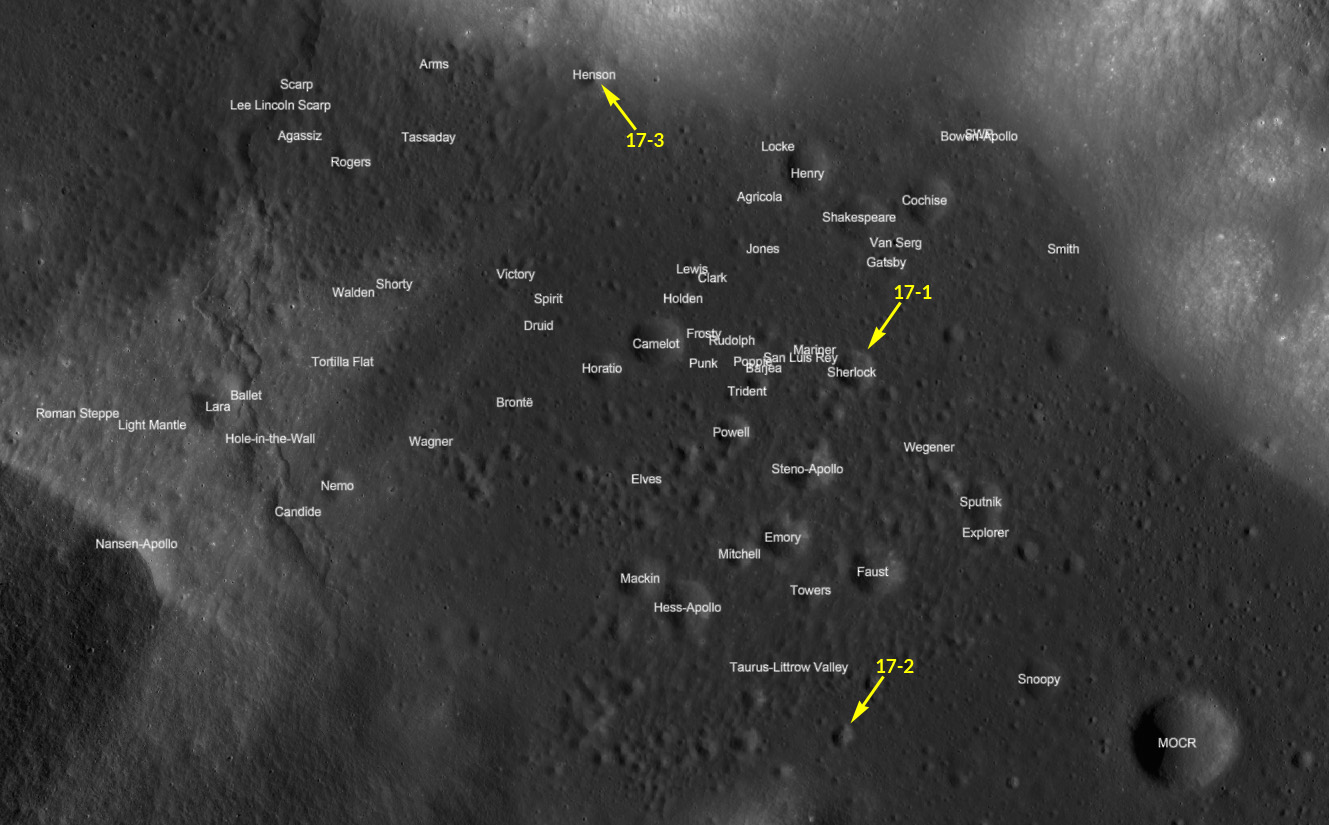
Evans: Okay. Copy that. Hey, while I think about it, on the landmark tracking there and that low altitude mark, the computer was pointing me - I wish I knew. I'd have to get a map to look at the name of it, but there I consider Sherlock. And then the one to the south of that, and then another one to the south of that. There are three in a row. And it was pointing to the one just south of Sherlock - one about the same size as 17-1. Okay. A readback on RP-3. T-1, 112:17:01; T-2, 21:51, 23:31, 24:19; be north, 04 miles.
The CSM Lunar Landmark book indicates that landmark 17-1 near the landing site is what modern mapping calls Sherlock. This labelled photograph is from the Lunar Reconnaissance Orbiter Quickmap site.
Annotated LROC image of the Apollo 17 landing site indicating the three landmarks used for tracking. Image credit: NASA/ASU.
The three craters mentioned by Ron appear to be Sherlock (17-1), Steno-Apollo and Emory. It seems the computer was pointing at Steno-Apollo.
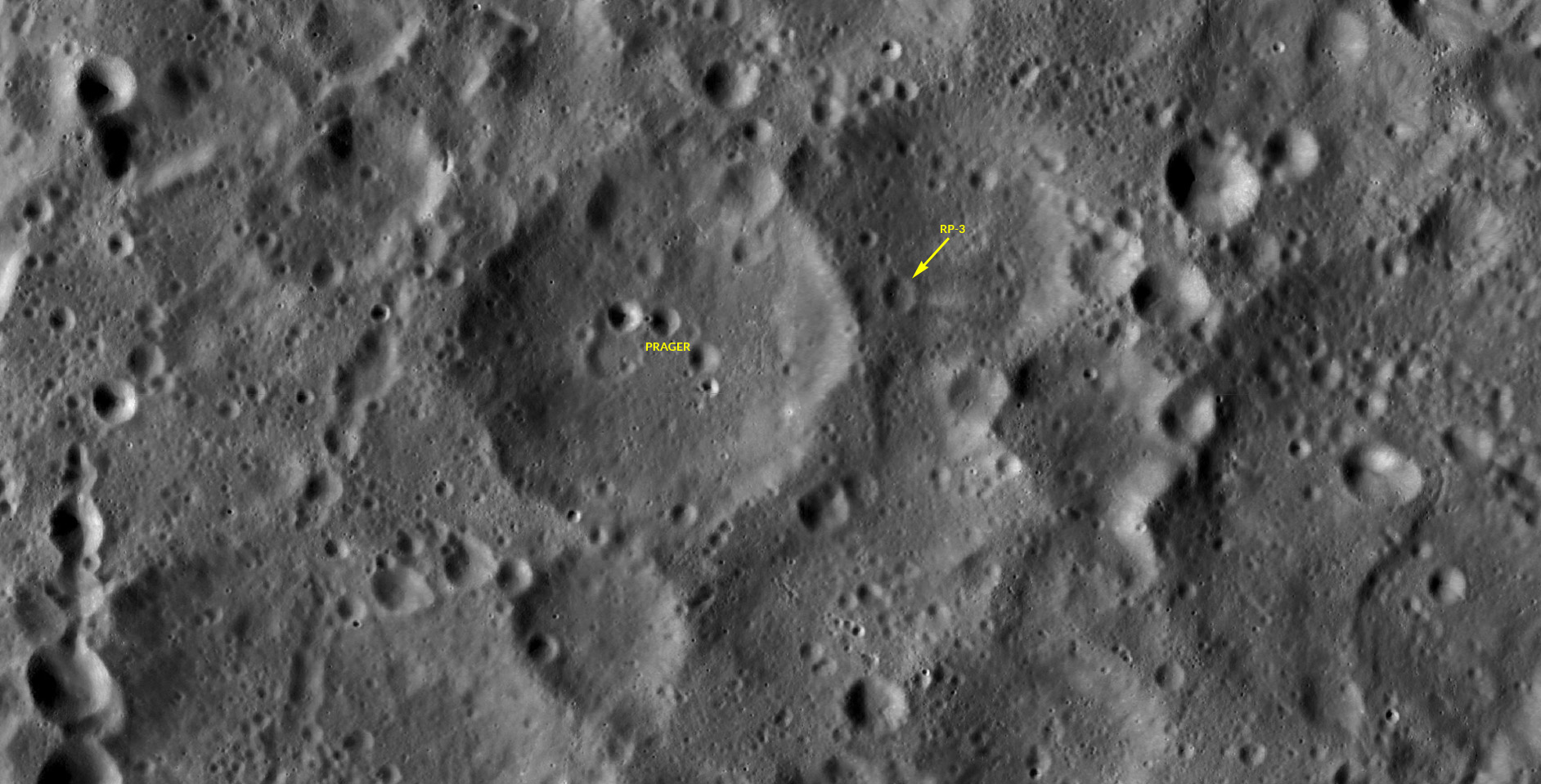
Landmark RP-3 is a 3-kilometre crater on the lunar farside, east of Prager.
Farside landmark RP-3 near to Crater Prager. LROC image credit: NASA/ASU.
Mattingly: Okay, that's good. And I have the - the other PADs if you're ready to copy them, or if you want to press on, then we'll come back and pick them up later. Your choice.
111:20:55 Evans: Why don't I get started to the Verb 49 attitude, then I'll get the rest of the PADs, okay?
Mattingly: All right, sir. I think that sounds like a good plan.
Mattingly: And we're through with our up-link, you can go to Block when you want to.
Evans: [Garble.]
Evans: Okay. Got you loud and clear, too.
Evans: Okay, Houston. Okay. Proceed. Okay, Challenger and Houston. I'm maneuvering to Circ burn attitude - Okay, sure will - Ah-ha! Great!
111:25:40 Evans: And, Houston; America here. While we're maneuvering, I'll go to Receive on the VHF, and you can send those PADs E to N up.
Mattingly: Okay. Here they come. Echo: 113:02:00...
Evans: Wait a minute. Hold it. Hold it. Hold it. Hold it. I'll tell those guys to go it - to Receive only. Hey, Challenger; America.
111:26:05 Evans: Okay, Jack, can you go to Receive only on your VHF there? I've got all these PADs to pick up now. I'll call you when - when I'm all through.
Evans: Okay, Houston; America. Let's try it again on pad E.
Mattingly: All righty. Pad Echo: 113:02 all zeros; Foxtrot: plus 1013.4, plus all zips, minus 0050.0; Golf: 113:57:00.00; Hotel: 115:36:45.00. India: 112:49:52.35. Juliet: 115:36:45.00. Kilo: 117:35:45.00. Lima: 113:14:24.91; Mike: 119:34:30.00; November: 114:57:19.09. Over.
Evans: Okay, readback as follows: Echo: 113:02 all zips; plus 0103.4, all zips, minus 0050.0; Golf: 113:57 all zips; 115:36:45.00. 112:49:52.35. 115:36:45.00. Kilo: 117:35:45.00. Lima: 113:14:24.91; 114:34:30.00; November: 114:57:19.09. Over.
Mattingly: Okay, let's go back over Mike again. That's 119:34:30.00. The rest are correct.
Evans: Okay. On Mike, 119:34:30.00.
Mattingly: Okay, got them all.
Evans: Amazing.
111:29:34 Evans: Okay, Challenger; America. I'm through with all the PADs now.
112:35:09 Evans: Hey, Houston, this is America. Good burn.
Mattingly: Okay. Glad to hear it.
Evans: And I'll give you some dope here. Okay, it was on time. Burn time, as near as I can tell, was 4 seconds. VGX was 69.9. Okay, The trim angles were 357, 89, and 4 degrees of yaw. Okay, at the completion of the burn there, the Noun 85's.
112:35:55 Evans: The Noun 85's were plus 1.70 and a minus 0.6. They are trimmed out to 00 and a plus 0.1. Delta-VC was minus 10.0.
Evans: And I didn't look at that one until 112 plus 00. Oxidizer was 30.3. Fuel was 31.1. And unbalance was minus 200. Over.
Mattingly: Okay, that sounds good.
Evans: And - oh, P76 was good on the LM, too.
Mattingly: Okay, sir. I've got your P24 PAD.
Evans: I'm on [garble] three.
Evans: Okay, I'd better take it first.
Mattingly: Okay. I'll give you a 17-1. 112:50:52, 55:42, 57:22, 58:10; north 02.
Evans: [Laughter] Okay, Ken; Jack keeps talking every time you do. So maybe you can keep one ear on them or something. I got T-1 at 112:50:52; and I think T-2 was 55:42, and that's all I got.
Mattingly: Okay, America. Are you ready to try again on the P24 PAD?
Evans: Okay. Let's try it now.
Mattingly: Okay. 17-1: 112:50:52, 55:42, 57:22, 58:10; north 02.
Evans: Okay; I copied that that time. 112:50:52, 55:42, 57:22, 58:10; north 02 miles.
Mattingly: Okay, that's correct. And you were starting to say something about your RPs - target?
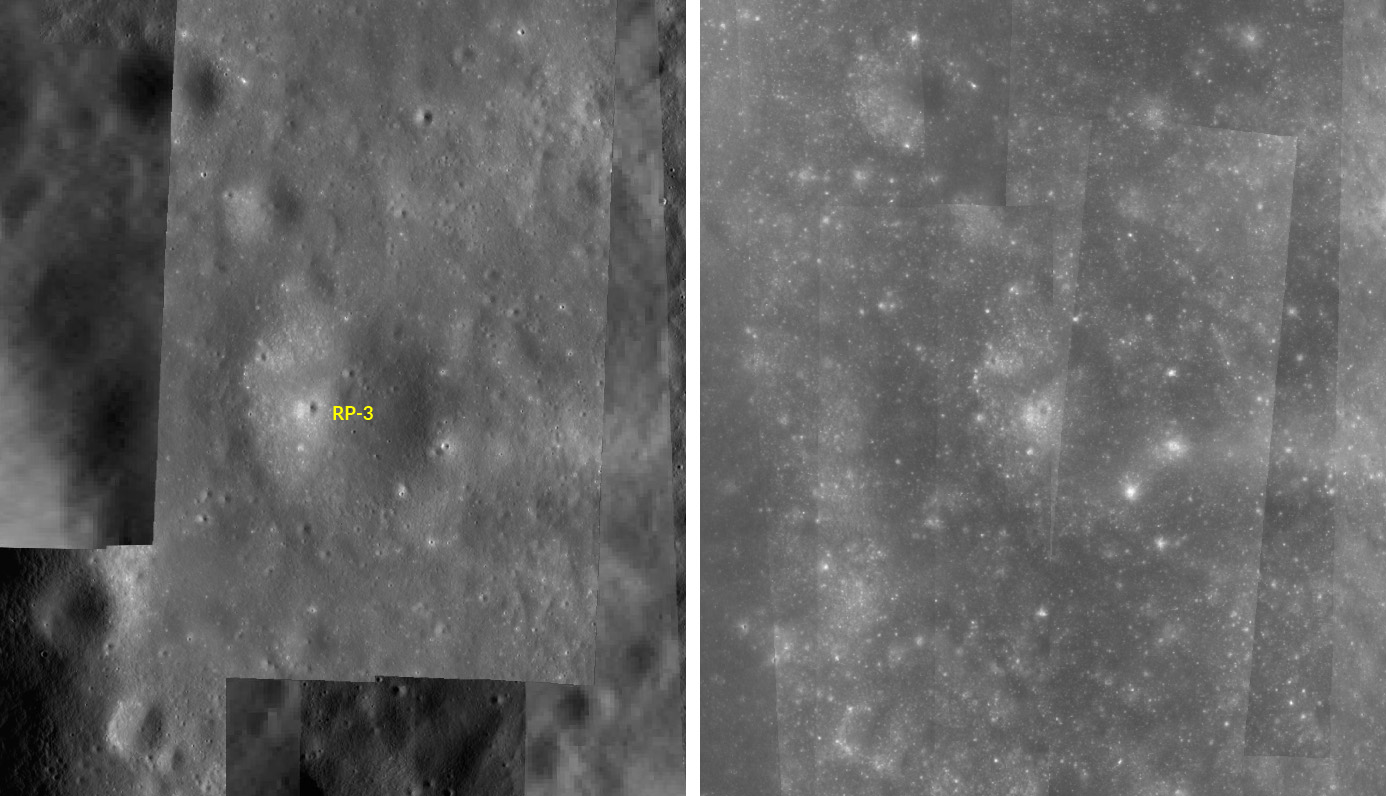
Evans: Yeah. RP-3 is just about the limit of high Sun angle that you could take to track that thing. I could track it up to TCA. And then, from TCA on across, you could hardly even tell there was a crater there, at all. It's just completely washed out.
The angle of incident sunlight on the lunar surface is important for seeing the topography of the landscape. This pair of images from Lunar Reconnaissance Orbiter show relatively low incident lighting on the left, and high on the right. With no shadows, the form of crater RP-3 is nearly impossible to discern.
The effect of varying lighting angles on the perception of surface topography. LROC Image credit: NASA/ASU.
Mattingly: Okay. I'll keep that in mind when they look at it.
Evans: I think we got some good marks on it anyhow, though.
Mattingly: Real fine.
112:40:06 Evans: Also, Houston, I lost the landmark at 24:01 instead of 24:19.
Mattingly: Okay.
112:41:14 Mattingly: Okay, America. We've taken one last look around your bird and it's looking good. So at least your half is Go for PDI.
Evans: Okay, mighty fine. And I think that chamber pressure was up around 95. I really couldn't swear to it. So you might take a look at the read-out on the playback.
Mattingly: Okay. You got a mighty fast scan pattern to see all that.
Pilots are trained to scan their instruments quickly so thet they can get their eyes back out of the window. Often, they will get used to doing so in a particular pattern.
Evans: [Chuckle] That's what I say. I really couldn't swear to it.